
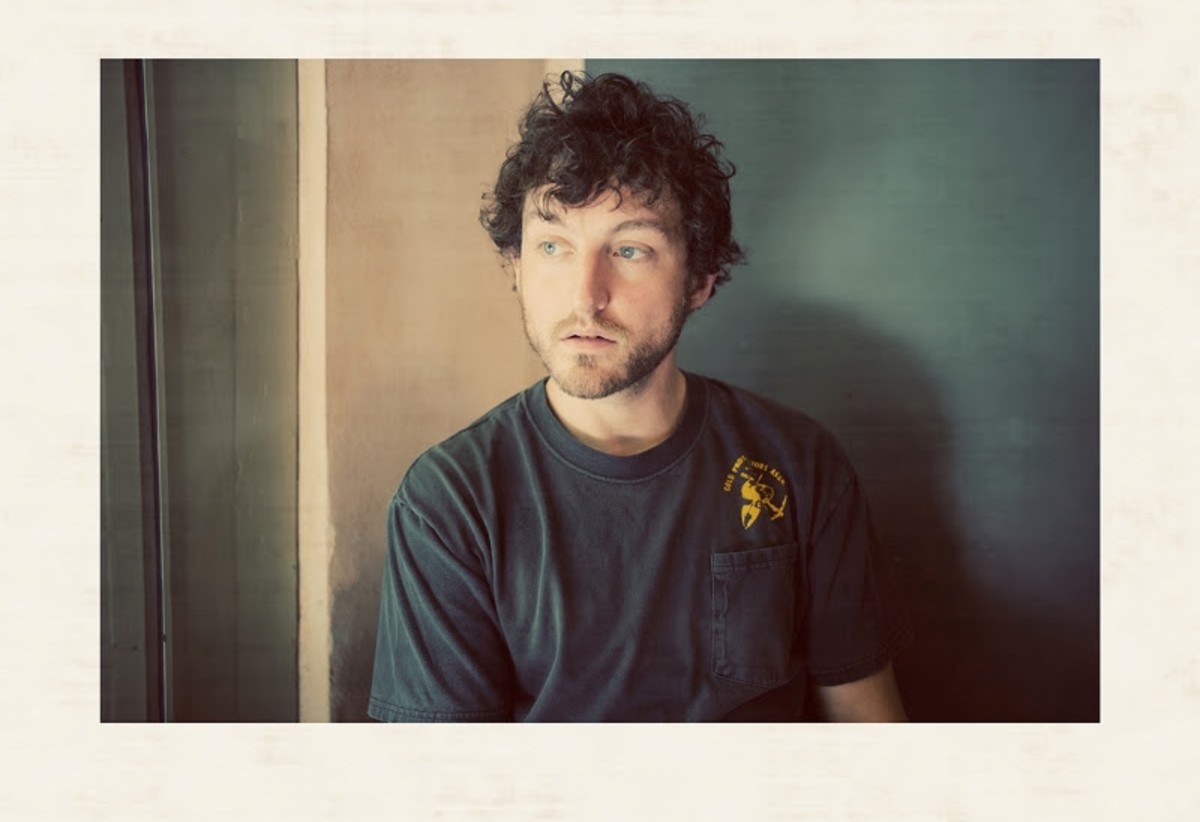
John Calvin Abney calls it “spiritual archaeology.” Every record he makes, he says, is a kind of excavation—digging into memory, grief, and fleeting experience to see what can be unearthed in song. His newest recording, Transparent Towns, may be his deepest dig yet.
“I can’t help but think that every time I make a record, it’s just because I’m trying to make sense of something that’s transpired in my life or in the lives of people I care about,” Abney said. “It’s not like writing a journal entry. It’s as if you’re excavating remains to gain a deeper understanding. You’re trying to go far deeper than you allow yourself in everyday life.”
That impulse guided Transparent Towns through a turbulent period in the Oklahoma songwriter’s life: the loss of his father, the deaths of both grandmothers, and a grueling throat surgery that forced him into silence.
A Return from Silence
Abney had toured relentlessly for much of 2022, playing hundreds of shows across the country. But early in 2023, in San Francisco, his voice simply gave out.
“I came off stage and I couldn’t hit any of my notes anymore. I had gravel, asphalt, in my throat,” he said. “I just couldn’t sing.”
The diagnosis required surgery and long stretches of enforced quiet. For a songwriter who had built his life around sound and motion, that stillness was both devastating and strangely clarifying.
“Most of the time I wasn’t trying to write a record,” he said. “I was just trying to calm the depths of how I felt about being in silence and in convalescence, in this space of liminality. I couldn’t sing, so I had to find other ways of listening.”
Those ways included recording the ambient sounds of landscapes—prairie winds, rainfall, the hum of Oklahoma nights—and threading them into the texture of his songs.
Back to Oklahoma
Abney has lived in Austin in recent years, but when the songs began to gather form, he knew he had to return to Oklahoma. It was where he first learned his craft, and it offered both memory and grounding.
“I realized I’d never made a record at home in Oklahoma,” he said. “So I called a bunch of my friends and made it out on a chunk of land—trees, prairie grass, storm shelters. The summer winds whipping through while we cut tracks. It really encapsulated how places evolve. We think they’ll stay the same while we’re gone, but they don’t. And neither do we.”
One striking feature of the recording process was an old underground storm shelter, repurposed as a natural echo chamber. Microphones and speakers captured the reverberations of performances above ground, sometimes even catching the sound of rain plastering prairie grass overhead.
“There are parts of the record where you can hear this unbelievably strange, beautiful ambience,” Abney said. “It enhances what you capture because it marks the space and the time. It’s another sensory flavor that tells the listener where and how the music was recorded.”
Memory and Loss
The themes of memory run deep on Transparent Towns. Abney’s grandmothers both died of neurological diseases—one with Parkinson’s, the other with Alzheimer’s. Their struggles impressed on him the fragility of recollection.
“My grandmother would say, ‘Everybody treats me like a child because I can’t remember what I said five minutes ago. But I can remember my first date with your grandfather, the color of the car seats,’” Abney recalled. “It’s so selective and strange. Our memory is such a dishonest narrator. That’s a huge part of this record—how much can we trust what we remember?”
The album also contains “Sierra Dawn,” a song about his father, a carpenter for four decades. Their bond, Abney says, was often more like friendship than fatherhood.
“He didn’t really have the emotional tools,” Abney admitted. “For better or worse, we were good friends more than father and son. That song is about him working construction, and about me trying to make peace with what we had—and what we didn’t.”
A Curious Upbringing
Born in Reno in 1989, Abney moved frequently as a child before his family settled in Oklahoma. His curiosity for music was boundless.
“I wasn’t picky. I wanted to know what everything sounded like,” he says. “There was folk, classic rock, 90s country in the car, Alanis Morissette, Fiona Apple. My dad bought me Hendrix records. My uncle gave me Beck and Kate Bush when I was in fifth grade. My cousin gave me Flaming Lips. It was just everything.”
He also gravitated toward the textures of instruments. The warm, woody tone of the Wurlitzer electric piano, for example, became an obsession.
“You chase sounds that tickle you,” he says. “That was a big one. It sent me down a rabbit hole into all sorts of records—soul, R&B, Nashville country. It’s funny how one sound can change the course of what you listen to.”
Songs in Flux
If Transparent Towns feels haunted by impermanence – that’s deliberate. For Abney, both people and places exist in constant change.
“You think towns, venues, rivers, forests will be exactly as you painted them in your mind the first time you saw them. And what a surprise when you come back and they’ve changed,” he says. “But so have you. Nothing is static. These spaces are alive too—growing, changing, living, dying, just like you are.”
That recognition underpins his approach to songwriting: accepting that originality is hard to come by, but attention to detail can make familiar themes feel new.
“We’re damn near threadbare at this point,” he says. “We only have so much to say, so we have to say it the way we can. That’s where the attention to detail matters. It’s not just the act of creating—it’s continuing to create in a world that is constantly homogenizing.”
Transparent Towns
Transparent Towns is, in the end, a record of flux—of landscapes that shift beneath our feet, of memories that betray us, of relationships that blur the line between comfort and pain. It is as much about spaces as it is about people, as much about silence as sound.
“Everything is always in a state of perpetual flux or chaos,” Abney said. “That’s kind of our birthright. Just the fact that we can even wake up is pretty miraculous. And if I can mark that miracle in song, then maybe I’ve done my job.”
For story ideas and pitches, Brian D’Ambrosio may be reached at dambrosiobrian@hotmail.com
Comments
Loading comments...
Leave a Comment