
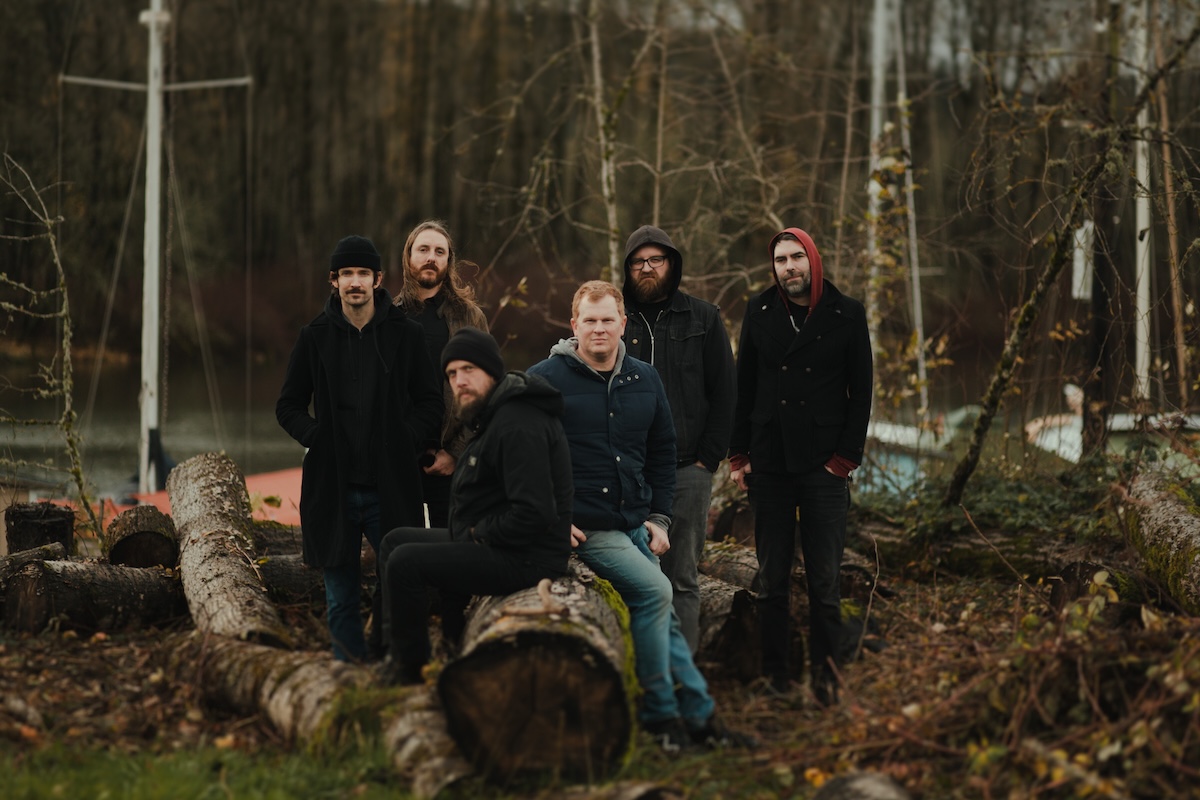
Portland-based band The Builders and The Butchers will be releasing their new album, which marks their seventh, on April 3rd, via Badman Recording Co. It’s titled No Tomorrow, and as the title might suggest, it has plenty to do with the current apocalyptic feeling of existence. And yet, within the fiery imagery and doom, there is the energy of humanity determining how they will act and relate to each other under such circumstances. There’s a sense of taking stock on the album, of determining what can be salvaged from the wreckage.
Following the success of their previous album, Hell & High Water, which had a particularly strong live show existence, the band had a few different things in mind for No Tomorrow, including bringing in more strings and varying songs between more acoustic and more electric approaches. Along with the new tracks and experimentation of No Tomorrow, the world of the band’s music is being expanded by the creation of a tabletop game called Devil Town, funded on Kickstarter by Long Tail Games. The Builders and The Butchers also have big plans for their album release show in Portland at the Aladdin Theater on April 16th, where they will be joined by members of the Portland Cello Project to bring the new songs to life.
Today, Glide is excited to offer an exclusive premiere of No Tomorrow in its entirety. I also spoke with the Butchers’ vocalist/guitarist/songwriter Ryan Solee about the global and national social climate’s impact on this new album, the welcome influence of a new vintage guitar on his songwriting for this collection, plans for live shows, and more.
It may sound funny for me to say this about such an apocalyptic album, but I’ve really enjoyed listening to it. It made me laugh a little to realize that, because it’s a very dark album, and I didn’t just find it interesting, I fully enjoyed it.
Thank you! I really appreciate that. We’ve been a band for a long time, and we kind of have this thing that we do. The songs come from wherever they come from, but for me, it’s like therapy if I don’t work it out. Is it just good for me to work it out through song, instead of other means? [Laughs]
I think one of the reasons that I enjoyed listening to it so much is that this is how the world feels to me right now. And I felt like, “This is real. Let’s just say it out loud.”
Totally. I feel like, with the Trump reelection and all the things that came after, people were just too exhausted to say anything, or didn’t want to because it was a bummer. But now, we’re in a place where we have to get our shit together, organize, and be in community. That’s what I’m feeling a little more in this moment. People are saying, ” Okay, what can I do? How can I help people?
There’s been time to get out of the shock mode a little bit, but the question is: What does our survival look like? Can it be cultural survival rather than just basic survival?
Yes, and you hope that the pendulum swings back and we find the line to be drawn, to say, “We’re not doing this anymore.” Where is that line? If it takes someone being a pedophile to draw that line, then so be it.
How did you decide to name this album No Tomorrow? I think that’s an amazing way of hinting at an apocalypse.
That’s been the band’s whole thing. I’m not a Christian, but the band has been deeply inspired by the ideas around Revelation and the idea of an end. How can we be humans as that’s going down? How can we treat each other well, as that’s going down? It’s really, really difficult to write a good political song anymore, I feel. All of the best ideas have been used, and things got said in the 60s which you could say again, but they’ve been said.
I tend to like a more opaque song, which says, “It’s okay if you don’t think this way, but I think everybody deserves some grace.” And let’s really look at who our enemies are, and it’s not millions of people, it’s just a few people who have hoodwinked other people into thinking their way. People are scared and angry, and they make bad choices when they are.
I would add that there is a portion of people who benefit from the craziness, and so stand by and let it happen.
Oh, absolutely. That’s a tale as old as time to pit one group of people against another group of people.
As a songwriter, I doubt you’re consciously thinking of these things when you write, but the writing is coming out of this climate and furor.
Yes. It leaks in, but it’s not overt. If you have your head in the sand and don’t know what is happening, maybe you could work without it, but I have two kids, so it’s just in my face every day. There’s a big sign outside their school that says “This school is a safe place for families of color,” because of the ICE raids down the street. What the fuck is happening?
I see a commonality on the album in terms of the sounds that you’re working with, but it’s so closely enmeshed with the feeling and ideas of the songs that it seems unique among the albums that you’ve released.
I appreciate you saying that. When you’re creating a vibe musically, that’s going with the melodies, it’s trying to marry those things. There are a lot of times in the recording process when you’ve got a lyric here, and a weird harmonica there, and that’s not the vibe, and it’s not going right, so you have to get rid of that instrument, and try another instrument. I feel like voices and instruments are so indicative of a mood. We have a new viola player, too, who’s been a friend of the band a long time and has been with us on tour. When you start putting strings on things, it really changes the whole dynamic and the way you feel when you listen to it.
There’s also a whole lot of intricate guitar work. I got a really nice guitar in the last few years, which I can actually play things on that I couldn’t before, so that’s expanded my guitar repertoire. It’s been fun to grow that way, since I’m 47, but it’s been cool to get a little better at your instrument so late in the game.
That always needs to happen, if it can. It’s a lifelong thing. What kind of guitar is it?
It’s a hybrid. It’s an archtop Gibson parlor guitar from the 1950s. It’s an electric, but I can play it around the house and hear it. The action’s so light. I don’t know how else to say it, but whenever I pick it up, I write something that I like. Sometimes those instruments and your DNA fit together so well that you say, “It’s like this guitar was made for me!” It’s almost like a romance. [Laughs] It’s just vibey, and it writes songs. It’s not me, it’s just the guitar!
I’ve had many people assure me that guitars have songs in them. And if you shift guitars, be ready for something new. And if it’s an antique, even better.
It’s like 80 years old, and it plays like a dream. I got it from a friend who didn’t play it, but said, “I know that you will love this.” So it all worked out, and I was very thrilled to have it.
Do you need to use it live to play those songs?
No, I wouldn’t use it, just because it is so old. Our live set is pretty hard. Sometimes things break. It’s a little bit wild. I would hate for that guitar to break, so I transpose it onto the main guitar that I’ve always played on. And it works out. It’s just that the writing wouldn’t occur to me on that other guitar.
Were there things that you talked about with the other band members about the sound that you were going for on this album? Were there differences there?
Yes, a little. Every record is like a weird reaction to your last record, at least for us. So the idea with this one was to make it a little more Folk-instrument-based, a little more acoustic-instrument-based, and not so full of electric guitars that it doesn’t have space to breathe. So that was one of the main themes of this. I would generally write the songs, bring them in, then mess them up, cut them up, use a part here, a part there, and do a bunch of editing.
The other thing is that we record the songs, and we really don’t know what they are until we play them live. The audience reaction dictates what we play. It’s very fluid what we do live. We try not to play exactly like the record. The record and the live show are completely different experiences.
I can see in a few of the songs that they are constructed in a way that leaves room to add or stretch things. It seems like a goal.
Yes. I try to leave things like that. I try not to be in my ego so much where a song “needs to be like this.” It’s a weird, cosmic thing, performing, and every night is different. The audience is what makes it. Songs change. It’s one of my favorite things about the band.
Do you change your setlists during a particular performance based on what’s going on in the audience that night?
We’ll make a setlist, but we can always call audibles, saying, “They are not feeling this. Let’s do this, and this.” We’re always up for mid-set changes. Sometimes, if somebody yells out a song that we haven’t done in years, we try it, but we tell them, “This might suck!” We try to make people feel included, and nothing is too precious.
I think the sound difference between some of the songs on this album, with some more acoustic and some more electric, would work well in a live show, with plenty of variety. I listened to the album in order, and I felt that way.
The track order is important to us. We try to make something that’s a listening order that makes sense and tells a little bit of a story. There are realities about what can fit on the side of a vinyl, so we have to stack the songs in a certain way. It’s a funny balance between making the record make sense, up to a point, and fitting it on vinyl. We tend to push it on the vinyl thing, where it’s right at the max. It gets tricky.
Some of the order was interesting, with a variation of heavy and light, making sure to balance that. I think the song “Mother Mary”, where it’s placed, offsets things a little by being placed sort of centrally.
We’re a band that has Country elements, and we’re all big fans of real Country music, but we’ve never written a song like that before, a real Country song. So that was a fun thing to work with.
It feels like it could be from another decade, another century, even. You bring in the strings on that one, too.
You mentioned earlier how words and instrumentation come together to vibe, and to me, that song’s about a down-on-his-luck guy, who’s a romantic at heart, but whose life is all fucked up. The banjo and viola part that the guys came up with is the perfect thing for that and right on the nose of what we were hoping to come up with.
There’s something weirdly hopeful about that song, like things are breaking down, but yet we will keep dancing.
Right. It’s like that Pogues song, “Fairytale of New York.” He’s a big piece of crap, but he’s hopeful and trying to convince her that things are all going to work out. And she thinks he’s a big piece of shit. It’s the best!
Comments
Loading comments...
Leave a Comment