
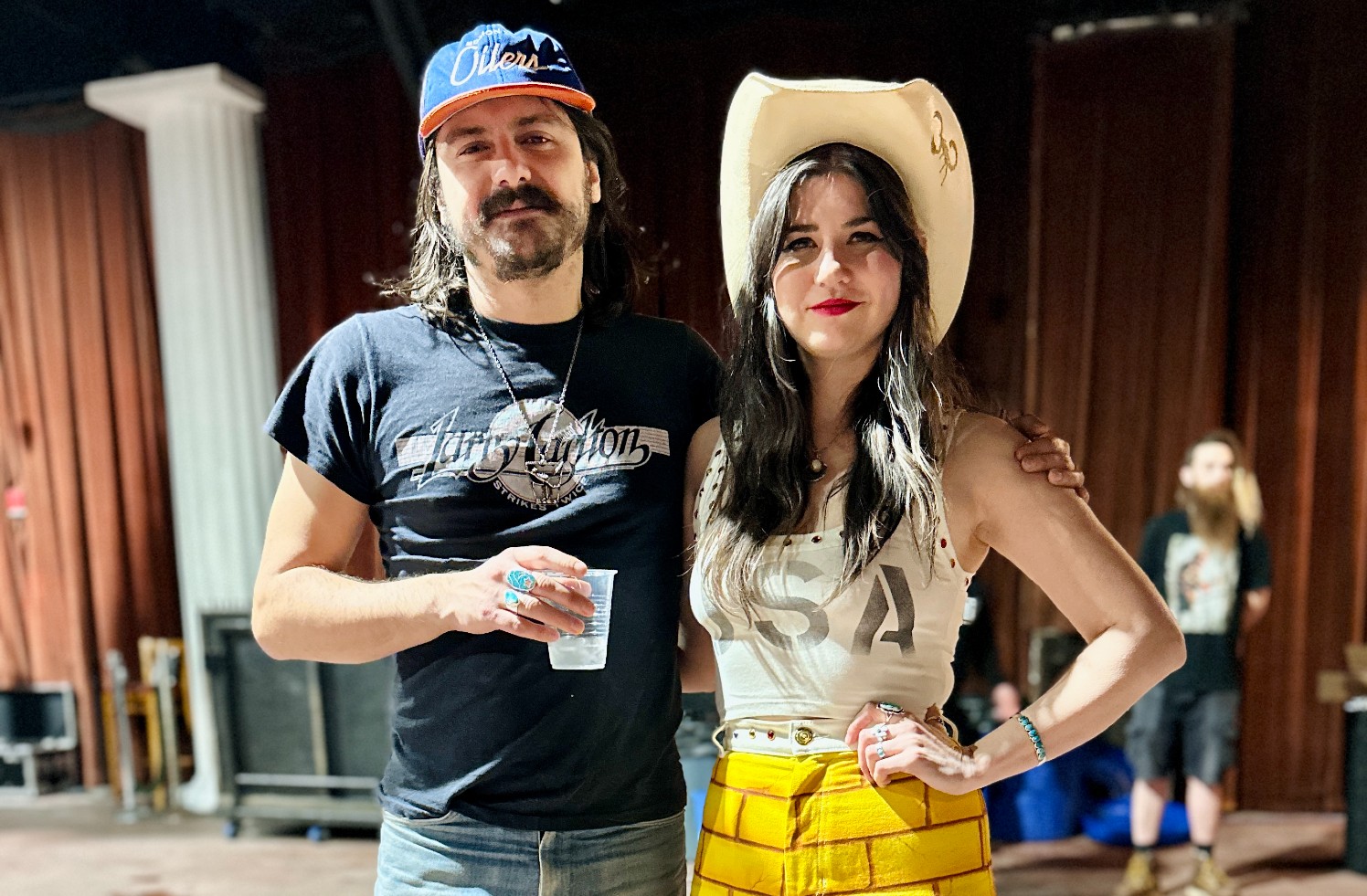
Pearl Charles and Michael Rault are a fascinating couple. They met via a mutual friend back in the summer of 2019, while Charles was recording her album Magic Mirror, with Rault flying in from Montreal to hang out and add some guitar. What started as a friendship grew into a musical and romantic relationship, and the two of them have been together ever since.
Both are songwriters who have an extensive and unique history. Charles began her career as part of the southern California folk duo The Driftwood Singers, she then joined the Joshua Tree based garage rock group The Blank Tapes as their drummer before stepping out on her own and releasing three critically acclaimed albums. Rolling Stone referred to her music as having, “a cosmic country mirrorball vibe, like if ABBA and Gram Parsons had a baby.”
Canadian born Rault has been releasing cool retro, psych records since 2008. His last two albums came out on Wick Records, a subsidiary of Daptone Records. He has worked with some of the greats in the industry, from Wayne Gordon, the producer / head engineer at Brooklyn’s legendary Daptone studio, to indie rock luminary Mac DeMarco, as well as 70s Zambian Rock band WITCH. He has shared the stage with King Gizzard & The Lizard Wizard, Whitney, Shuggie Otis, Charles Bradley, Os Mutantes, and Thee Oh Sees.
Glide’s Joe Adler sat down with the duo backstage at Burlington, Vermont’s Higher Ground after the finale of their east coast run with the incomparable outlaw country powerhouse Margo Price to discuss everything from songwriting to cooking.
I found out about you guys when you were both announced for King Gizzard’s Field Of Vision festival last year. I had made these playlists of all the artists and you both stuck out immediately.
You gotta know what you’re getting into.
Yeah, it was before I realized that there was no overlap in the artist’s sets.
Pearl: Which was so cool. That was awesome.
Yeah. I talked to Lucas (Harwood, King Gizzard’s bassist) a little bit about it. He was telling me about this Australian festival that inspired Field Of Vision that he and the band used to go to when they were growing up. He was like, yeah, no overlaps. So you get to see everybody. I thought you guys played great sets that weekend.
Michael: Yeah that was fun. Pearl’s one on that side stage was my favorite moment of the festival. I mean, because we kind of thought, oh, it’s a late night side stage. We didn’t really realize everyone was gonna come from the main stage and have nowhere to go. Right up until 10 minutes before we started playing, there was no one there. We already did our main stage set, kind of passed the highest pressure point, and thought this will just be fun. We went into it with a really loose vibe, but then it just kept filling up. Then it was way more people than the main stage. So we’re like, oh, this is like the biggest show we’re playing of the weekend.
Pearl: It might have been one of the biggest shows we’ve ever played.

So you just came off stage for your last night of Margo Price tour, how did it go?
Pearl: The whole thing has been great. I’ve been friends with Margo for a few years now. We kept wanting to try to find a time to do something together. It’s funny, we found out that we were gonna do this tour as we drove away from Field Of Vision. So we were already riding a high from that great weekend and then found out we were going to do this and I was so excited.
We started out in New York City, which is a very fun place to kick off a tour, but all the shows have been great in all the cities and all the audiences. Margo’s band is really great, their guitar players are crazy, obviously I’m partial to a ripping guitar player. Can’t deny it. It was really cool to be covered in Rolling Stone for the first show. And my uncle got to see me play in New York as well. He said he saw me play with my first band ever, like when I was 18. That’s been about 16 years. So it was cool for him to see such a drastic shift. I don’t know if shift is the right word.
Michael: Although at the same time your first band was an old timey acoustic duo. And then he managed to miss all the years of you doing everything else. And then came back and saw us doing an old timey acoustic duo!
Pearl: Very true. It’s cool to show people who know you, but don’t know that side of you, what you are up to.
Out on the road as a duo, what are the differences that you’re noticing with the songs as opposed to doing them with the full band?
Pearl: We just opened as a duo in Europe for Neal Francis. Up until that point, I feel like we’ve really pushed ourselves to pretty much try to do a full band anytime that we could. Neal Francis’s music is very different from Margo’s in the sense that it’s very funky and almost disco-ey, and kind of more like what our full band stuff is like. So I was much more hesitant about doing a duo for that. We went into it a little apprehensive. We love touring as a duo just because it’s so easy and it’s obviously very cost-effective. I also really enjoy it because I’m a quiet singer, and the focus is on the voice, the lyrics, and the songs themselves. But also, I have Michael as a great foil, so I don’t have to have all the responsibility on me all the time. He gets to solo and take away the attention for a little bit. I wasn’t sure how that audience would receive it, since they were there for a funky disco kind of show, but it went so well.
Michael: We also really found that, as far as the duo thing, that it put a lot of focus on the songs, and as Pearl said, with me as the foil with the lead guitar. I think a lot of times when we’re playing to another band’s crowd as an opener and they don’t know what we sound like anyways, they see two people with acoustic guitars, they’re kind of like, oh, it’s gonna be like an acoustic guitar set, it’s going to be kind of sleepy. And then when we start actually doing a lot of lead guitar and stuff, I feel like a lot of times people are more enthused than they probably would be if we were a full band.
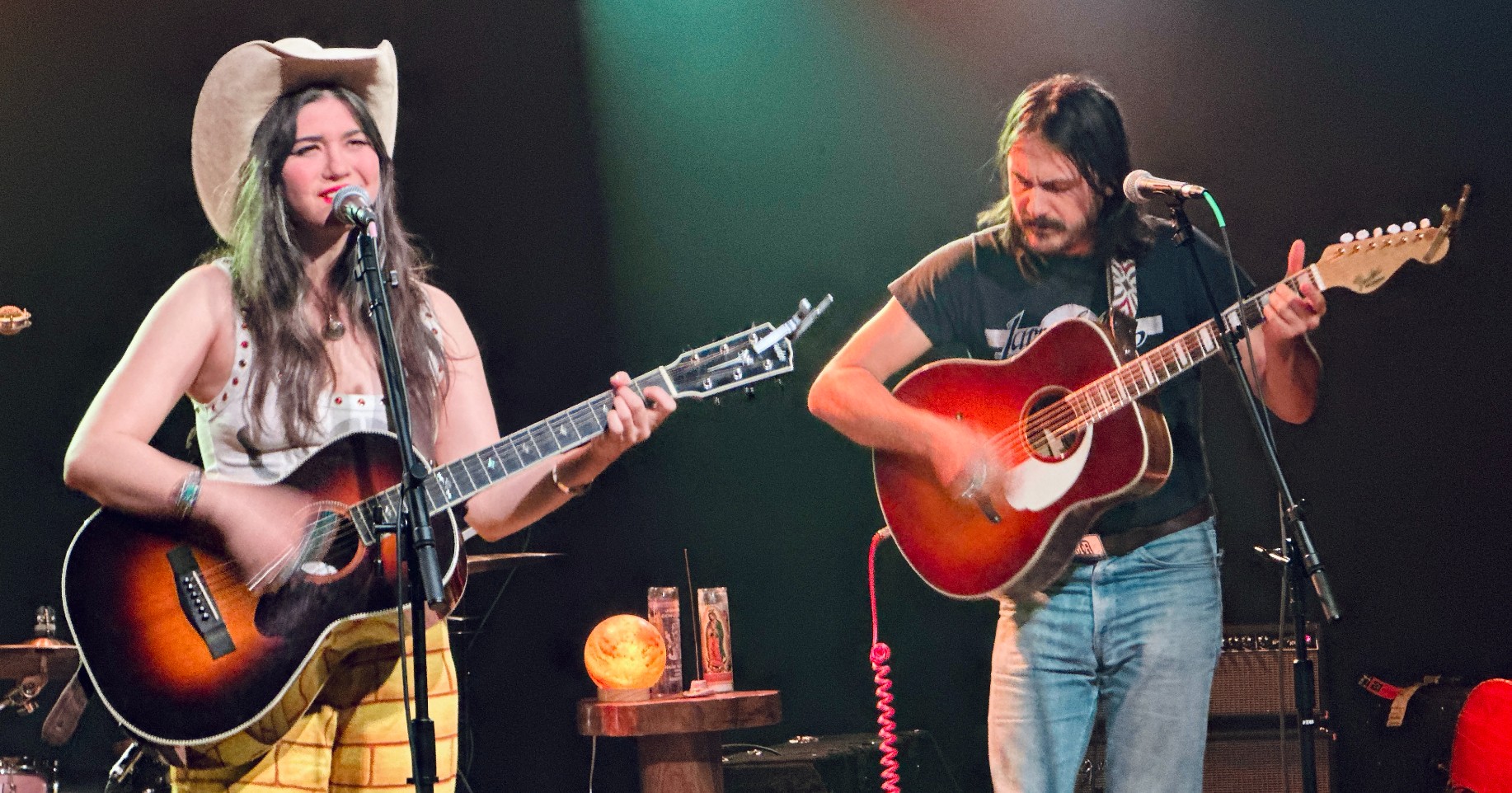
In addition to musical companions, you are also romantic partners and go through life dealing with everything together. On stage tonight, during the first couple of songs, your guitar was not in the mix.
Michael: It was not working. It was my fault. Well, it was my battery’s fault.
Pearl: That’s the funny thing about a soundcheck, you go in and everything’s perfect and then you go back and everything’s different. And that’s true most of the time. A soundcheck only goes so far. It’s nice to know that everything’s working, but that doesn’t mean it will be.
Encountering that on stage and being able to work together, did you find it analogous to your life together as a couple in general?
Pearl: We were definitely talking to each other while we were playing the songs, we were like… What’s happening? Is your guitar coming through or not? We usually try to really stay in show mode, but it’s cool to have an ally and someone you can talk to and be like, is this, is it working? Is it not working? And then working together to find the solution, whatever that may be. Luckily tonight, I knew, okay, if I put the call out, someone will probably come and help. There was an acoustic guitar right next to him, but I don’t want to just grab whatever.
Michael: That was Margo’s beautiful 1968 Gibson J45. I was like, I’m not gonna help myself to that.
Pearl: The guitar you actually got is her new custom Gibson that she designed, which is a beautiful guitar.
Michael: I think it’s really easy for us when we’re touring as a duo, whether it’s when technical difficulties are happening on stage or when they’re happening while you’re driving or rerouting around a storm. I think that we can have a pretty open dialogue and that can mean sometimes expressing more frustration than you would maybe want to if it was with other people who are not your partner. Expressing frustration, expressing everything is kind of a bit more open and it’s a little bit easier because we know each other really well. At the end of the day, if one of us can be kind of like this is crazy, what are we going to do here, and you can say that kind of openly, it’s kind of nice to be able to do that. Whereas in some situations, you’re like, everything’s great, this is going really well. But you’re feeling inside that this is totally messed up and don’t know what to do. It’s nice to be able to have a situation where we’re both very much on the same page. We’re both pretty much privy to everything that’s happening with the songs and with the records, the ones that are already out and the ones that we’re making.
What’s cooking in the kitchen now?
Michael: We’ve got half of a new Pearl Charles record recorded that we just did at our studio. I mixed her last record at our studio. When we started recording that one, the studio hadn’t really evolved to where it is now. It was only by the very end when we kind of decided we were going to look for a mixer that I was like, well, it’s actually pretty set up, and I can mix it. Now we’re starting the whole thing at our studio. We have five songs recorded.
Pearl: I feel like with the last few albums, we just want to start. We make demos, but everything’s pretty up in the air.
Michael: On the last record, on Desert Queen, the opening song, Does This Song Sound Familiar, had never played it with the band and we had no idea how we were going to arrange it. We actually just got everything else done in the studio time that we had booked. And so Pearl was like, I have this song written with Trevor Beld Jimenez. I was like everyone take five, and went outside and learned all the changes, came back in, showed it to the band, and then our producer, Lewis Pesacov, and the band, we all just kind of came up with the sound and the vibe and the playing, just in the moment. That was when we realized that sometimes the stuff that we didn’t rehearse is actually cooler.
Do you look at the albums as a collection of songs, or do you look at them as a story that unfolds?
Pearl: I love the album format and think of myself as an album artist, but I’m generally not thinking like that conceptually when it comes to the record. And I found that all my records are extremely eclectic. To me, they seem very cohesive. I know how the music industry feels about it: we don’t know how to quantify this. What is this? Where does it go? Is it Americana? Is it disco? Whatever those things even mean these days… I feel like that’s a very vague thing. I feel like we fit into all of those categories in one way or another, but then they’re like, but does it go on the country playlist?
Michael: Or does it go on the disco playlist that’s like actually just modern, driving music or whatever. I think that the themes usually present themselves. On the new record that isn’t out yet, we went in and I ended up rearranging a few things, like changing some chords and changing sort of like the groove and vibe of some songs. One of the songs ended up becoming a little bit more pointedly angry, not like punk or anything; it kind of sounds like Billy Joel.
Pearl: Billy Joel can get pretty angry!
Michael: Yeah, he is an angry guy though, you see him wailing on his piano with his mic stand. But, anyways, we started to realize, I think because of the slight alterations to certain vibes, we didn’t change the lyrics or anything, but we started to realize there were certain themes in the songs that hadn’t seemed obvious before. So we were like, every one of these songs, maybe with one or two outliers, is basically about a similar thing, which is questionable men.
Pearl: Which is a chapter, luckily, I’ve closed in my life. But I’m still working it out mentally, obviously!
Michael: I love like a theme album, but I feel like even with The Rise And Fall Of Ziggy Stardust, it has its flexibility because he’s a rock and roll alien, this is just a rock and roll song, sung by the rock and roll alien. But even if there isn’t as good of an explanation as that, even on a theme record, it’s cool when there’s a couple of songs thrown in there that you’re like, that song just rocks. That’s why that song’s there. Maybe at some point you realize that it even fits in a different way.
Do you find new meaning in the old songs in both of your discographies when you’re playing them now?
Pearl: That’s a great question. I feel like every night that you play the song, like the state of mind that you’re in during that moment, brings on such a new experience. I’ll play a song and find something new in it that I hadn’t seen at the time, or just the way that you’ve evolved as a person, your life experience has changed the way you’re gonna interact with that. Or it also can sometimes just bring you back to that moment that’s so far away.
Michael: Step Too Far?
Pearl: That’s a great example.
Michael: It’s off of Pearl’s album Desert Queen.
Pearl: We mostly wrote that song about the frustration of the music industry, honestly. But it’s kind of thinly veiled, as maybe it could be about a relationship or whatever. Things have changed so much politically in the world that it’s really taken on that new meaning for me these days.
To me, that song felt like it was about a relationship.
Pearl: Yes, that was actually never what was intended. But that’s the thing, I mean, it’s funny because my little sister is not a musician. She likes music, but not in the obsessive way that we do. And she showed me some random new pop song, and I was like, this song is so specific to the point where I don’t find it relatable. She’s like, no, but that’s what’s so cool about it. I’ve always tried to leave things somewhat open-ended and open for interpretation because I want everybody to be able to take their own meaning from it and feel like whatever it is for you.
Michael: Pearl also just likes writing poetry. You can know what it’s about, sort of, but it’s not tied down to such a specific thing.
Pearl: I always say songwriting is like carving or like chipping away at marble or wood or something. You’re like, what’s in there? And then you start carving away, and eventually something comes out of that.
Michael: I do think that with the song “Birthday” on the last record, Pearl had the idea of saying “everyone knows it’s not your birthday”. That was the whole idea. I was like, what do you mean?
Pearl: I don’t know what it means, but I know that this is a great line.
Michael: We wrote this song together, nobody else was involved. We kept digging in. That song became pointedly, clearly about a certain thing to us. We might have written it in a Steely Dan-esque way of leaving a lot of, or Paul Simon, of leaving a lot of space around what we were talking about. But it took us sitting around the kitchen table for, I don’t know, an hour, struggling with chords or whatever, before we’re like, oh, that’s what this song is about.
Pearl: That one’s kind of also interesting because it literally has a zoom out. It starts very micro, but each verse gets more and more macro.
So what was the intention?
Michael: That one started out specifically talking about a friendship that we had that had fallen apart. Talking about how living in LA, there’s maybe some sort of fraught elements of relationships. Everybody’s kind of there trying to do the thing that they’re trying to do. But then with every verse we were talking about the fact that potentially…
Pearl: The way LA is and how it influences because of Hollywood, and the fact that everyone in the world gets their media, obviously now that’s not 100% as true as it once was, but that concept of everyone in the world is seeing Hollywood through whatever lens. It’s not always representing Hollywood, but the Hollywood view of whatever it is.
Michael: How this sort of potentially narcissistic, potentially toxic way of being in Hollywood has potentially become projected out to the entire world and the world is reflecting that same idea back. And then we actually thought we were done. I started making dinner and I was chopping vegetables. Then I was like, it’s a mean old state you find yourself in when you know it’s getting late, and then that was about the feeling that the world might actually just be on the verge of ending.
Pearl: But also your internal state as well.
Michael: That was a really fun one where we had very clear ideas of what we were talking about. Sometimes you’re kind of like skating around something and you’re like, there’s something here, but with that one we were like, this is what this song is.
Pearl: The song is very influenced by Steely Dan sonically. Michael told me that was often Becker and Fagan’s process as well, one of them would bring something to the other one and be like, I don’t really know what this is, but they would just somehow tease it out.
Michael: There’s the famous story about the Deacon Blues thing. Fagan told Becker, I got this chorus and it goes, they call Alabama the Crimson Tide, they call me Deacon Blues. And he was like, oh you mean they call those redneck crackers some grandiose bullshit name, so you should call me this grandiose bullshit name? He’s like, exactly. Okay, sweet, let’s write it.
Let’s talk about the studio you built in your home. Let’s talk about when you’re in the role of the engineer, producer, mixer, when you’re working with an artist that’s not Pearl. How do you pull the secret sauce, the magic, out of them?
Michael: For me it starts with the gear that we’ve got at the studio. It’s not the craziest pure collection, obviously some people have their million dollar setups, but we’ve got a lot of really great 50s, 60s, and 70s recording gear. Sometimes before I was a producer or an engineer, I’d go into someone’s studio and just hope that they have a similar sort of ear for what I want and that they’re set up to do the kind of thing I want. I feel like producing a band, I think most of them like my records and Pearl’s records, and that’s the reason why they wanted to come to the studio. I think that they generally want what my general idea of a sound is.
Any band, pretty much any style they’re playing, once they record through the stuff that I like to record things through, that’s already gonna sound a bit more in line with what I dig and also make it all sound a little bit more cohesive too. Like if a band is doing a few stylistic differences and they’re wondering if it’s too all over the place, as soon as we record it through all this stuff, it’s gonna already start to sound like it’s living in the same world. I have been arranging people’s records a lot, since I was younger. I’m not a technical arranger. I’ve recently started charting, doing string arrangement and stuff, but that’s just self-taught.
When I was a kid, I was really particular about the way bass and drums and guitars and stuff should play certain things. I’ve done that for a band called U.S. Girls, who are good friends of mine, on their record In A Poem Unlimited. That was the first of a bunch of things we’ve done together, but I didn’t produce it. I mostly played bass on it, but I demoed a few songs where I played everything on a cassette recorder for them and kind of pushed them in a slightly different direction, and then they gave me an arrangement credit. Now I’ve got the studio with the sounds the way I want, and I’m getting my engineering and mixing chops down a bit more. The arrangement thing has always been pretty intuitive to me. I’ve always been very, specifically into certain vibes of things that I like. It’s much less heavy-handed than it was when I was younger. As far as being able to sit down and listen once I’ve got all the sounds, hopefully most of the time it’s working. If it isn’t working, figuring out what it is, and then usually seemingly little things, like this kick drum pattern needs to be changed this way. Play the high hat like this.
Pearl: This is something I really value about working with Michael, and I see him do it with other artists, especially younger developing artists who are still trying to find their sound. Oftentimes, they’ll come and they’ll say, I want my record to sound like all these different bands that are all cool, but very different. I think Michael’s really good at actually digging a little bit deeper, because everybody wants their band to be cool but who are you? Let’s find what makes your unique version of all those things and put them together to make something new.
What is songwriting to each of you?
Pearl: Before we met, I was always into collaboration, and I think Michael was less so. I think I influenced him in that way, of being more of a collaborative person. But at this point, I would almost rather collaborate with Michael because when want to do this thing, but I’m not really sure how to do it, he’s just so good at helping get over that line and being like, I see what you’re trying to do, here’s how we’re gonna do that. But songwriting is a very therapeutic process, I obviously work through a lot of emotional things with it.
Michael: It’s kind of like a free form expression thing, though. Pearl is writing stuff down all the time, and I’ve kind of gotten more in the habit of that.
Pearl: The best ideas kind of just tumble out, almost complete. But then, other times it’s like the block of wood theory. Where you get a vague idea, but you have to kind of figure out what it is. But that’s where it’s like a psychological exercise, what am I, what’s in my subconscious.
Michael: It’s almost better than therapy. Like the times where that really works, you’re just like, whoa, I didn’t even think that I needed to sit down and write a song about this thing.
Going from your first self-released album to your most recent, the self-titled album, what do you think evolved?
Michael: For me, over the course of my solo records, I got a lot more interested in a lot more advanced music ideas. In the early days, I always kind of wanted to be doing something more complex because for some reason, I’ve been really drawn to that. But I didn’t have the ability to do it. In my early days, I was kind of like, this is just as good as I can write these songs right now. I don’t know all the stuff that I need to go any further than this. I learned a lot more and then my taste expanded to the point that the last record is progressive pop songwriting and everything I wrote came really easily. I sat down and wrote a lot of those songs on the guitar, which I hadn’t done in a really long time, instead of a piano. Somewhere in the middle, I was trying to find new things. I did a lot more writing separately, like writing all the music separately, writing all the like lyrics afterwards, trying to find a melody and then writing all the chords around that, then writing lyrics to that, like doing things bit by bit because I was just trying to coax some inspiration out of myself at that time.
Pearl: That’s where I think our collaboration is really greater than the sum of our parts. I think I’m bringing Michael back to those roots, and then he’s bringing me to the more complex musical ideas that I’m interested in, but I don’t know how to execute. So together we are writing stuff that’s tackling new ideas, both lyrically and harmonically. .
On your debut album Sleepless Dreamer, you feel very present with your writing. And as the next two albums came through, it felt like reflection was kind of coming into it. Do you feel that way?
Pearl: I think with Sleepless Dreamer, I was very young, that was the first full album that I’d ever written. It was heartbreak, a break up, you know, the kind of stuff that you are tackling when you’re younger. When I went on to write those other albums, I wanted to start exploring other topics that are more interesting to me. Try to find a way to say something beyond just my own experience. Of course, my own experience colors all of those things. But I definitely see the evolution. Michael came in midway through my second album, Magic Mirror, and started bringing in this other side of things. He’s really good at bringing out a side of the artist that they don’t even see within themselves. So I think that having him be involved has really helped me find a more authentic voice for myself. Everyone’s like, with my last album Desert Queen, this feels a lot more mature. I’m like, well, yeah, I’m older, I’ve had a lot of life experiences.
What are your top albums?
Pearl: My number one album is Tusk. I always say Tusk because that’s a good desert island disc. I love Christie McVie and I think she shines the most on that album for me. You get a little bit of everything. I love so many different kinds of music that I don’t think have been explored in my music at all. Right now, I’m obsessed with Thin Lizzy, which I don’t know if you’d really be able to tell from any of my records, but maybe from the next one.
Michael: Gaucho by Steely Dan… It’s tough too because a lot of our favorite artists, like Pearl loves ABBA, they don’t really have a great album. They have great singles.
What are some contemporary artists that you’re enjoying right now?
Michael To be honest, I really don’t listen to that much new music. Which isn’t to say that there aren’t great artists out there today. We really love Margo’s band and what she’s doing these days. We really love Neal Francis. When we toured with them, they blew our minds every night. We love Drugdealer.
Pearl: And Weyes Blood.
Michael: Drugdealer is a band that does extremely well, but they’re kind of strangely underground, but they stream like crazy and they’re very popular. They play big shows, but they’re kind of just in their own little world. They’re hard to describe. They make 70s soft rock stuff mostly. I played guitar on their song called Pictures of You.
Pearl: I love Hannah Cohen’s new album. She’s great.
That album is one of my top favorites from last year, by far. She also played King Gizzard’s Field Of Vision festival. Speaking of that, how did you guys get on that festival?
Michael: We don’t really know. It was kind of random, I’d been on good terms with them. I toured them very, very early. I opened for them through 2014 or 2015. We played a bunch of shows in the south. And then we came back up to New York, and we played a sold-out show at Music Hall of Williamsburg, which is like a 1000 capacity or something like that. At the time it was very exciting for them. They’re like, oh my God, we sold out a 1000 seater! We got along well on that tour, hadn’t talked to them in a very long time, and then we randomly got the offer to do the festival with Pearl’s stuff. Then their manager hit up our manager and was like, the guys just found out that Michael’s in Pearl’s band and he should play a solo set too. So I don’t even know. I think maybe Michelle Cable, their manager, might have been like, we should do the Pearl thing because we’ve done a couple things with her. She also manages Mac DeMarco, who’s a childhood friend of mine from Edmonton. We’re kind of adjacent to a lot of these things even though we’re in a kind of different scene, but it was really cool that they just came across and reached out.
Have you collaborated with Mac?
Michael: We recorded some of my most recent album at his studio during COVID. I brought some of what I started at Daptone and went over to his place in LA. We both had been in isolation for a long time, we reunited and worked on that a little bit. Pearl and I recorded our version of Christmas Must Be Tonight, our cover of The Band’s Christmas song at his studio. He wasn’t really involved besides just hanging out. We had somebody else engineering at his studio. I played bass in his original band Makeout Videotape. I was the first bass player in that band. I played a couple random shows, and then they came through Edmonton once when they were based in Montreal already and I got up and played bass for that one show. It was very impromptu back in the old days, crazy stuff. But yeah, we haven’t ever worked very closely on anything, but we go way back.
What are some of your favorite shows or festivals that you’ve been to as a fan, not as an artist?
Pearl: I’ve been extremely blessed to have seen a lot of my favorite artists. I saw Prince, I saw Tom Petty, I saw Chic. I’ve gotten to see Paul McCartney a few times. I got to see George Jones once. That was pretty random. Probably not one of the best shows I’ve ever seen, but just to be in that man’s presence. And he showed up, which he’s famous for not doing. I went to “Oldchella”, the Desert Trip festival, with Bob Dylan, Rolling Stones, Neil Young and Paul McCartney. I just try to see all the classics. I saw the Eagles and Fleetwood Mac, both with all original members. I can’t believe I didn’t say those first, those were probably two of the best ever.
Michael: I don’t have as good of a list as she does, but I saw Dr. John play at the Edmonton Folk Festival. I was already really into his music, so it was very cool to see him play. I also saw the Neville Brothers, another New Orleans classic band play at the Edmonton Folk Festival. That was cool. My dad is in the music scene in Edmonton, so I was backstage with him when I was like a teenager. It was cool because the Neville Brothers all came off the stage and then they just stood shoulder to shoulder, smoked cigarettes, and talked about the show. We went over and I shook Aaron Neville’s hand, and his arm was bigger than my whole body. It was just really, really sweet. It was cool to meet him and talk to him for a second with my dad. I saw Allen Toussaint play, to keep the New Orleans thing going, which was a really big one. Not at the folk festival, that one was at a random concert series. I saw Levon Helm at the Edmonton Folk Festival when his voice miraculously returned after his throat cancer, shortly before he died. So that was miraculous, to get to see him play.
One final question, you were just talking about family. How did, and do, your families influence the artists that you’ve become?
Michael: I‘m really lucky, my whole family, my mom, dad, and uncle, are all professional musicians. My mom was more trained in school, so she taught me all the training that I have because I never did that. My dad and my uncle were rock and roll dudes. They did a lot of cool stuff, my dad toured with Bo Diddley, as his guitar player, for a while. They got brought down, both of them, my uncle and my dad, got brought down to Nashville because they met J.J. Cale, and he liked their band so much that he hooked them up with his manager Audie Ashworth. So they were working down in Nashville for a while. They ended up back in Edmonton, and then I was born up there because they’re all crazy people and didn’t stay in Nashville for some insane reason. I was really lucky to be exposed to some really great musicians and that’s definitely a huge reason why I do what I do.
Pearl: My parents were artists as well. No one in my family plays music, but they all love music, especially my parents. The artists that my parents showed me, that I got to go see with them like Leonard Cohen and so, so many other amazing songwriters, and the classic rock, the stuff that I love, they totally influenced me just by showing me that stuff. And they saw that I loved to sing and that I could carry a tune at a very young age, they really supported that. In my family, to be rebellious is to not do something creative, which is what all my other siblings did. So I guess I’m less the black sheep in that sense. It’s cool to have people who really support you, and to this day I don’t know if we could keep doing it without the moral support. I know so many people’s families don’t support them doing this. I just always thought that being an artist was a path, because they told me it was, so I haven’t given up, despite all the challenges.
Comments
Loading comments...
Leave a Comment