
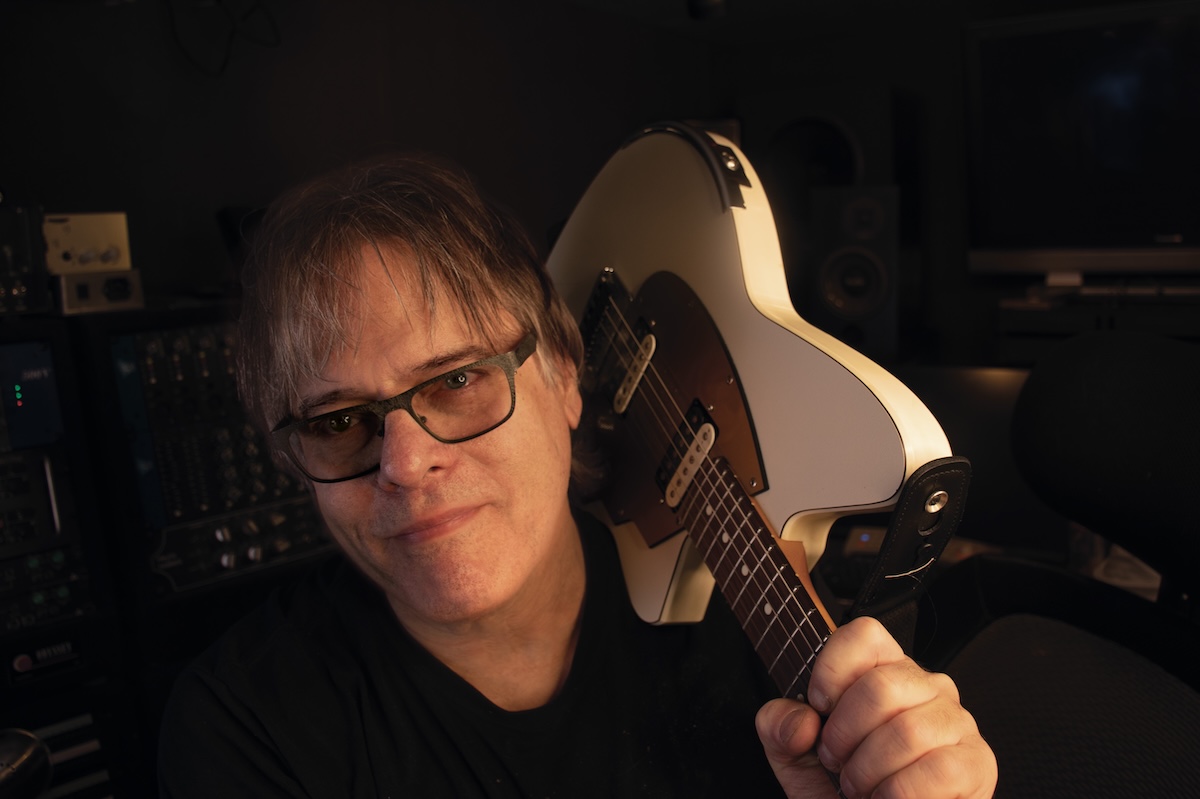
The band Shoes, known for their Power Pop sound and tight-knit ways of writing, recording, and releasing, continues to release new albums, but this time, following an album, Gary Klebe found himself writing an unusual amount of music. He didn’t think anything of it at first, thinking those songs would eventually make it onto a Shoes album, especially given that they write towards albums and usually don’t have many songs to spare. But as the songs started to line up, the terror slowly dawned on him: he might have an album taking shape, and that might mean facing the silence and self-doubt of making a solo record.
Now, his debut solo album, titled Out Loud, is arriving on April 10th. Working as his own engineer, producer, and multi-instrumentalist, Klebe recorded Out Loud on nights and weekends, and when he was ready, he headed off to Nashville to record the drums with longtime friend John Richardson. The result is a varied soundscape with interesting and sometimes surprising lyrics, but one that encourages you to really sink into the songs’ moods. They seem to convey a lot emotionally, both on the surface and beneath. I spoke with Gary Klebe about how the album snuck up on him, the persistence of his self-doubt, and the drive that kept him moving forward while making Out Loud.
I guess the obvious question is what made this the time for you to do a solo record, when you presumably could have done one before now if you wanted?
Since the last Shoes records, a couple of years after we finished it, I thought, “I’ll start writing songs for the next Shoes record.” Then, I started having more songs completed, about four or five songs. And we weren’t ready to start a Shoes record yet, since everything has to be in sync for that. But I just kept coming up with songs, which is unlike me. It was never my intention to put out a solo record, but then I started thinking, “Is this an album?” I started thinking in album terms. It kind of snuck up on me. If we had been ready to make a new Shoes record, I would have said, “Okay, you guys take the ones that you like best.” But then I was finished with it, and I didn’t know what to do with it. It’s been done for a while; I just didn’t really have a way to release it until recently. Once I’d done these songs, I moved on to Shoes as my main priority.
I think that because of the way you all have always operated as Shoes, very self-motivated and self-contained, it doesn’t feel surprising that you would handle all the aspects of this record, either. It seems like that made this more possible. Is that fair?
In terms of knowing how to make records, we learned the mechanics of recording before we could even play.
Exactly.
Recording was always an integral part, and the tape recorder was always an instrument for us. It enabled us to do things we wouldn’t otherwise be able to, like overdubbing. Eventually, we learned how to play our guitars! It took a while! [Laughs] But we still had the same approach. We communicated by sending takes back and forth. We don’t play an acoustic take to each other. We don’t do it that way. We say, “Here’s the tape. Let’s get back together later.” We’re weird! We’re just weird and different.
You may have always been that way, but that method seems even more typical if you’ve been playing together a long time. You don’t need extraneous language.
Yes, that’s right. We have a weird way of communicating, and we don’t know any other way. We don’t read music. We have no music theory. We have our own language. I thought for a long time that was a disadvantage, that we weren’t very worldly when it came to the music biz, but it’s just our way of doing things. We probably came up with things that sounded unique to other people because we weren’t tainted by other influences. Not that much, anyway. Just by what we heard on the radio, that was it.
We are the sort of people who were sitting, listening, learning music you liked by playing it back over and over again, instead.
We never played other people’s music very much, to be honest. We would do it just to hear it as listeners. I think that’s what separated us from other people, too, is that we made records from the beginning, just based on being a listener. It wasn’t from knowing how to play a Led Zeppelin riff. It didn’t confine our view on how to do things. A long, long time ago, when we had to get gigs together, we had to play some covers, and that was painful, because we didn’t know how to do it. I’m a massive Beatles fan, and I couldn’t play you one Beatles song! I can’t even play my songs very well.
This is very reassuring to hear. More and more, I’m hearing people say that they really have to isolate themselves, physically and mentally, in order to come up with songs that are authentic to them. There’s a strong argument to tune out the other noise.
Yes, there’s a pressure to conform at all times, it seems. Fortunately for us, we didn’t know how to conform. This was our only way of doing it. You find your own way. It takes a while for it to sink in, but then you start to realize, “Hey, maybe it’s not so bad that I’m doing my own thing. Maybe I even have an advantage from doing it that way.” Do you feel that way sometimes?
Oh, yes, and I think that’s something that young people often begin to realize as they get a little older, that creativity is something to be prized, and it’s built on weirdness. It’s built on idiosyncrasy. If you assume that you’re doing it wrong, that might actually be exactly what makes you, you.
And the flaws can be your strength in the end. It can force you to beef up on the content. In my case, melodies and lyrics make up for not ripping through solos. That’s not what I like about what I do; it’s more about the raw essence of the song, the songwriting part of it.
Was it still a bit lonely for you to take these steps towards recording this album by yourself?
Times one thousand! Jeff and John are in my life, and my connection to the music world. We depend on each other. Even just a nod of yes or no helps provide some reinforcement. That just doesn’t work when I’m on my own; I just have to face it. It was hard to get used to. I was always doubting myself. I didn’t realize how hard it would be until I did it. When I first started writing for Shoes records, I would think, “It’s not that great now, but we’ll flesh that out.” But that was gone here. These guys are my biggest influences. We were just in a bubble from the start.
Just having someone to react off of, to make decisions, can be so important.
You’re hoping that the person you bounce off of will agree with your direction, but if they don’t, you know, and you’re still glad you did it. It gives you some confidence in what you’re doing.
I think even if things aren’t perfect, the emotion and feeling of a piece is what people will connect with anyway. It carries the day.
That’s right! How does Bob Dylan get by with that voice of his? He doesn’t carry a tune very well, but the essence of it is understood. It being imperfect really is part of the presentation, and what makes it more believable, I guess.
Did you feel that you personally believed in all of these songs, and that’s what helped keep you moving forward, to release them?
Oh, well, as I moved along, I thought, “These suck!” [Laughs] But that’s how I always feel. I’m pessimistic and pretty self-effacing about these things. But I knew it sounded pretty good. I know when something is good, I just don’t know when something is great. You’re always reaching out for greatness, if it’s possible. I was happy with what I was working on, but I knew I didn’t have as clear a perspective since I didn’t have my partners. It really made me appreciate solo artists a whole lot more, and people I know who write everything. I know what they go through now.
How did you know when the songs were finished in terms of recording?
When a girlfriend of mine asked me, “How do you know when it’s done?”, I said, “I can’t answer that. It’s done when I just have to stop now.” There’s nothing that tells you, “It’s perfect, it’s perfect, move on!” There’s no such thing.
So you sat and tracked every song, except for the drums, which must have had some kind of placeholder, and then you went and saw Jon Richardson in Nashville to do that part?
Right. Normally, what we do, going way back, is put down a drum machine or some kind of loop to set the tempo. Then, we put the tracks down. For a lot of records, we did track drums at the beginning. We’d know the bass and the song. We’d know the song, the whole structure of it, and the drums from the beginning.
But then, when Skip left the band, we had to figure out other ways of doing it; we got more into drum machines and tape loops. Not to record them, but to use them as a metronome to put the parts down. With this record, I had at least three-fourths of it done, sometimes more, and then I brought Jon in. It takes a special drummer to be able to do work that’s already finished, because the drummer is usually the leader and the glue for everything. But Jon can follow an existing loop, or click-track, like you wouldn’t believe. He’s a machine, and it still sounds totally normal! He’s just very good at that.
But it was close to being finished when I went to Nashville. I was pretty nervous, because I had spent a long time working on this, and the drums we did in a day and a half. It was pretty nerve-wracking to have everything solidified so quickly. It had to be right. But I was happy when I got back and listened to it. I knew when we were doing it that it was good because he’s always good.
You and Jon have known each other a long time, too. Was he at all surprised at you taking this step to do a solo album?
He knows that we’re always piddling around with some song or some music project. I don’t think he was that surprised, because we talk on a regular basis, so he knew I had two songs, then I had four songs. He encouraged me to keep going. I was terrified of being singled out as the weak link in a band! I was afraid of what the reviewers would make of me, and I’d finally be singled out as the weakest member! [Laughs] That’s always the fear. Jeff went through this himself when he put out a solo record about ten years ago. He faced that same fear, I think, saying, “Please don’t say I suck. You can say that I’m not as good as Shoes, but please don’t say I suck!”
It is very exposing. There’s no one else to blame!
I know it! If they don’t think the bass sounds good, it’s all on me.
This is also a portrait of you, since you are really the input. Do you think this represents your mind in a more focused way than you’ve seen before?
A lot of that is about the lyrical content, and I never paid much attention to lyrics in the beginning. It was “all girls like boys, boys like girls.” It was all pretty simple. I’m not saying that’s a bad way of doing it. The Beatles were like that in their early years, too. But on this album, I ended up spending more time on lyrics than anything else. The music actually came pretty easily. I didn’t want to be saying the same things over and over. That exposes more about myself, and there’s more vulnerability in the lyrics.
I really enjoy the lyrics in these songs. There’s also a nice range, sonically. Some songs really have their own accent, and the album is varied.
I was kind of torn on that, because Shoes is my foundation, and always will be. But I was also afraid of sounding too much like Shoes. I wanted this to be at least a little off the path. To this day, I still don’t really know: Does it sound like a Shoes record? That’s okay. I’ve said all along that if this album is one-third as good as a Shoes record, then I’ve done my job.
I think it sounds somewhat like a Shoes album, but it also doesn’t sound like a Shoes record. The song “Shake Me”, for instance, is more Rock ‘n Roll, with reverb. It’s edgy. I think that’s a nice balance with other songs.
I’ve shied away from slow ballads in recent days, but some of these songs are a little more stripped down than I’d usually do, and some go a little further than I usually do, like “Shake Me.”
My theory, which is probably crazy, is that you allowed yourself a little more space on this album to create feelings via the sound. It has some stretchiness and space to it.
That’s good that you take it that way! Thank you!
Comments
Loading comments...
Leave a Comment