
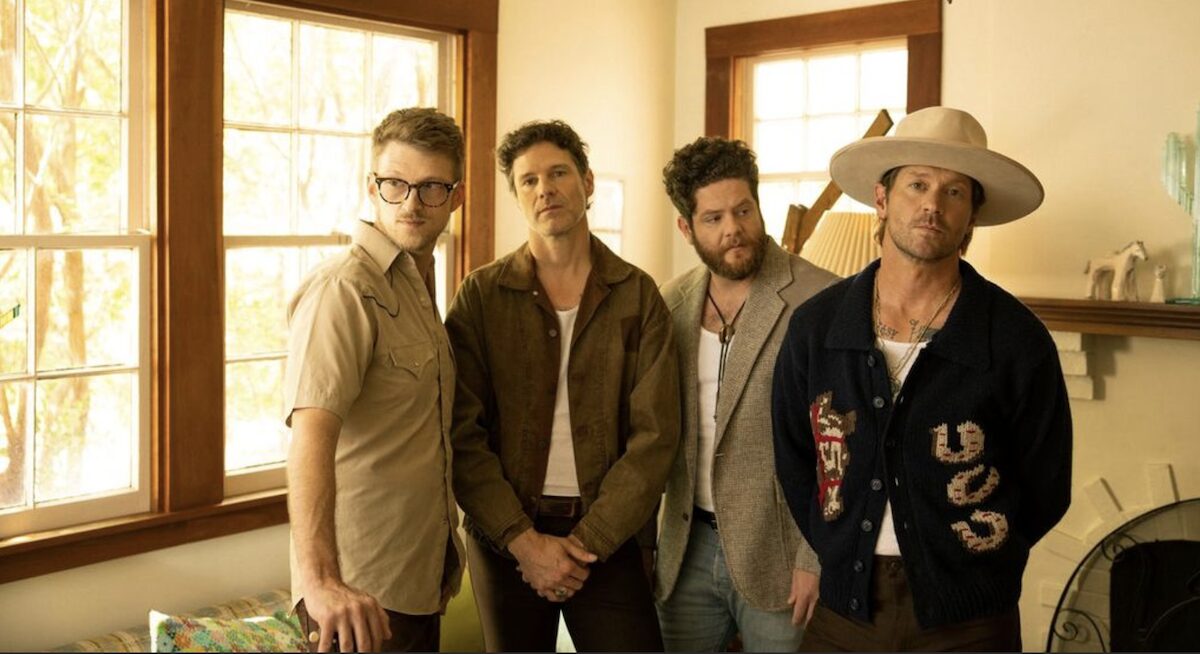
The Grammy-nominated band Needtobreathe released their tenth studio album, The Long Surrender, at the end of March. Produced by Dave Cobb and recorded at his studio in Savannah, Georgia. The album was intentionally recorded with a live feel, and the band is very geared towards performing these songs live, already bringing them into their sets this summer. The presentation of the songs also ties into a retooled approach to live performance that will focus more on band and audience inclusion in the show and less on screens and visual imagery.
The album balances high-energy and more introspective tracks, but that energy comes more from the performers, with electronic adjustments dialed back. That fits with the songs’ thematic territory, which speaks from a place of humility, recognition, and reexamination of what we find valuable or meaningful in life. Both the songwriting voice and the sound on the album are things that fans will recognize as uniquely Needtobreathe, but they also feel like a kind of new start for the band, one with unprecedented directness. I spoke with Bear Rinehart around the time of the album’s release about the big ways this album ties into live performance and about what it was like to write songs that find the positive side in powerlessness.
I think the live sound of the record really gives a sense of how gripping these songs would be live, right as you are starting to tour them. There’s a blend of high energy and more reflective tracks, too, which would make for a varied set.
We want a lot of joy. We have a high-energy kind of show, and you want to weave that throughout. We’re excited about it. I’d been listening to a lot of 70s, loud records, like Joe Cocker. I love big shows like that. I love live shows before Production became a thing. Before “content” and all those flashy things, when it was really on the band ot take you through the journey. All those things. I think we’re going to lean into those things on this tour. I have little boys, and I told them, “We’re not taking the video screens.” And they said, “What??” They said, “That’s the best part.” But I think where the band is right now, it makes sense. We’re reimagining some of the old songs that way, taking the audience through them, musically. I want to force the perspective of the audience into that moment, like we’re all in this together. It’s going to feel like a smaller venue, and I think that’s important to us.
It’s interesting that you put it that way, because that’s how I imagined this album while listening to this. The previous album felt more like stadiums and amphitheaters, but this one feels like it should be in an historical venue, with wooden floors, really shaking the place.
Yes, totally! One of the ways that we achieved the sonics for this record was an idea that Dave [Cobb] had early on. He said, “All the reverb that we use, let’s make those room mics.” So, on a vocal, you’d usually cut it close-up and add a reverb somewhere. But this was the idea of putting a microphone thirty feet away, in the corner of the room, and fading that in. You could give it real space, and that worked for me. It felt like it was in a room, because it was. For me, that’s about preserving its authenticity. When you go into a live show, you can’t put everybody around the band, but there are artists who I think do a really great job of that.
I went and saw Pearl Jam a couple of years ago, and they ended the show with all the lights up. And in an arena, that’s the way to do it. I thought, “Now, this feels like we’re in a bar together, and everybody’s involved.” There are different ways to do that, and we’ve been thinking about how to put ourselves up there in a way that feels inviting. We looked at Wilco and Tom Petty, where there would be a lot of instruments on stage that the guys could move around to. Rather than just putting up a video and fading to black while the stage is reset.
There’s also something to be said for the realism of letting people understand how music is made, too.
Right now, I feel like people are just so over that element, and maybe AI has pushed this too far, of now knowing whether what they are seeing and hearing is “real.” I think there’s an attraction to when something forces people to pay attention, and we need a connection in this way. That’s the idea of where we’re trying to head.
People have told me that, fans and artists. I think we’re flinching away from being too close to that edge. I think it’s nice that you’re thinking about doing things differently for fans, but I think it’s also good for you all to be able to do something a little different, year by year.
I think that’s true. Our joy on stage is by far the most important part. One thing leads to another, and the crowd feeds off of that. We’ve been spending more time talking about that and thinking about that. A lot of that, for us, is feeling like we’re out there on the edge a bit, musically. If the band want to go a new direction, we can go. The more we feel like participants in that, the better.
We can change the set list and identify what’s challenging. I try to surprise the band a lot by calling on solos when they are not expected. [Laughs] Because the biggest joy we have is when you call a guy out on a song when he’s not expecting it, and then he kills it. Then, everyone in the band is smiling like eight-year-old kids.
The way these songs are put together seems to leave room for that. They feel stretchy, like they could expand into solos for added energy. They are not fragile in their construction.
Right, we’ve taken the grooves those songs are based on, and the feelings those songs are based on, and we’ve said, “Okay, we can expand them.” I think that’s part of the Joe Cocker reference, because he was doing other people’s songs, and Leon Russell was leading that band as an insane musician, saying, “What if we change that? What if we expand that?” All those things were intriguing to us, and so we’re going to spend a lot of the summer rehearsing and preparing for that.
When it comes down to the themes on this record, I can see how all the songs fit together. There’s a directness and a dialing in to deep emotions that’s pretty pervasive and powerful.
I sort of took the filter off. I’ve been a little more protective of my personal faith stuff in the past, for whatever reason, good or bad. But this time, I thought, “This is all I’ve got right now. This is what I’m leaning on. I’m going to write this.” That’s what the record ended up being about.
You didn’t censor yourself while writing, or make a decision to hold back some songs afterward. I remember that on your Wilder Woods album, Curioso, you were trying to follow the songs more than predetermine their direction. This sounds similar, like a development.
For sure. I think, with the solo project, there was the question of, “What is the vibe of this? Is it different from the band?” I think this record, in a strange way, is as much a solo record as anything anyone has done, but sometimes things just align, and that’s what happened with the band. For our drummer, his dad had just passed. He had decided to quit drinking and was going through this journey of sobriety. And I was, too.
There were some things that made me think, “This is the same wavelength.” So the songs were coming to me very personally, and I was just writing straight out of that place, but in another way, it wasn’t a solo record at all. It hit all the band members very hard, in a way they could relate to. I asked, “Would everybody say this in this way?” It was nice to have that freedom, where they just said, “Just say what you need to say, and let everyone get behind it.” I was very fortunate to have that.
If the band feels the songs are theirs, too, and reflect where they are coming from at that time, then that’s ideal, absolutely. I think when it comes to audiences, too, the state of the world has been so crazy for so long that these kinds of songs can speak to people who have also been going through stuff.
Yes. To me, the perspective of the record, even though it’s mine, is a very humble one. It’s like the first day of AA. It’s saying, “I have a problem. And I can’t do this alone.” I think the perspective on the record is a little bit like that. But yes, I do think the world has been absolutely crazy, and so much, culturally, has been about the “self.” So it puts this crazy pressure on everyone to somehow fix the problem.
You get online, and you start fighting, as if you, somehow, could sway the argument and win it in the end. That’s a lot of pressure for individuals to have, to say, “I can shape my way in any way that I want to. I can fix anything!” I think, in a way, the humility on the record does speak to people. It doesn’t matter what you believe, faith-wise; there’s a freedom in that kind of surrender. To go, “If I were here by myself, with no one else, this would not end well. I’m going to have to find my people, I’m going to have to find support where I can, and I’m going to have to give myself some grace, here.” I hope it finds people where they are at, and that it’s positive.
I think there’s a relief when people hear things that they know to be true, but haven’t allowed themselves to say. The attitude that you were just explaining seems to say, “I don’t have all the answers in myself.” And that there’s more to it all. That’s an important recognition. It’s like people have been taught to always present that they know the answer to everything. So there’s a release in being able to say, “I don’t have all the answers.”
Right. I joke about this live, sometimes, but there’s a lot of truth in it, that we’ve been sold some idea of freedom that’s something as you’d see on a t-shirt, where there’s an eagle on a motorcycle, or something like that. That makes it seem like I have the power to fix myself. And we can’t get past that, somehow. There’s a powerlessness that’s beautiful to me, and that’s maybe something that I learned through the sobriety journey, also.
I realize, “Man, I’m just as powerless today as I was yesterday. That doesn’t mean that I’m not capable of doing great things, or loving people, or being loved.” It does take some pressure off. I can say, “I don’t have to save the world today.” I think I was saying that to myself every day while making this album. I think it’s there on the album.
The song “The Long Surrender” really sets that up, but the song that goes all the way to the brass tacks is “Mamma Loves Me”, where you lay it all out.
Yes!
For me, when I listen to the album, I also hear little things in the imagery that suggest how life can shape and change a person, like losing loved ones, having children. That change is possible. And that can be a good thing.
I’ve got little boys now, and I’m constantly talking to them about that principle. As a parent, one of the things I like about the sports thing is that they fail. It’s so hard for me to set that up for them in my own house. I don’t want to see them fail. But in front of their friends, they strike out. That’s such a valuable lesson: “If I strike out, it doesn’t say that I’m a bad person.” What if all those tough moments teach us the most?
I think all that’s true, but from an adult perspective, I have a lot of baggage from how I grew up, from the conservative Christian thing. I had some abuse in my history as a kid. There’s a lot of that where you go, “Do I throw out those 20 years? Or was I also loved a lot during that time?” It’s “both, and.” I think some of that is being worked out on the record. I tended to block out all of that in my life as “the dark time.” But so many of the failures in my life, when I look back, I have regret, but I’m also thankful for. I wouldn’t have learned the lessons I needed. I wouldn’t be where I am without them.
Comments
Loading comments...
Leave a Comment