
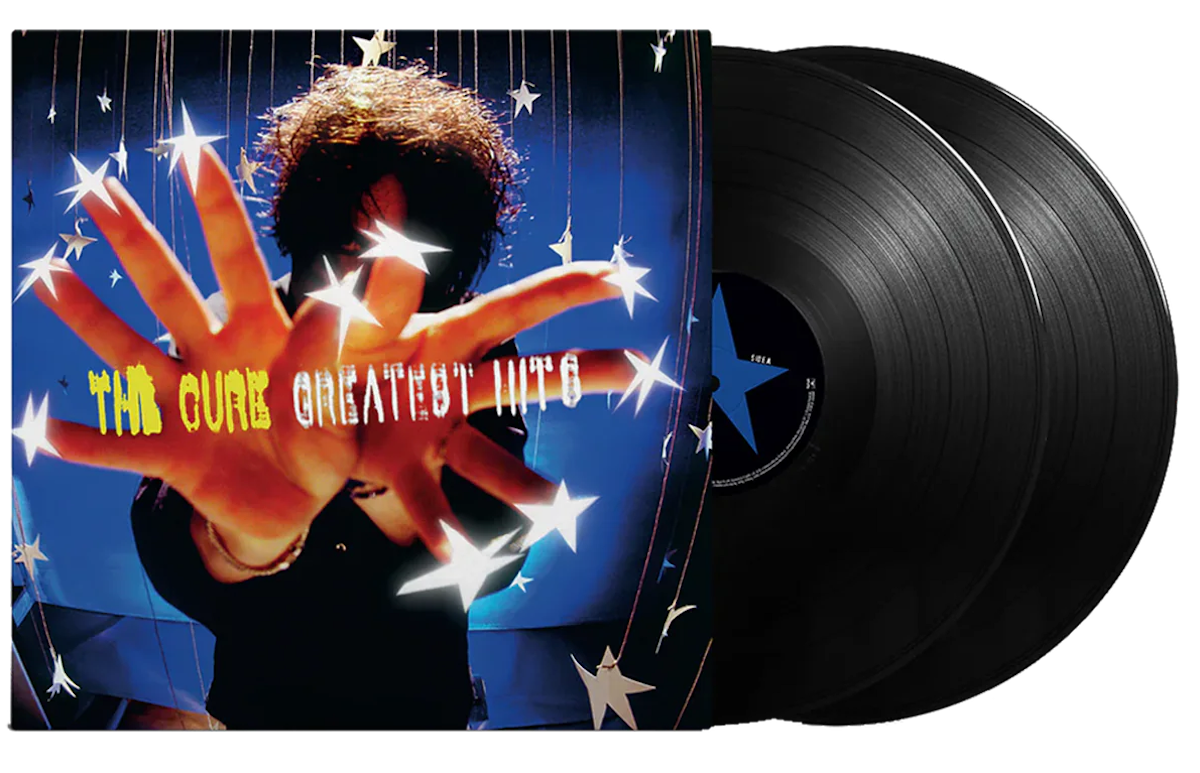
By the time The Cure released Greatest Hits in 2001, they had already built one of the most recognizable catalogs in alternative music, moving from scrappy post-punk minimalism to lush, radio-ready pop without losing their identity. Owing one last album to Fiction Records, Robert Smith agreed to put out a greatest hits under the condition that he could choose the tracks himself. With Robert Smith personally curating, the collection feels less like a label-driven roundup and more like a deliberate snapshot of how the band wants their legacy presented. As the Greatest Hits celebrates 25 years and the band marks 50 years, Rhino Records is reissuing the compilation on Bio Silver vinyl as a 2-LP set.
The first LP starts at the beginning in 1979 and contains most of their 80s output. The band’s first single, “Boys Don’t Cry,” is still one of their best-known tracks with its tight guitars, quick pacing, and one of their most recognizable melodies. “A Forest” (shortened edit) slows things down and leans into atmosphere, with a repeating groove that builds tension. It’s no wonder it is still their most-played live song. From there, the shift into “Let’s Go to Bed,” “The Walk,” and “The Lovecats” highlights the band’s pivot toward quirky, synth-driven pop. These songs don’t abandon the darkness entirely, but they introduce the lighter side that would define their mid-’80s run. “Inbetween Days” is clean and efficient pop, driven by rhythm more than mood. “Close to Me” keeps things fairly minimal but adds personality through its horn arrangement and trumpet solo.“Just Like Heaven” is one of The Cure’s most recognizable songs, built around a bright guitar line and a steady, driving rhythm. Robert Smith keeps the vocals simple and focused, allowing the melody to carry most of the emotion. “Lullaby” slows things down with a creeping, almost claustrophobic feel that reminds you how comfortable The Cure were operating in darker spaces even at their commercial peak.
The second LP focuses largely on their late 80s and 90s run. On “Lovesong,” the bass line carries most of the song, sitting front and center while the drums keep a steady, almost mechanical beat. Guitar parts are minimal while the keyboards fill in the background. “Friday I’m in Love” goes in the opposite direction, with a fuller, more layered arrangement. The guitars are brighter and more open, strumming through the chord changes and giving the song its momentum. Deeper cuts like “Never Enough” remix from Mixed Up and “High” fill in the edges of their later-era sound without dragging the pacing. The final side feels more like a coda than a climax. “Mint Car” and “Wrong Number” reflect a band experimenting with modern production trends of the late ’90s. The final two tracks give fans previously unreleased material. “Cut Here” leans into a more reflective tone, with steady drums, clean guitar lines, and a restrained vocal from Robert Smith. “Just Say Yes” feels more like a late-era experiment, pairing The Cure with Saffron from Republica for a brighter, duet-style pop track.
As an entry point, Greatest Hits does exactly what it should: it covers the major eras without getting too deep in the weeds. For longtime fans, it’s a well-sequenced refresher. For newer listeners, it’s a reminder of just how many essential songs The Cure have stacked over the decades.
Comments
Loading comments...
Leave a Comment