
Grateful Dead cover bands are a dime a dozen, which is a testament to the legacy of the legendary jam band. Nearly every city and town in the country seems to have a group of musicians offering their own take on the band’s music for local Deadheads eager to experience it live. Over three decades since the real thing’s demise following the passing of the Grateful Dead’s benevolent leader, Jerry Garcia, this music is as timeless and beloved as ever. These days, you can experience Dead tunes performed by drag queens, mashed up with Steely Dan, sampled into electronica, and performed by legendary folk artists like Gillian Welch and David Rawlings. Hell, even boy-pop blues cosplayer John Mayer threw his hat in the ring for several years to massive commercial success as part of Dead & Company.
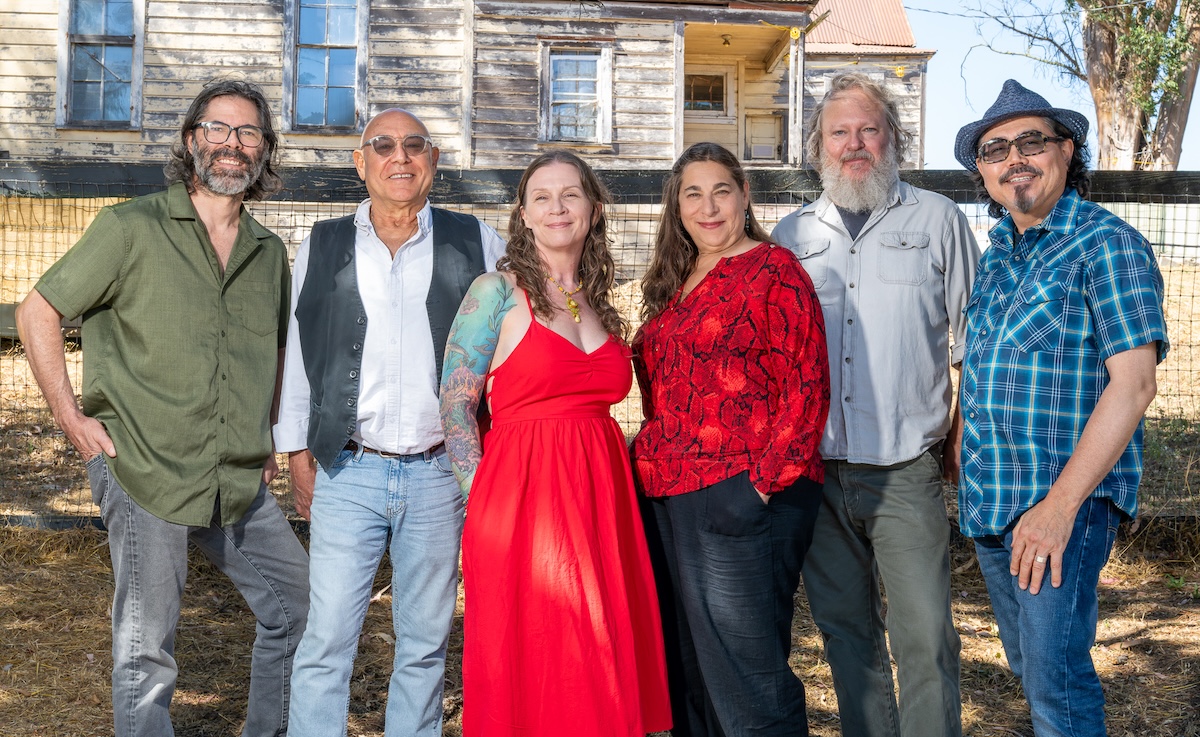
Amidst all of this torchbearing, there is endless debate over the purity and, in some cases, the originality of acts in truly capturing the spirit. Joe Russo’s Almost Dead and Dark Star Orchestra are among the most beloved, but Jerry’s Middle Finger is entering that arena with an approach that feels almost entirely new. Led by Rodney Newman, the California-based band has been rapidly gaining new fans and moving into bigger venues with an emphasis on the work of Jerry Garcia, who always maintained a prolific solo career alongside his day job with the Dead. Though they aren’t as dedicated to faithful interpretations of specific shows as Dark Star Orchestra, their big band renditions of Garcia’s prolific solo work often sound almost eerily similar to the originals, with just enough fresh originality sprinkled in to keep things fun. They do this with a cast of seasoned musicians, with lead guitarist and singer Garrett Deloian taking on much of Jerry’s role. His guitar tone and vocals are similar to the real thing, but never get into complete copycat territory, which may be part of what makes JMF (an acronym fittingly close to the Jerry Garcia Band’s “JGB”) so exciting as a live act.
With fans they have dubbed “Fingerheads,” the band is developing a loyal following, and they continue to spread their music through the release of free monthly live recordings, much like Deadheads traded tapes. For those of us who are devotees of Garcia’s solo work but may be skeptical of yet another cover band bastardizing the material, Jerry’s Middle Finger is a refreshing and musically delicious continuation of the legacy. Recently, Rodney Newman took some time to discuss the origins of the band, their approach to interpreting Garcia’s music and others’, how they keep their live shows interesting, and what we can expect in the future.
Besides the obvious, what is the meaning behind the band name? It feels a little provocative.
In the early days of JMF back when we were playing parties and then graduated to dive bars, the name came out of necessity, which provoked several weeks of back-and-forth name exploration between Garrett and I. The band “name game” was one of our favorite pastimes. There has never been and will never be anything negative implied. Over the years, however, for those who don’t have an understanding of Jerry’s history and the fact that he lost his middle finger in a wood chopping accident in the Santa Cruz Mountains as a child, there have been some questions asked and backlash that it meant something bad. On the contrary, the name and this band honor and respect Jerry Garcia more deeply than can be calculated. Some have said we are “the missing piece”… Any which way, the name is intended to be a clever title for a family of friends and musicians who have devoted their lives to tribute an incredible, and very unique human being who has and continues to change our lives to this day.
So many musicians just go for Grateful Dead covers, but strikingly few cover Jerry’s solo career. What drew you to doing this?
When we experienced our initial early burst of success, it was impossible to ignore that another band, Cubensis, with whom we were friends, had somewhat cornered the market on the Grateful Dead tribute act in SoCal. Garrett and I had equal love for the JGB material and thought it might be a fun thing to try to morph the band into a JGB lineup. So we did, and it took off even faster.
In my life as a Deadhead in the late ’80s and early 90’s, when Jerry was still raining down the magic on all of us lucky hippies, I was seeking out GD and JGB shows simultaneously to achieve a perfect balance. I was not the only one, as their two repertoires complement each other. The JGB catalog is often a bit more digestible for newbies to the scene, as Jerry played so many of his favorite songs as covers, from Motown to reggae to Dylan.
Little did we know that 10 years later, you could not throw a rock without denting the car of someone in a Dead cover band. JGB is still relatively uncharted territory for most tribute acts, with a few exceptions, of course.
Have you been surprised by the interest in this? It seems like the venues you play just keep getting bigger.
Having discovered the Grateful Dead and JGB shortly thereafter in 1989, being an excellent example of someone who immediately “drank the Kool-Aid” and surrendered completely to the unique, vibrant, and deeply magical experience, I am not even remotely surprised by the positive response to the JMF experience.
The community around this music is unstoppable. The ethos and mystique of the Jerry/Dead musical concert experience are 100% intoxicating and, for many, seemingly addictive. The fact that it seems to have grown since Jerry, then Phil, then Bobby’s passing is incredible, but it makes perfect sense. It all provides answers, comfort, joy, support, and escape to those who take part. All the things we spend our lives seeking to find. This community is a world of its own, a true escape…and a beautiful place to exist.
As Bobby said, it will last for 300 years.
Personally, I am confident it will thrive forever.
The growth of this band, I believe, is largely due to this thriving and supportive community, as well as to the hard work, love, and dedication we have given to the musical experience we are sharing.
What is your approach to crafting setlists? Do you look at historical examples to recreate, like Dark Star Orchestra, or make it up on the spot?
Garrett puts the setlists together a week or two in advance of each performance, sends them to me, and then we collaborate on fine-tuning things. We incorporate songs and styles from every era of JGB. Some songs are pre-backing vocals, pre-Melvin Seals, from the Merl Saunders era, played by Legion of Mary, or off Jerry’s records that were never played live or played very few times. We really try to mix it up and keep it fresh. Garrett builds the lists using a similar structure to the lists Jerry chose. From time to time, we will do a recreation show, playing a list from an actual show Jerry performed that is relevant to the venue, date, or other unique characteristic.
Can you share a rundown of your gear and talk about how you get that Jerry sound out of your guitar?
I cannot go too deeply into the tone Garrett has conjured from his setup, but I can say it is one of the best in the biz. He has worked very hard to dial in his tone for a decade, constantly improving it in any way he can. It all starts with his guitars. He started emulating Jerry’s sound with his tried-and-true Gibson SG, which he had modified many years ago to include similar electronics to enable the unique effects loop that Jerry’s guitars used. His other guitar is a true work of art. It is known as “The Scarab” and was custom-built for Garrett by Leo Elliott at Scarlet Fire Guitars in Carrollton, Texas, generously funded by Andy Logan of The Grateful Guitars Foundation. GGF is an incredible group of humans who provide unique replica instruments to players across the country, feeding the Grateful Dead/Jerry Garcia sound with authentic, handcrafted instruments. We are all very lucky to have received this kind of support, and the result is an elevated musical experience for all.
Where did the idea to release a new live album come from every month?
All of our shows are recorded by our Tour/Production Manager, Jon Hart. Jon is a gifted recording technician and an invaluable member of our team. We have put almost every JMF show played up on Archive.net to share with the world, but it is sadly an underutilized resource that many people never really utilize. To get our performances out to the masses more efficiently, we began releasing live albums last year, which have been very well received on several streaming services. It feels good to let people hear us more easily, as the feedback and love we have received are beautiful.
Were all the band members big Deadheads or Jerry fans when you came together?
Yes. Everyone in the band is a Deadhead, to varying degrees. Several of us attended countless shows and went on tours. The Deadhead community has been a huge part of our lives. Our keyboardist, Jon Gold, started going to shows in the 70’s and had countless adventures following the band. Jon was also a member of the Mystic Knights of the Oingo Boingo, the first incarnation of what became the popular group Oingo Boingo, led by Danny Elfman, in the 80s.
Beyond our backgrounds as lovers and followers of the Dead and Jerry, part of what makes JMF so special is our experience in several other genres and styles of music, not to mention our diverse backgrounds outside of music. Our Bassist Son Vo, for example, escaped Vietnam as a child, a story that he shares in a book he published a few years back titled “Tales of the Mekong Delta Bluesman.”
We are an interesting family that adores what we do together and are so thankful for the devoted, loving community that supports us across the country.
As someone who has been making music for a long time, what has been your favorite part of this journey so far?
There is a cyclical flow of energy at our shows. The band is only one ingredient in the magical stew crafted each night we play. When we take the stage, our performance feeds off of the crowd, who feed off of the music, and so on, and on. Having been an audience member my whole life at Dead shows and JGB shows, not to mention countless other incarnations of musicians who have and continue to take the stage, I know deeply how it feels to be elevated by this music. When I am playing and look out and see the smiles and expressions of emotion our fans are experiencing, I share in that transformative event with them. It is hard to put into words how it feels to be part of the sound that awakens those feelings in people. All I can say is it is an absolute gift, and definitely my favorite part of this journey.
Do you have any personal favorite Jerry shows?
There are too many to mention, and all for very different reasons, but the first that comes to mind was a Jerry Garcia Band show I attended on Feb 7, 1992, at the Henry J. Kaiser Convention Center in Oakland, CA. I remember Jerry walking out on stage with a HUGE smile on his face. I get chills just thinking about that moment. His joy set the stage for an incredibly powerful evening.
Each night I was blessed to see Jerry play, with JGB or the Dead, whatever the case, it was always a complete adventure. Each night felt like a lifetime of experience, filled with highs and lows. It is, and I hope it will continue to be, for myself and all the other fans who keep coming out, something that will never fade away. It is precious beyond words.
- ← PreviousGolden Age Thursday Samples: The Crusaders’ “A Message From the Inner City” (1972) Becomes Jazzy Hip-hop Via Queen Latifah (1993) & Juggaknots (1996)
- Next →Surfing The Tube: Alabama Shakes Share More Reunion Tour Footage; UPROXX Interviews Thundercat; Colbert & Anne Hathaway Discuss Taylor Swift & New Movie “Mother Mary”
Comments
Loading comments...
Leave a Comment