
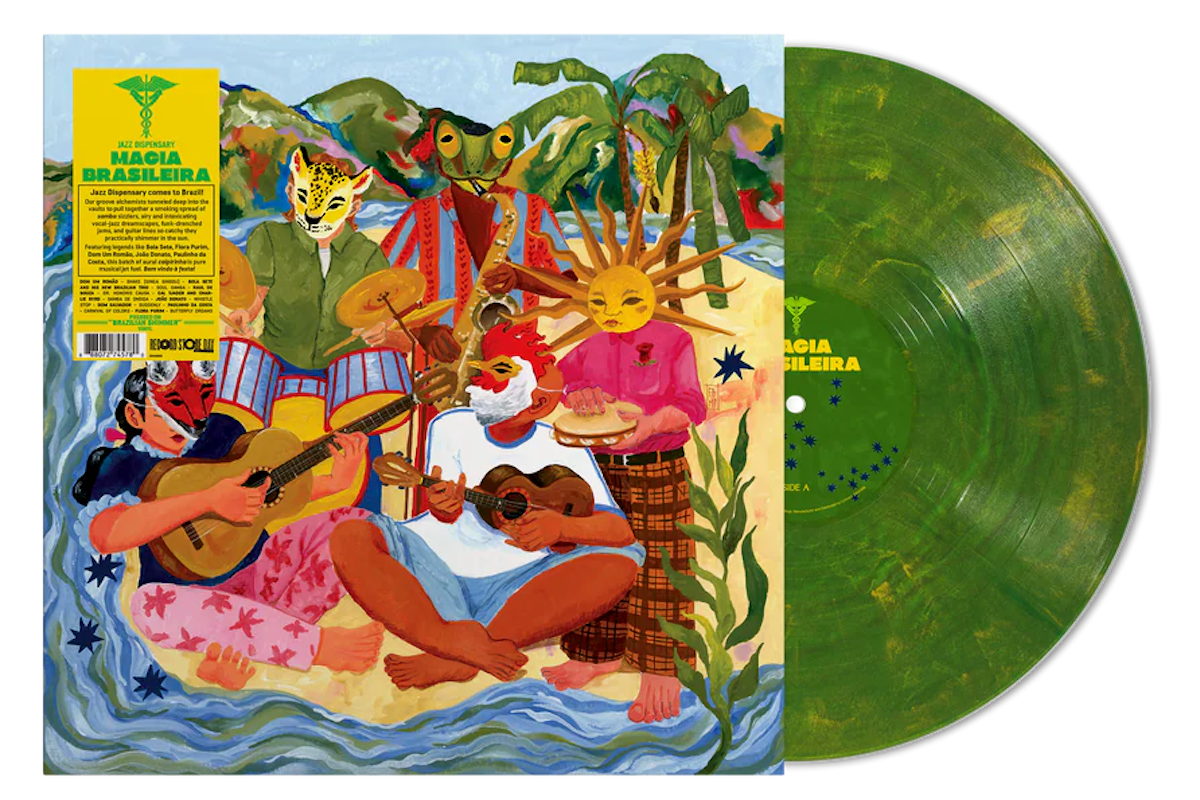
Jazz Dispensary’s compilations tend to work best when they lean into a specific mood, and Magia Brasileira takes the listener to the Samba-filled Brazil of fifty years ago. This set spans the late ’60s through the ’70s, focusing on Brazilian artists and adjacent players who blurred samba, jazz, and funk in a way that feels loose yet tightly played. It’s not a deep archival statement so much as a small sampling of tracks that best exemplify the music scene at the time. For Record Store Day 2026, Craft Recordings is releasing Magia Brasileira as an RSD Exclusive pressed on “Brazilian Shimmer” green/yellow / gold splatter vinyl with original artwork by São Paulo-based artist Fernanda Peralta.
Side A starts with Dom Um Romão’s “Shake (Ginga Gingou),” which is built around layered percussion and a steady drum pattern that drives the track from start to finish. The rhythm stays locked in while small horn and keyboard accents move in and out of the mix. Bola Sete’s “Soul Samba” strips things back to guitar, bass, and light percussion. His playing is precise and repetitive, keeping the groove consistent, with small variations in phrasing rather than big shifts. Raul de Souza’s “Dr. Honoris Causa” brings in a fuller arrangement, with trombone carrying the main melody over electric keys and a more pronounced bassline. It leans closer to jazz-funk, with a tighter, more structured feel. “Samba de Oneida” closes the side with vibraphone and guitar sharing the lead. The rhythm section stays steady underneath while the melody is passed back and forth between the two.
Side B opens with João Donato’s “Whistle Stop,” which centers on a repeating keyboard figure and a syncopated rhythm section. The groove is steady, with the keys doing most of the melodic work while bass and drums stay consistent. Dom Salvador’s “Suddenly” follows with a similar setup but adds more emphasis on chord changes and a slightly fuller arrangement, with keys and rhythm guitar filling more space. Paulinho da Costa’s “Carnival of Colors” introduces vocals, but the percussion remains the main focus, with the vocal line following the rhythm closely and the arrangement adding light disco elements without shifting the overall feel too far. The album closes with Flora Purim’s “Butterfly Dreams”. Her vocals are front and center, supported by electric piano and a restrained rhythm section that keeps the tempo steady.
The strength of Magia Brasileira is how clearly each track is defined without breaking the overall flow. The players are tight, the grooves are consistent, and the sequencing keeps everything moving without any one track feeling out of place. The pressing here is immaculate, both visually and sonically. The mix across these recordings is consistent enough that nothing feels out of place despite the different sessions and years represented. It’s not meant to cover everything, but what it does include is well chosen and easy to stay with from start to finish.
Comments
Loading comments...
Leave a Comment