
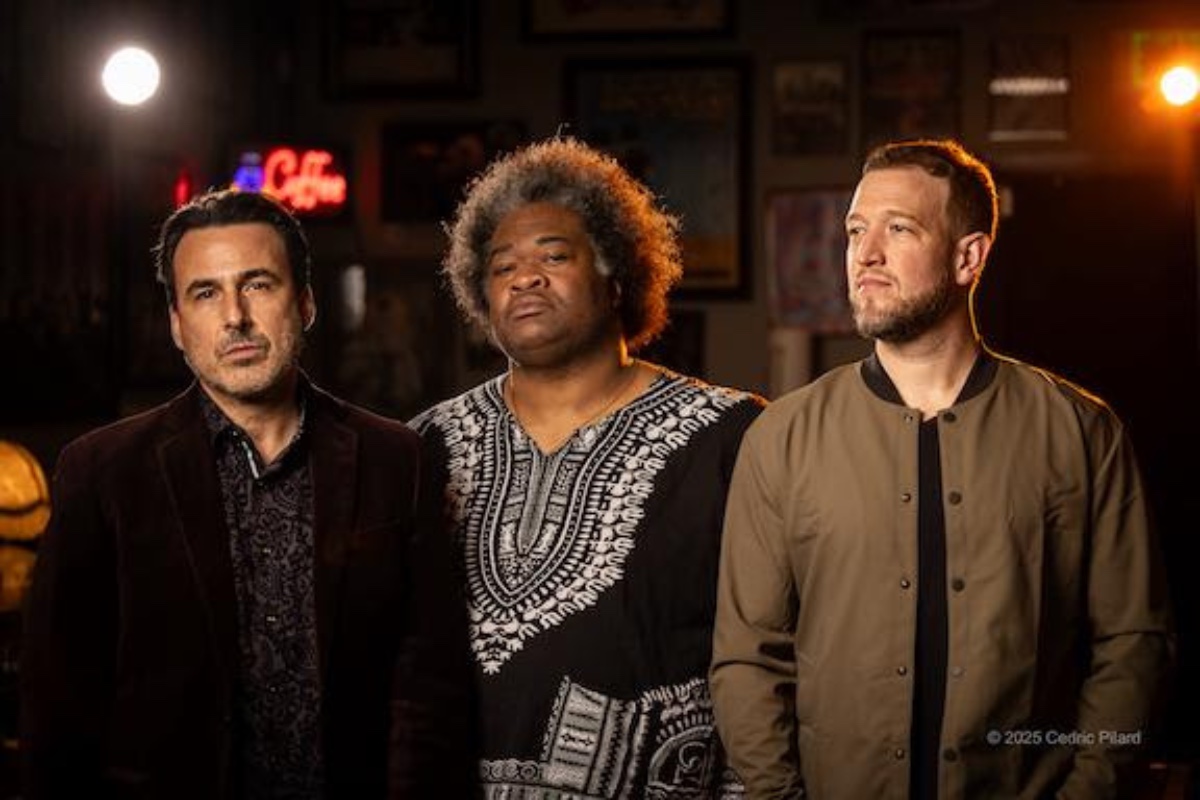
Much modern soul and jazz music seeks to honor the cherished legacies of these genres. Over the past few years, artists have been emerging from corners of the internet, tipping their hat to the heyday of these genres by seemingly imitating their heroes. While these artists and albums are not things to ignore, they leave a gap in the contemporary scene, a hole patiently awaiting some innovation to bridge the gap between modern and classic music. Parlor Greens, the organ trio consisting of drummer Tim Carman, guitarist Jimmy James, and organist Adam Scone, began construction on this bridge with the release of Emeralds, their stunning 2026 sophomore effort that beautifully toed the line between organ trios of the past and Parlor Greens’ lofty visions for the medium in the future.
The eleven-song LP, recorded and released with the illustrious Terry Cole and Colemine Records, is an expansive listen. With sentimental instrumental balladry like the emotional closer “Queen Of My Heart,” the bouncy, digestible “Eat Your Greens,” and their refreshing organ trio extravaganzas like the push-and-pull of “Red Dog,” Emeralds is a daring leap for both Parlor Greens and organ trios as a whole. The surreal amount of colors and emotions covered across the trio’s second outing together is an ode to their open-minded creativity and trust in each other’s prowess, something drummer Carman is incredibly proud of.
Carman, one part of the three-headed beast that is Parlor Greens, is a modern-day workhorse. Between his work with James and Scone and his work in the Blues scene with bands like GA-20 and now Canyon Lights, Carman has stamped his individuality across multiple contemporary acts. With Parlor Greens, the band in which he and Cole helped conceive and materialize, has proven to be a fruitful, egoless collaborative spirit, one conducive to the drummer’s wide-ranging prowess and ever-evolving creative visions.
Glide had the absolute pleasure of hopping on a Zoom call with Carman to discuss Emeralds, how Parlor Greens evolved into the trio we see today, and how he balances his many musical projects. You can read our full conversation below.
Emeralds has been out for a few days now. How are you feeling now that the record is finally out of your hands? How are you feeling about the reception?
Excited. It’s been a long process of recording and getting everything ready for release, but it’s always exciting and refreshing to just put it out in the world and see how people respond. So far, the response has been really great; we’re all happy about it.
What was it like getting back together with your Parlor Greens bandmates for a sophomore effort? How has your vision for what this trio can become changed since you first started playing together?
I’d say the only difference between Emeralds and our debut album is that, when we recorded the debut, we had never even really played together. We were kind of just put together and put into a studio, and things just happened organically that way.
For this sophomore record, though, we have been touring and spending more time together, coming up with ideas as a group. It was informed a little differently in the sense that we showed up in the studio knowing each other better as humans and musicians, so I think we had a little bit of a different approach.
Who put all three of you together in that studio initially?
It was Terry Cole, the owner of Colemine Records, and me. We had talked about doing an organ trio record together. Cole kind of formed the group; he was the one who threw out the idea for Adam Scone and Jimmy James. I know Jimmy and Adam, but I had never played with them in a musical setting, while those two had played together on a record for Jimmy’s Scone Cash Players. The first time the three of us ever made any sort of sound together was when we recorded the song “West Memphis” in the studio at Colemine Records.
It was only last year that you debuted your Blues-rock project, Canyon Lights. What is it like bouncing between these different genres? Was there any overlap in the recording of these two projects?
Yeah, I was working on the Canyon Lights record at the same time I was doing Parlor Greens. It’s been really challenging to juggle the two, to be honest. I’ve actually had to get a sub to play in Canyon Lights on drums, because gigs are just happening at the same time, and I can’t be in two places at once. For example, in early May, both Parlor Greens and Canyon Lights have shows in Europe at the same time. I have a good buddy of mine, a great drummer, Harrison Fauea, who’s playing with Canyon Lights while I’m with Parlor Greens.
Is that a matter of compartmentalization, or are you just so in the moment that you’re able to bounce between these two worlds?
Yeah, I mean, I love both styles of music. I do think there is a bit of shifting gears between the two, which was initially a bit of a challenge. There was one period last year when I was out with Parlor Greens, then we had a little break, and I flew straight to a tour with Canyon Lights, then flew back to be with Parlor Greens.
It’s kind of a shifting mindset, but my heart’s in both of those styles of music. It keeps me on the edge of my seat a little, which is nice.
Have you always had this diverse taste? What drove you to start this new outlet with Canyon Lights?
Well, I’ve always done stuff like that. I was in GA-20 for five or six years, which was a heavy blues band, and Canyon Lights was formed by me and the former lead singer of GA-20, Pat Faherty. I’ve always played that type of music, but since high school, I’ve tried to diversify as much as possible. I was in the jazz combo and in the big jazz band, but then I was in a punk band with my older brother. I like having diversity in playing and being able to express myself in different situations.
Was it always the drums? Was this your first instrument, and what drew you to the drums from such an early age?
My first instrument was piano when I was super young, but I never really could get into it; I didn’t practice much. My older brother started a punk band and was looking for a drummer, and I remember I was just drawn to the drums since I was like 10. So I convinced my parents to let me start playing drums, and I haven’t really looked back since.
I was fortunate that I was able to gig from a pretty young age with my older brother. I think I was around 11 years old when I started recording and playing shows around Boston.
Along with your many musical projects, you’re also a published author with books like Philly-ISM, which explores the works of jazz drumming great Philly Joe Jones. Are those your biggest inspirations as a drummer, or what drummers inspire you the most?
In the jazz world, it’s definitely Roy Haynes, Philly Joe Jones, Jimmy Cobb, those are my guys. Elvin Jones, people like that. But I’d say in the world of the organ trio thing, my guys were Idris Muhammad, Ben Dixon, and Donald Bailey. I love Blues as well, so I have Fred Below, who’s one of my all-time favorites.
I’m all over the place. I have sort of different influences depending on the style of music.
Going back a little bit to that first Parlor Greens album, what excited you about making an organ trio album in the first place?
Well, I think Scone and I both bonded over the 60’s organ trios that sort of do some more of the straight-ahead stuff, like Big John Patton and Jimmy Smith. Personally, I felt there was a void in current organ trio settings, where people were leaning more toward the funk side, and I wanted to approach it through the traditional soul jazz, kind of straight-ahead elements, and some boogaloo and stuff like that. That’s what got me excited about Parlor Greens, and throwing James into the mix adds a whole different element because he brings in Steve Cropper and Hendrix elements as well.
I just think the unit as a whole is a special and unique thing that, personally, I feel is different from a lot of organ trios going on today. What I will say, though, is it’s awesome to see how organ trios are coming back in a big way. There’s a bunch happening right now, and some are amazing. The Breaks, which is Eddie Roberts, Stanton Moore, and Robert Walter. They’re about to release their first record, so it’s just cool to see. I love the organ trio format.
That leads perfectly into my next question. Soul and jazz, as you’ve mentioned, are both going through a bit of a renaissance period. Do you feel that excitement when recording Parlor Greens, and how do you see the band fitting into this revival scene?
I feel like we’ve found our own little avenue within that world. But again, you have people like Same Fribush, he’s got a great trio that he plays in, and there’s a lot of younger artists that are popping up. I really enjoy what the three of us are doing, and I’m grateful to be part of this project. To be honest with you, it’s kind of hard, in my opinion, to define exactly what our sound is, because we kind of hop all over the place. We’ll play a straight-ahead swing shuffle thing, and then go into a boogaloo, or go into a heavier funk thing, and then Jimmy’s playing with his teeth, taking a solo; it’s just all over the place. We just see where the music takes us; every night is an adventure.
Emeralds feels much more daring and experimental than Parlor Greens’ debut. Was that a conversation that was had, or did it happen more naturally?
It kind of just happened organically, and I think a lot of the reason why is that we’ve gotten so comfortable with each other playing live. One thing I love about this band is that no one’s afraid to take the music in a direction. There’s no ego, no judgment, and I think that free space that we create for each other allowed for this new record to get more experimental.
All three of us are pretty open-minded about where the music can go, and I think that led to this record having some different elements.
Was Emeralds also recorded in Ohio at Colemine Records?
Yes, this one, we had no edits, no overdubs, no click track, nothing like that—just a lot of performances.
How do you think your own personal evolution as a drummer influenced the sound of Emeralds?
For a while, most of the bands I was playing in, I had more of a supportive role. With Parlor Greens now, I’ve been challenged to take some more solos and really express myself in that way. I’ve been able to do that, especially on this new record, and take some more risks. I also just get to play some feels that I don’t normally get to play, which has been a lot of fun.
You’ve touched on this a little bit, but how collaborative is the writing process for Parlor Greens? Are all three of you bringing ideas to the studio, or are you all going in with a blank slate?
It’s a mixture of both. For Emeralds, we had the idea to do the “Jolene” cover, so we knew we were going to do it. And then “Eat Your Greens,” that particular track, we had sort of put together while we were on the road, and we had played that live before we recorded it. The rest of the record, though, for the most part, we wrote as a group in the studio, and it’s interesting how that happens. Maybe Scone will come up with a melody idea, and I’ll put some drums behind it, and Jimmy will come up with something, and we’ll arrange together. A lot of times, it happens so quickly, and we’ll do it in one or two takes and just move on, and we kind of forget what we did.
For example, after we were in the studio, Terry sent us the roughs of what we had done, and when we heard “Drop Top,” none of us remembered writing or recording that one. It was early in the morning, and we were just in the zone and had moved on to write and record another one. So when we heard “Drop Top” back, we were like “Oh, damn, this is a cool one.” It’s an interesting process, but it’s definitely collaborative. We all bring different elements to the table when we write.
How long was the process from deciding to do another Parlor Greens record to releasing Emeralds?
Well, we knew from the beginning that we were going to be doing a second record. We did two different sessions at Terry’s. In early January 2025, we went in and recorded for 4 days. We got most of the record done then, and about six months later, we went back and added a few more tracks in a few days, too. So we never spent that much time in the studio, really. It was probably like seven days altogether, at most. Terry is an incredible engineer and great to work with; he mixes everything.
So do you record these songs and then leave the other elements of an album’s release, like the sequencing and title, to others?
No, we’re super hands-on with it. It’s definitely a team effort. Even during the mixing process, Terry is mixing everything, but he’s sending us roughs, and we’re all giving notes, coming up with song titles together, and developing general album concepts and titles.
What was it like sequencing Emeralds? How many songs were recorded during those short in-studio sprints, and how did we land on the eleven that we see today?
I think we recorded maybe 15 or 16 songs, so a few of them didn’t end up coming out. We might end up working on those a little bit more for the next record. Sequencing is always an adventure and an interesting process to go through. I think we all sort of like to view the sequences almost like playing a live set, what you start with, what you finish with. Also, because we’re putting the record out as an LP, with an A-side and a B-side, I personally like to think of the first song of the A-side and the last song on the A-side as the beginning and the end of a set, so you fill in the middle, and the same with the B-side.
I think Scone played a large role in sequencing this record, in particular, too. He had some great pointers and thoughts. After recording “Queen of My Heart,” I think everyone knew that that had to be the last track on the record, and then “Eat Your Greens,” we pretty much knew would be the first as well.
And the album title, Emeralds, is that as simple as the stone being green and you guys being Parlor Greens?
No, that one took us a little bit to come up with. We kind of went back and forth on some different tile ideas, but happy we settled on that one. The cover is fantastic too; it came out great.
Do you remember any of the other album titles you guys were kicking around?
It was almost “Emerald,” just singular, and we made it Emeralds. It was other things that were using the green idea, but Emeralds was definitely the strongest.
By the time you, Jimmy, and Adam became Parlor Greens, you were already pretty established in multiple music circles. What do you think this project provides to you that some of the other acts you’ve worked on or with?
It’s a group where all three of us can be in a supporting role while also shining a little bit. Most of the bands I’ve been in, there’s a front person and people supporting that front person. I do really feel like Parlor Greens is three equal members who all have their own moments to do their thing. But at the same time, there’s no ego in this particular project, which I love. Everyone knows their role in the project, and we’re all in it to make the best music and have the best time we can.
It’s definitely forced me to stretch out, and as I mentioned earlier, I take a lot more solos now than I did before. That’s been great for me as a musician: stepping out of my comfort zone a little bit and playing some feels. With GA-20, for example, I was playing a lot of shuffles, which is my bread and butter. I love playing shuffles; I can do that all day. Now, getting to do some more of the 16th-note funk stuff or the Idris Muhammad type of stuff, I’ve always had a love for those, but I haven’t been able to play them as much, so it’s been really exciting to be able to express myself in those formats.
Parlor Greens is heading out for a few tour dates in support of Emeralds. Are you excited about getting back out on the road, and which song on the new album are you most excited for fans to experience live?
I’m definitely excited to be on the road. We’re playing the New Orleans Jazz Festival, we’re going to Europe with labelmates Kendra Morris and Taylor Williams, and we’ll be out there for a week. I’m so excited about that.
We’ve had a chance to play most of the songs on Emeralds live already. I think my favorite of the new ones, which is hard to pick, but I love “Mustard Sauce.” That one in particular is just fun as hell to play live; it has a cool feel to it. “Red Dog,” as well, I like playing, “Drop Top” has been fun.
It’s cool because we write and record these songs in the studio, and then once we start playing them live, they sort of develop a whole new life to them, and they start going different places that we wouldn’t expect. We’re still in that exciting moment where every time we play these songs live, because they’re so new, we don’t really know what’s gonna happen within them. It’s been a lot of fun to just explore each one of those.
Have any of your other projects brought you out to Europe before? It must be a real treat to know these songs you’ve written have that far of a reach.
GA-20 went to Europe a bunch. It’s always a pleasure to get out there and play. It’s incredible, and I try not to take it for granted. Last year, Parlor Greens got to go to Japan twice to play out there. That was surreal. I try to remind myself to be grateful for those experiences and to appreciate them as they happen. At the end of the day, it’s pretty incredible to be like “Oh, the music we’re making, my two drumsticks, is allowing us to go overseas and interact with different people, experience those cultures, and see other cities. It’s pretty fantastic.
Going back to the start of Parlor Greens, did you go into that first album with the mindset that this is an entirely new entity you’re undertaking? Or did you initially see the band as a one-off experiment?
I went into it not really knowing what it would become. I was literally just talking to a friend about this; he asked me a similar question. I knew it was going to be a cool record, but I didn’t know if we were going to tour. I didn’t know what it was going to turn into. Once the first single dropped, I was running the Parlor Greens social media page, and I just started getting crushed by messages like “Oh, you guys should come on the road with us,” and I was like, “This is a lot to handle.” That’s when I hit up a friend of mine who manages a bunch of bands, including the Monophonics, and he started managing us. Once he hopped on board, a booking agent got involved, and it just turned into this beast, in a good way, and then we started touring.
I didn’t know what to expect when Parlor Greens started. Long story short, when we first met to record, I was just looking forward to making some good music. It’s exceeded all of our expectations in terms of the response and what it’s led us to do.
What do you credit all of your ambition to? What drives you to be in so many projects at once?
I think I’m not very good at sitting still, to be honest with you. Also, just making a living in this business as a musician, it’s hard to be doing just one thing. I think you have to diversify and get involved in as many different avenues as you can. Also, I love so many different styles of music, and I want to play them all. So I find myself drawn to doing different things for my musical growth and to express myself in different settings.
Throughout our conversation, it’s clear that you never lost that fandom you’ve had for music since you were a child. Is that something you make a point to stay connected to?
No, I think it’s more natural. I’m grateful that I can play in projects where the music is really fulfilling, and I’ve played in scenarios where that isn’t necessarily the case. That being said, I always want to approach music and play music from the standpoint of a fan and a person, because I think if you approach it any other way, then your ego gets involved, and you’re playing for yourself. At the end of the day, we’re all serving the music, we’re all fans of the music, and we want to present the song in the best possible light.
I think if you come at it from the perspective of “I want to show off” or “this is about me,” rather than as a fan of the music, it can be less genuine.
Since you seem to be constantly recording or touring, do you listen to much new music? When you’re going in for one of those few-day sessions with Terry and Parlor Greens, do you isolate yourself artistically, or are you still being a fan of it all?
Yes, I like to. Especially for Parlor Greens records, I’ve been doing this a lot recently because we’re planning the next session. I usually go back and focus on listening to stuff from the 60s and early 70s. I’m constantly looking for new things in that decade that I haven’t heard before to provide some inspiration for grooves, especially because that’s how I approach music. It’s almost like a research mode where I’m just trying to get inspiration from different things. I will say, I look into that period of time for anything new, not that there’s anything wrong with the new music coming out, but I like living in that world in particular.
Wrapping up with Emeralds, and since you’re in so many projects at once, is there a sense of relief when an album like this is put out in the world? Or are you already thinking of the tour and all of the next steps? What do you hope people take away from the new album?
I do have the mindset of “now it’s on to the next thing,” but I’m trying to work on that. I’m trying to take a step back and be grateful for what we just created, and now that it’s out in the world, appreciate it.
With Parlor Greens, we just want to make instrumental music that makes people feel something. Whether they want to dance or with a song like “Queen of My Heart,” a lot of people have become emotional listening to that one, because it’s a really heavy tune that Jimmy wrote about his mother, who passed away. I think that’s our goal. We don’t have a vocalist on our music, but I still think there’s a lot of emotion in the instrumental music we make. Live, it’s a whole different thing, so we want people to come out to the live shows and check out how we’re interpreting these songs live, because it’s exciting and it’s been cool to see audiences of all ages just enjoying the music.
We’re trying to introduce and expand the love of the organ trio to as many people as possible.
Comments
Loading comments...
Leave a Comment