
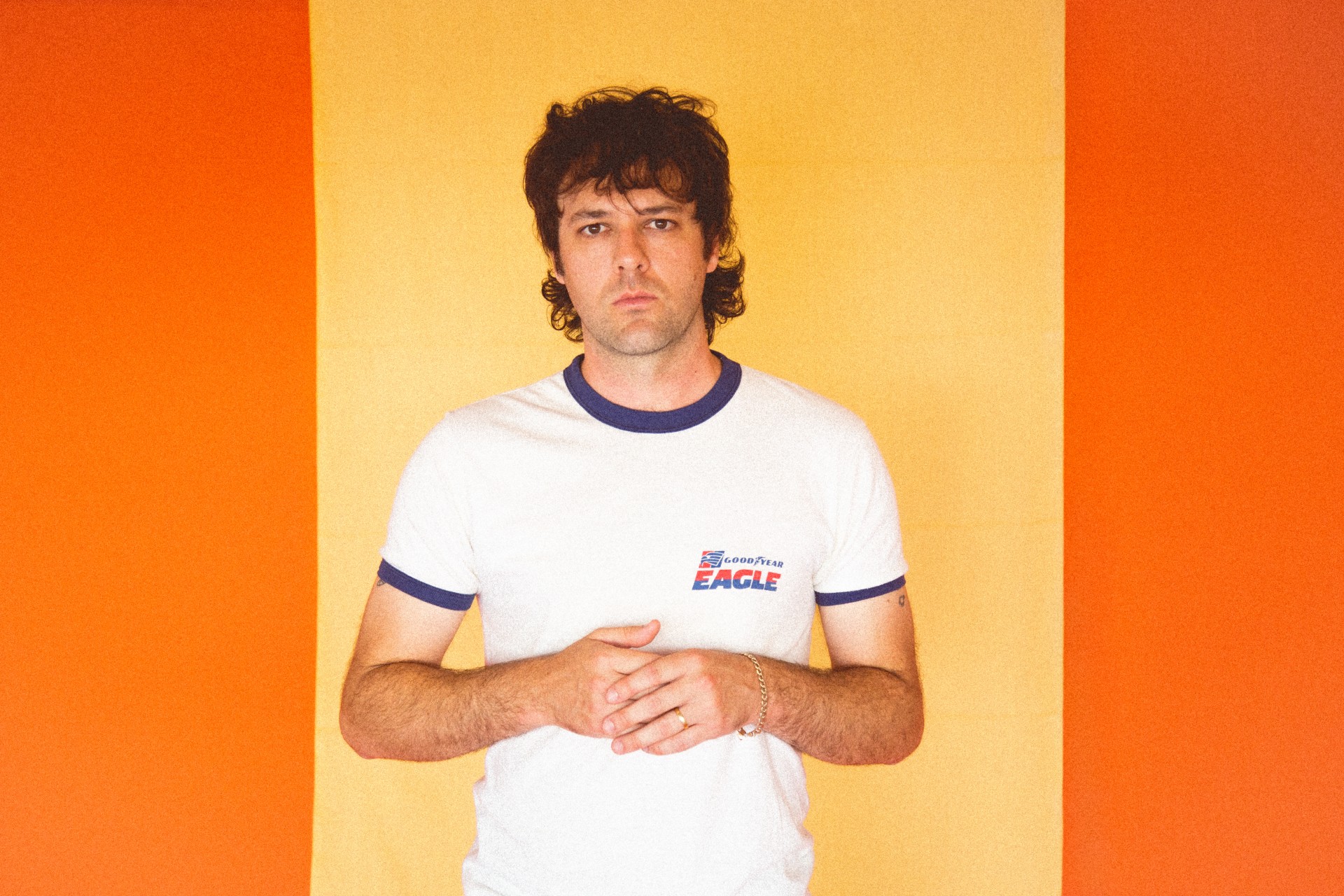
You might know Michael “CAVS” Cavanaugh from his day job, drumming for King Gizzard & the Lizard Wizard. But the percussion wiz has just dropped his second solo album, and you could say it’s a “trip” in every sense of the word.
Engaging and lushly arranged, the all-instrumental Sojourn takes listeners on a journey through the river of Cavanaugh’s mind, driven as much by melody as rhythm. Which makes perfect sense until you find out that Cavanaugh doesn’t play a pitched instrument. Exactly what’s going on here?
We talked to Cavanaugh by phone from Down Under. He was jovial and enthusiastic about the new record. We talked about his influences, the state of rock overall, and his background in jazz.
Just don’t call Sojourn a jazz record. This is less a jazz record than a true fusion of styles: elements of jazz and funk sit alongside ‘70s psychedelia, global trance textures reminiscent of Infected Mushroom, and touches of prog and krautrock. As a bonus, bass duties are held down by Joey Walker of Gizz.
How would you contrast Sojourn with your first record? How did your goals change between them?
Well, with CAVS, the first record, my aim from the very start was just to make a record of drums, grooves, layered percussion, and everything. There were so many moments making that record, I was like, “What if I just put a bass line in, you know, just like a moody little synth part or something? And then I just stuck to the concept, which was really hard. Yeah, so that was definitely by far the goal of the first record. And it’s a pretty challenging concept, which was cool. And then with the second record, Sojourn, I was like, “No, I’m just gonna do whatever I want or do whatever comes to mind.” You know, if I have to get players in, I get players in. And then it all just went from there. But yeah, my goal for the second record was to not lock myself into any kind of concept.
It’s been said elsewhere that on Sojourn, you’re not overplaying, you’re not doing anything fancy at all. You’re just building a vibe. Would you say that’s in contrast to many classic fusion records?
Yes and no. It’s interesting because, in terms of drumming, you can listen to some of those old Harvey Mason records and stuff. And, those guys could play, but when they did their solo stuff, they didn’t go overboard or anything. They’re just laying down a groove. And, you know, then some of the other players that are playing on his record, you know, whether it be the guitar or horns or something, they’re getting pretty freaky. I’m not saying that I’m virtuosic or anything like that. I’m just thinking in terms of listening. I really don’t want to hear, like, just fancy stuff all the time. I say that, but then I also love King Crimson and ‘80s Crimson and stuff, and Can is my favorite band. So I’m influenced by them pretty heavily. There’s nothing sort of complicated going on there. It’s all just sort of scrap rock stuff, you know, but it’s just so much texture and music.
You’ve said that there’s actually a narrative story to the record. Obviously, that’s not going to come through literally, given that it’s an instrumental album. But you said there’s some Indiana Jones elements, which fit the vibe perfectly. Can you tell me a little bit about the story and kind of how it played into the making of the record?
The story is sort of still in my head. I want to eventually get it down on paper. The story idea didn’t come until after we had finished tracking and everything. We were editing, arranging, and mixing. And it was just starting to become this sort of journey. And we both sort of pictured being lost on a tropical island and, you know, lots of mythical temples and creatures and just sort of running from them and stuff. Some of the track titles, like “Victoria Amazonica,” the first track, that’s a giant water lily. We pictured this traveler, this kind of voyager. He’s on a river or something, and he’s on a giant water lily, and that’s his boat. And he’s floating down the river, and it’s the Emerald Isle, which is what early explorers would call the Amazon River. That’s sort of why I wrote the second track. And yeah, and then the third track. You know where I’m going? All the track titles, and like the journey, sort of have their own little pockets throughout this.
Was it helpful having Joey Walker around? You guys obviously have a long-term relationship and ways of communicating. Tell me a little bit about your working relationship and the solo record.
It was pretty much the same as with Gizz. It was more about getting him to play my ideas. Whereas I guess in Gizz I’m playing to his ideas or to Stu’s ideas or something (laughs). A lot of the players had their own ideas, which was awesome. But yeah, having Joey there was really good. We tracked the drums first, then Joey came in and knocked out all the bass in a day. So he’s very quick, which I like. And it was also still ultra-creative. The other players I hadn’t worked with before, but they were all so good, you know.
Tell me a little bit about the creative process. You did all the percussion stuff, but you don’t play a pitched instrument. So you did some sampling and other things, and had the other players sort of overdub on it. Is that right?
Yeah, kind of! I made demos using samples, you know, basslines from some old hip hop records. And some jazz samples and stuff like that. Basically, just to build a vibe. And so I knew kind of what key I wanted the songs in. I built a vibe, and then I played drums to these demos. We recorded the drums for these demos, to this vibe that I had. And it wasn’t sort of anything yet. I just tracked the drums to these demos. And then each day a different player would come in, a different instrument, and we would just sort of build from there. And I’d get the players to play the sample I had or, you know, their take on it in my demo. And then I’d get them to do a take of where they just improvised. And there was a lot of chopping, editing, and arranging.
As far as the samples go, do you think that listeners would be able to go through and say, “That’s the bassline from ‘Gin and Juice’ or whatever?” Or is it so far gone from the samples and things that it’s just—
Nah, it’s pretty far gone from the samples. It all just changed. There might be little moments.
You painted over it, so to speak.
Exactly, yeah. The samples were just there to guide me through building these vibes.
You became interested in jazz as a youngster, but it felt beyond you then. At some point, it seems like you must have lost the hesitation. You’ve put out a couple of jazz fusion records. What happened?
Nah, I guess I just started listening to it more and realizing that you can kind of have your own kind of take on it. I wouldn’t call it jazz, but it definitely has a jazzy feel. You get intimidated by jazz players. I’m just like a rock and roll drummer. I think Flea has talked about this before, in a few interviews, about how he’s always been intimidated by jazz but has always just loved it. And he’s never really been comfortable playing it because he feels like he’s too shit. You don’t have to hit a jazz vibe as deeply as what those crazy jazz musicians do. And Gizz has done that with some really jazzy chord progressions and stuff like that. But in terms of the drumming, I haven’t done anything too traditional jazz drumming.
We’re at the end, unfortunately, of the classic rock era. In 10 to 15 years, all of our classic favorites will either have died or retired. What do you think the music business looks like in 15 years? Is it bigger bands still in big venues? Is it a lot of small bands? Put on your prediction hat. What are we going to see?
I think there will always be rock, garage rock, and punk rock. You look at Amyl and the Sniffers and Geese. These young bands just bring it back every so often. It gives everyone hope. I can’t see that going away. It’s going to be tough. I think that’s just always going to exist. Maybe that’s just me being hopeful.
It’s like with metal and hardcore music. The fandom, they’re just so dedicated to that style of music. I feel like that exists in garage rock and pop rock, especially here in Australia. Pop rock is just making a big comeback as well. I’m being hopeful, but I can’t see it ever fully dying.
That’s a reasonable take. As much as there has been a lot of good music in the past, there were commercial restrictions. Think about the ‘80s, for example. You had to have the ballad on the record. “How can we get radio play and commercial success?” I feel like the lack of options for some of that has actually improved creativity. “Well, this ain’t going to be a hit anyway. Who gives a shit? Let’s just make it as good as we can for us and the fans.”
Exactly, man. And that’s what Gizz does. We make whatever we want, whenever we feel like it.
Comments
Loading comments...
Leave a Comment