
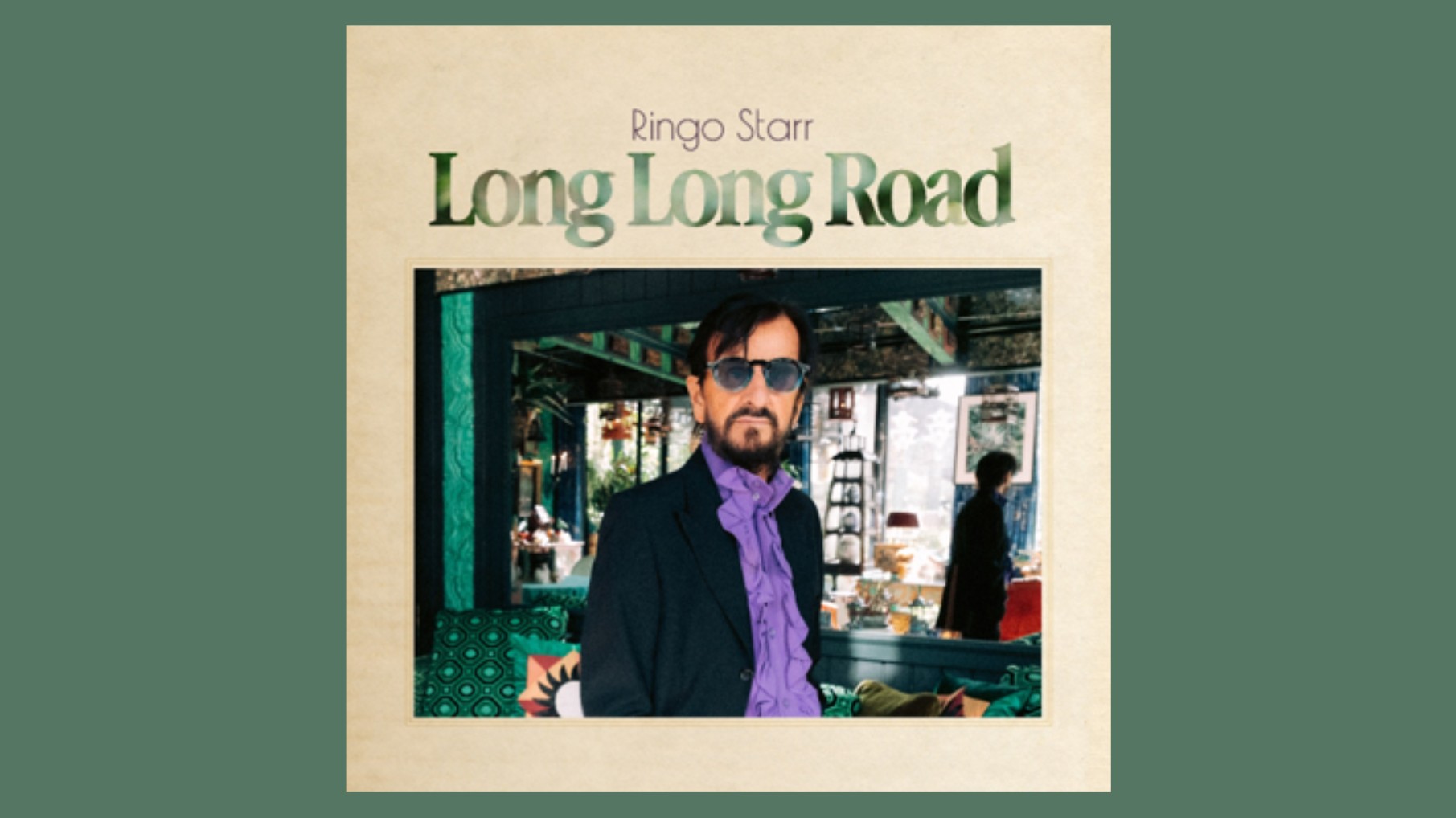
Ringo Starr approaches his 86th birthday in July indisputably at the top of his game. Underrated as a musician whose vocal expression, like his drumming, has always catered to the direct rather than the expansive, Starr nevertheless has been recording reliably and touring steadily ever since reigniting his career in the late 1980s. In 2025, he turned to country music on Look Up, a collaboration with the venerable producer and songwriter T Bone Burnett. The pair created an album as sparkling and seemingly effortless as anything Starr has ever done, with the possible exception now of his new release, Long Long Road.
Similar in appeal but more diverse in tone, Long Long Road builds on the sound Starr and Burnett created in 2025, taking distinct yet judicious steps outside the box. One of Burnett’s strategies as a producer is to amplify the artist’s personality through some contrasting element. His foil on Look Up existed mostly in the musical contributions of Billy Strings and Molly Tuttle, two of Nashville’s outstanding young acoustic musicians.
They return, along with many of the other musicians who Burnett calls The Texans, to make pitch-perfect contributions yet again. Tuttle and Strings are both given solo space on the stomping delight “Why,” as well as other songs. But their harmony vocals are just as striking. Their light timbres slide in above or below Starr’s rich, rounded voice, which has hardly diminished with age. A bare quaver and a patch of rough grit here and there are the only signs you’re listening to an octogenarian. The grit actually gives Starr’s voice some character, especially alongside Tuttle on the heartbreaker “She’s Gone” or the sublime duet “You and I (Wave of Love).”
Other Texans make indelible contributions, like multi-instrumentalist David Mansfield intensifying the atmosphere on strings, Colin Linden growling into lead spots on slide guitar, Paul Franklin soaring on pedal steel, and Dennis Crouch holding songs to the ground on stand-up bass.
One of the Texans who stand out on Long Long Road is multi-instrumentalist Rory Hoffman and his crypto-clav. A crypto clav sounds like the genetically altered offspring of an autoharp and an accordion and looks like the hammered dulcimer. With it, Hoffman steps into the role of an MVP, bridging the distance between ‘60s psychedelia and the Nashville sound, which was the dominant country sound during the same era. Hoffman’s odd, chromatic melodies, as on the driving tremolo groove of “It’s Been Too Long,” are sometimes given additional color with string or keyboard arrangements from Patrick Warren.
It’s unclear what muse drew Burnett to Hoffman, but it looks weirder on paper than it sounds on the record. From the clarity of Tuttle’s acoustic guitar on the opening song, “Returning Without Tears,” to the closing title track, Long Long Road is imminently relatable, and so much of that has to do with Starr’s voice. Once again, on paper, a Liverpudlian country singer doesn’t work. But Starr fundamentally owns the effervescent smile that the old country singers used to put into their voices. Their articulation, drawl, and tone bubbled up with it. It doesn’t matter if Starr’s accent is still just this side of cartoonish. He’s a natural-born country singer.
In the same way that the curling snaps of his snare dominate the groove of every number, his voice is so persuasive that he makes material his own that clearly is not. He only co-wrote a handful of songs. Most of the rest were written or co-written by Burnett for Starr to sing. Lines like “I have seen the dark machine confuse you” ought to sound odd riding on Starr’s easy-going voice, but he is, if nothing else, the great normalizer. To Burnett’s credit, he may be the first producer to show just how many contrastive elements Starr’s voice can smooth over. He probably could have added a choir of Peruvian pipe players and gotten away with it.As the title suggests, age and perseverance linger in the subtext of Long Long Road. Starr’s Beatles references in “Choose Love” may be a tad on the nose, but that’s forgivable. For over two decades, fans have watched the last two Beatles age and, for the most part, not chafe at becoming pop culture’s grandfathers. The title track reminds listeners that the road was not always easy, that there is joy in persevering ‘[t]hru thick and thin,’ but a delicate, tangible sorrow knowing that one day the road will end.
Comments
Loading comments...
Leave a Comment