
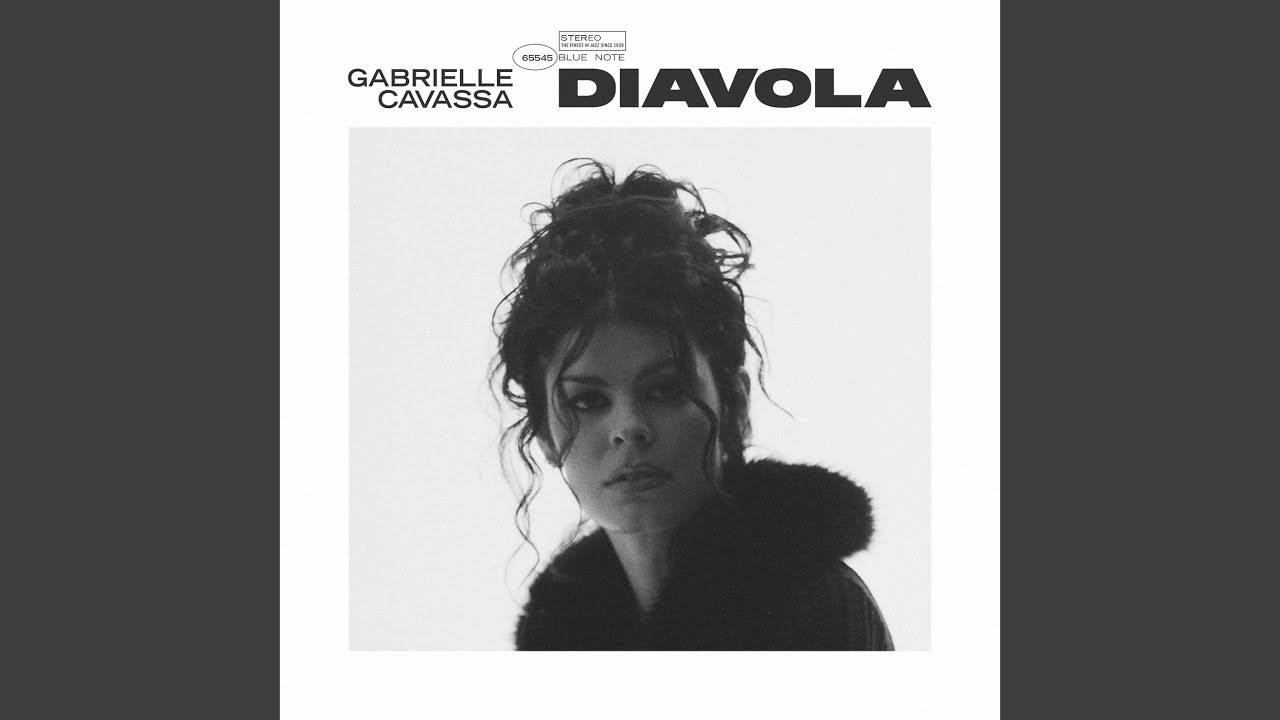
If you are an ardent follower of Blue Note, you’ll recognize New Orleans-based vocalist Gabrielle Cavassa from Joshua Redman’s 2023 where are we, his first vocal album. She is not your typical jazz vocalist who swings and takes the stage with a commanding voice. She is intimate, subtle, and one who inhabits each lyric of the song as if it belongs to her. One of the better descriptions is from Blue Note President Don Was, who co-produced her Blue Note debut, Diavola, along with Redman. Cavassa’s singing was described as “akin to having her whisper secrets in your ear.”
Before her stint with Redman, she released her eponymous debut, produced by Jamison Ross, in 2020. A year later, she won the prestigious International Sarah Vaughan Jazz Vocal Competition, likely because her approach, riveting in its storytelling delivery, is so different from most female singers. She also has superb clarity in her articulation and a natural, unforced, spellbinding quality that draws the listener in, a balance of tender and quiet intensity.
Cavassa presents a collection of original songs and stunning interpretations backed by a luminous supporting cast that includes Redman, guitarist Jeff Parker, pianist Paul Cornish, bassist Larry Grenadier, and drummer Brian Blade. The central theme of the album is the coexistence of the angel and the devil, a dualism of possession and surrender, neither of which Cavassa is willing to let go.
Diavola opens with a brief instrumental, “Heaven Sighs,” written by Parker and featuring his resonant guitar tones. Cassava then transforms the Bacharach/David mega hit “Raindrops Keep Falling On My Head” into a practically unrecognizable version, with the relaxed, slower-than-molasses tempo, helmed by Blade’s unhurried groove and accented by Cassava’s wringing out the essence of each lyric, supported by Reddman’s tenor. She then nods to tradition by delivering a slow and steady, only slightly swinging version of Billy Eckstine’s “Prisoner of Love.” She elongates each lyric and approaches the dynamics with a studied approach. Cassava presents her original, the nostalgic and dreamy “Bossy Nova,” encapsulating the vibe of Italy’s southern coast with Brazilian syncopation, as she plays rhythm guitar behind Parker’s shimmering lead and solo.
The dreamy mood of the record shifts slightly with “To Say Goodbye.” Parker and Cavassa begin in an understated rubato before Grenadier weighs in with an emphatic pizzicato solo that reflects the anguish of Cavassa’s vocal line, one win whichshe demonstrates impressive vocal range. She then renders Luigi Tenco’s “Angelo” before the first side concludes, delivering it in its original Italian, as Grendadier this time marries his tearful arco solo with Cavassa’s mourning vocal. She pairs this with Luigi’s “Diavola,” singing in English but also in a lamenting style. Grenadier walks a stalking bass line over a droning undercurrent while Cornish adds tinkering fills. Though one might associate “Angelo” with “Angel,” that character is darker and more abusive. In “Diavola,” the character is so obsequiously sweet that the other half breaks off the relationship. So, the tension in the music reflects the two flawed characters.
In fact, rather than position them back to back, Cassava inserts Brodsky and Cahn’s “Be My Love,” where Parker lays down a droning guitar tone, over which Cavassa emotes her signature vulnerability ever so patiently. Few albums of this caliber would feature a Barry Manilow tune, but that just exemplifies Cavassa’s penchant for pop and other genres. Again, the sentimental love ballad is understated in her delivery, buoyed by Cornish’s shimmering piano and Redman’s declarative solo. Honoring her Italian heritage, Cassava closes with “La notte dell’ addio,” co-written by four Italian writers, and rendered as a duet with Cornish. Cassava says, “This is a gentle mourning. It’s a gentle kind of hope and acknowledgment of grief or what we’ve been through.” That statement could well apply to other tracks on this album, too. Cavassa’s approach is often dark and deep, proffering a rare intimacy.
Comments
Loading comments...
Leave a Comment