
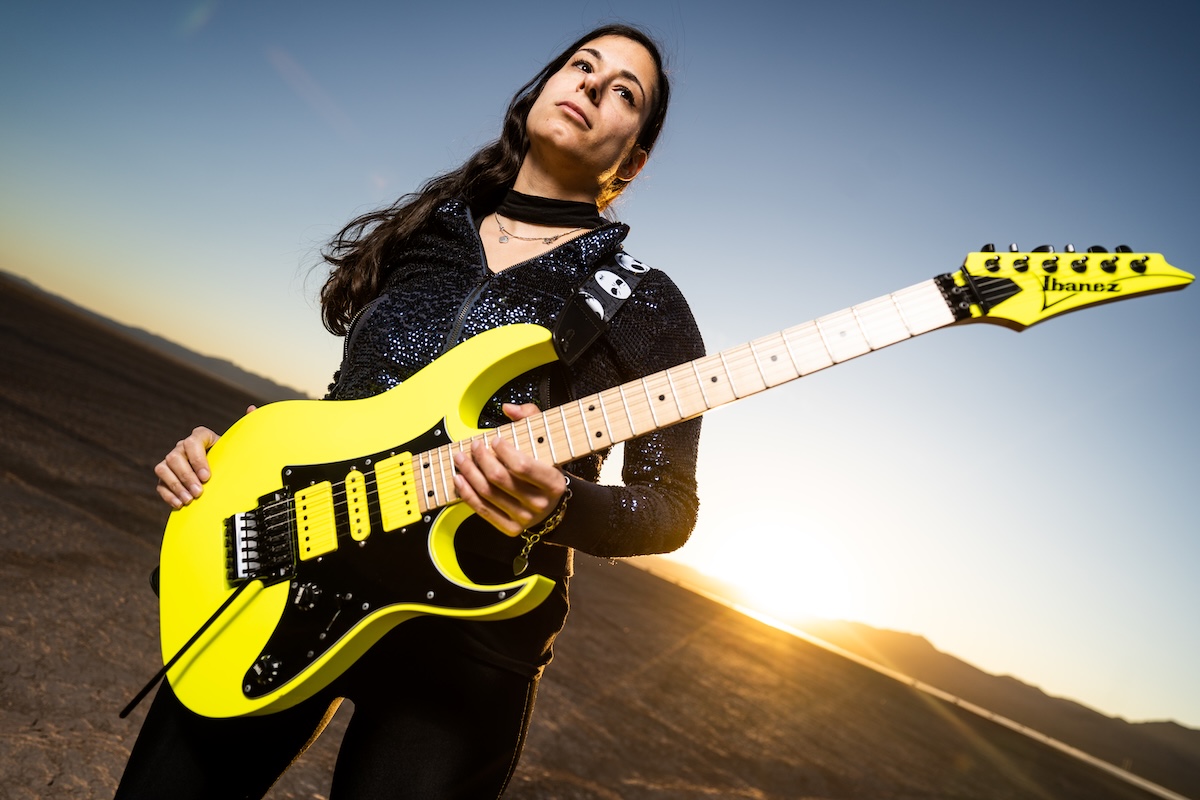
Guitarist and instrumentalist Nili Brosh released her fourth studio album, Eventide, in March, her first in several years. It built on the work of a few singles and videos she’s released in recent years, but added many new tracks and introduced broader musical experimentation to her sound, namely synths. Previously released songs were also remixed and remastered to bring them more fully into the album’s sound world, creating a cohesive instrumental experience for audiences.
For the album, Brosh also tapped a number of friends and bandmates to perform, drawn from her work with Dethklok, Danny Elfman’s band, and more. A few of those include Brendon Small (creator of Metalocalypse and singer/guitarist of Dethklok) and bassist Pete Griffin (Dethklok), engineer Shachar Boussani and Sidney Hopson (percussion) from Danny Elfman’s band, and even Ilan Rubin (Foo Fighters, Nine Inch Nails). The wide-ranging sense of sonic freedom on the album is a welcome offering from Brosh, with layering that adds to the atmosphere and mood. I spoke with Nili Brosh, while she was out on tour with Dethklok, about bringing the elements of Eventide together into a satisfying full picture.
We spoke a few years ago about your original music, and it’s great to see how full this new album is, with so many pieces that you’ve been able to develop. When did you start to see how the songs fit together as a group?
It kind of all gradually came together, with some stuff already in the bag and other things as ideas I had as voice memos filling my phone. I was keeping some kind of loose ideas in the back of my head about what was coming together. During another Dethklok tour in 2023, I had a lot of time to demo some ideas during the tour, because there’s quite a lot of downtime during those tours. So I took a lot of those voice memos and put them together, and it started looking more and more like a list of tracks that might go together on one album.
Do you think that anything else that’s been going on in your life has influenced the sounds that you chose to explore here? I see some development in directions.
Nothing necessarily in particular, it’s just a sonic direction that I’ve wanted to play around with for a while. I just naturally went there, and it was the right time to experiment. I do feel that the work I do as a sidewoman, all those sets of music I get into and play every night, that stuff gets in there and goes back into my music through it. I try not to question it too much; it just kind of naturally happens. I don’t know what comes from where; it just all kind of goes through you and back into your music. Whatever little things I’ve taken from other projects, unbeknownst to me, are what end up there.
One thing I feel when I listen to this collection is that there is more development in terms of layers, little extras, and elements that create atmosphere. It’s perhaps more compositionally full.
Yes, the songs are definitely the most important thing to me, so I try to get it from the compositional side first, and then the rest is secondary.
You have a lot of people collaborating on this album, from track to track. Did that just come up, according to what was happening in your life at the time, or was there more of a master plan of who you wanted to work on different things with?
Somewhere in the middle, I guess. I always try to ask what the song wants me to do and where that’s going to end up. That does depend on people’s availability and willingness to do it, but I’m definitely fortunate to have a lot of friends and bandmates who were down to do it. Everybody wants to work with their friends, so why not? I was fortunate to have a good group of people to draw from.
In a way, it’s simpler when people all go into a studio together to record, but were these songs done separately, with individual collaborations?
Yes, people did their parts separately. That’s mostly how I’ve always had to do my own records. I’ve demoed out the songs to the best of my ability, and whoever is going to play on them, I send out the demos, they record their parts, and send them back, and we kind of piece it together over time. It morphs into a new version of the song that way.
I imagine when you do things that way, just like when you’re in a studio together, things can happen that surprise you. Did you get back things that gave you hints that changed the song a bit?
That’s part of the point, for sure. The whole point of having people you like as musicians is to get their voice on it. What they would do. What they would offer. I already know what my idea was. Sometimes it gives me ideas to change things. It’s a way of collaborating back-and-forth that’s not really in real time. Sometimes you’re confident about what needs to go in certain places, and you want to build around it. It’s a case-by-case basis with music, always.
Is it trickier to ask people to do another take if you’re not in the same room with them?
Not necessarily. Everyone works differently. Some people will give you different choices and ask you to pick one direction. Sometimes you work on something together, then decide on a game plan. Or you just get a few options to edit from. Everybody’s a little bit different. I think, generally, when you go into the studio as a hired gun on somebody else’s project, you want to give whoever hired you what they are looking for. Most people are not stingy about that.
I notice that color plays a big role in the album, both on the album cover and in the music video for “Pastel Dreams.” How did that come about?
I’ve always had some relationship with colors and pitches, and key areas of how things sound, but I never really explored it. It’s just something that I’ve noticed. I don’t know if I have pure synaesthesia, or something like that, but I have some sort of relationship with it. I wanted that to really be conveyed on this album because of the sounds on it. I figured if I had an opportunity to do certain visual things, I could make that a running theme. So when you have cover art and videos, it’s an opportunity to show that side of it, what it sometimes looks like for me. I feel that we captured that pretty well, so I’m happy with it.
That’s particularly cool because, of course, this is instrumental music, and a lot of times, audiences rely on vocals for the themes of the album, so then the color world can become another aspect of that identity for the album. I remember the music video for “Lavender Mountains” has a lot to do with changing light. With the video for “Pastel Dreams”, you have the colors alternating, almost like in a dance club.
My director and I, Alec Clawson of Anomaly Film, worked on that together, and we played around with some ideas. We looked at what looked good in the studio that day, and ended up with that version.
I realize that you must have to think about color and presentation because you are someone who may appear in costumes to perform.
Sometimes, but not all the time! I like it. It’s another fun thing to play around with.
I saw a mention that you had more involvement with production on this album than in the past. What did that mean for you?
On this album, for some of the tracks that don’t have a real drummer on them, I did the drum programming, and some of the synths as well. For some of the synths, we had them replayed by Nick Semrad to give them the real touch. But I kind of built those more synthwave arrangements from the ground up, and didn’t have someone else rebuild them. So that’s my voice, kind of, on all the instrumentation on those tracks.
Wow! That’s amazing. The synths do have a lot to do with the atmospheric layers on the album, and it’s so cool that you created those parts. Do you think that you’d do that more in the future, now that you’ve done it this time around?
It’s always going to come down to the song and what the direction is, but I definitely enjoyed it, and was happy with the result, so it’s definitely something I’d be more open to continuing doing more myself.
I’ve always been fairly involved in Production, but I usually have a co-Producer to veto certain things, or take things in a different direction. With this, I just wanted to keep putting my own voice on it. That seemed right for this batch of songs.
The album feels like a full-personality statement, like the vision of a single person.
I’m glad it feels that way. Thank you.
By the way, about the video for “Pastel Dreams”, I’m really glad that it’s a performance video. We all see plenty of performance videos, but I think it’s easy to forget just how cool it is that guitars are played in this way, and this is what they do. It really spotlights the guitar’s ability to deliver a live performance that focuses on this approach.
Right, yes! I appreciate that, thanks. I’m glad.
With the song “Take You On”, I found the pace and the dramatic through-line surprising. I appreciated that as a faster interlude on the album.
To me, it seemed like a Synthwave Metal tune that’s like, “What if Racer X had been an instrumental band with synths?” That’s how I always think about that tune. It’s fast Metal, but it’s redone to make an electronic statement.
I think it’s cool that there’s so much background and texture on that song, rather than keeping it more barebones.
That was kind of my point: going for a more synthy, layered sound and trying to find space for all those things.
Do you think you associate a visual element with these songs when you’re writing them, or listening back to them? Some instrumental Rock bands I know of, for instance, think cinematically.
There’s some extent to the visual aspect. I don’t know that it’s always fully fleshed out visuals or movies, but there are definitely cinematic directions. And places where I think a certain tune of mine might fit visuals. I don’t know that I think in fully visual, movie terms in my mind that way, I just see a lot of places where I think my music could fit.
The song “Eventide” is one of the newer songs, and it really has its own personality to me, because of the heavier, deeper tone that comes in. It contrasts with the higher elements in the song. It feels more like a full orchestra in the song, with a sense of expansiveness.
I never thought about it like that. It was a melody I really liked, and I was hoping to dress it up appropriately with the arrangement around it. If it comes across that way, as a more fully orchestrated thing, that’s good! Maybe I did my job with that one. It is one of my favorites on the record. It’s the title track, obviously. I do think of it as some kind of blueprint of the vibe for that album. That was the reason for trying to go all out with it.
If you’re creating a kind of world for the album, that one is a great foundation.
That was the intention, so I’m glad that it comes across that way.
For the songs that got remixed and remastered, what were your goals there?
Honestly, I was trying to change them as much as possible, reworking them to be more in line with the album’s running themes, sound, and uniformity. They weren’t really changed very much, especially compositionally. We did a little bit of work on “Estranged”, but it was mainly remastering for the album.
Comments
Loading comments...
Leave a Comment