
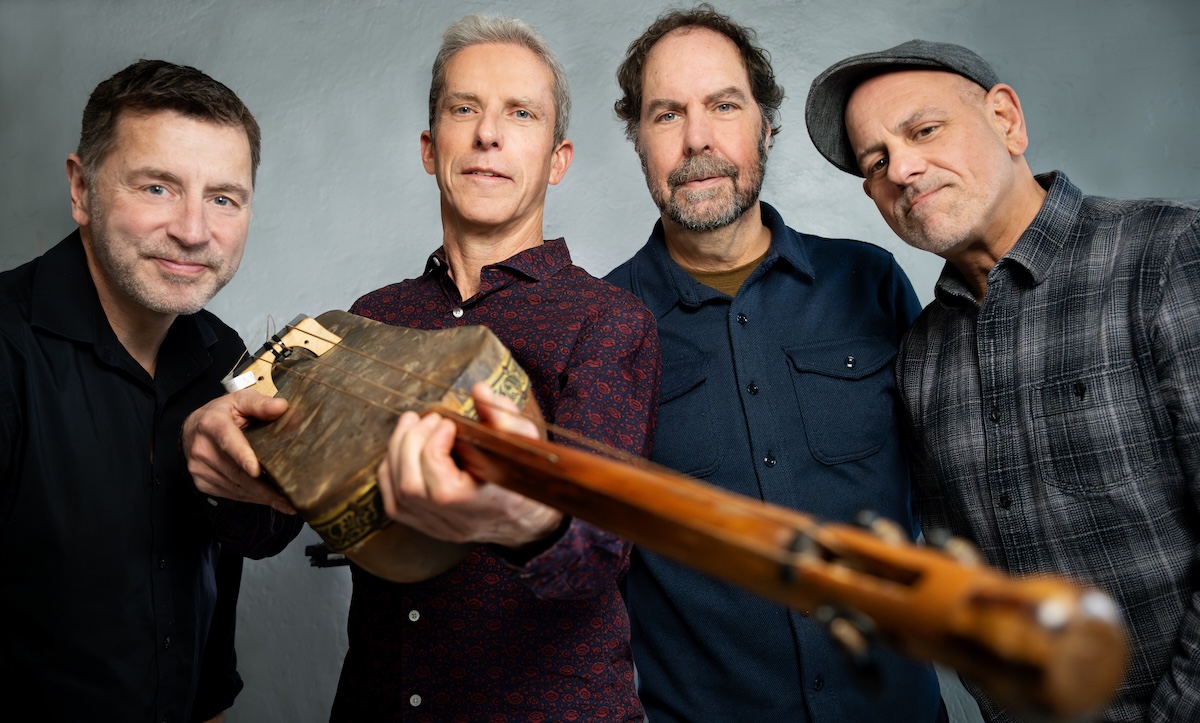
What begins as a groove in Club d’Elf’s world often becomes a doorway into someplace older, stranger and unshackled by time. The band has spent twenty seven years helping audiences lose track of time with its shape-shifting fusion of Moroccan trance, dub, electronica, jazz and improvised funk. Built around bassist and composer Mike Rivard, each performance features a rotating cast drawn from Boston, New York and beyond, creating a constantly shifting ecosystem where trance forms the central core of the band’s aesthetic. Under longtime member and Casablanca native Brahim Fribgane, the group absorbed Moroccan trance music deeply into its DNA. Fribgane passed away in early 2024, but his spirit remains embedded in the band’s sound, especially through Rivard’s commanding sintir work, learned under the guidance of Fribgane and Gnawa masters Hassan Hakmoun and Mahmoud Guinia.
Their new album, Loon and Thrush, which arrived April 10th, was recorded entirely live in the studio with minimal overdubs, channels that lineage into a raw, improvisatory flight. While largely built on Rivard originals, the album continues the band’s tradition of honoring key influences, offering Moroccan-infused takes on Grateful Dead classics “Bird Song” and “New Speedway Boogie.” The overarching theme of the record is “flight” itself — the avian imagery of the title track, the Dead’s celestial wanderings, and the enduring presence of Fribgane, whose spirit continues to guide the music from beyond.
Today, Glide is offering an exclusive premiere of the video for the standout tune “Atlas Mountain Hop.” The track unfurls less like a traditional composition and more like a slow-burning ritual—part dub séance, part desert caravan groove—where time stretches and contracts under the weight of its own hypnotic pulse. Built on a thick, elastic bassline and percussion that feels both earthy and otherworldly, “Atlas Mountain Hop” channels North African textures. The band leans into its improvisational DNA, letting the groove breathe and expand. Guitars shimmer and bend at the edges, keys drift in like heat waves off sand, and subtle electronic accents flicker through the mix like distant lights on a horizon. The band skillfully fuses North African influences, jazz, trip-hop, electronica, and global rhythms into something that feels both ancient and futuristic. The animated video offers a pleasant complement to this rich musical excursion.
Frontman/bassist Mike Rivard describes the inspiration behind the tune and video:
Brahim Fribgane first turned me on to the music of the Rwais – Amazigh musicians who come from the High Atlas mountains. The Amazigh are the indigenous, pre-Arabic inhabitants of North Africa, translating to “free people” “noble” or “free-born”. Like many, I had referred to them as “Berbers” but this term is largely rejected due to its colonial origins. Rwais are wandering poets who sing about current events much like the griot of West Africa. They accompany themselves on lotar – a banjo with a goat skin top – and rebab, a one-string violin. The rebab has a mesmerizing sound, almost like a human voice crossed with a flute. I was able to acquire one from my friend Abder who got me my first sintir, and took a lesson with the great Amazigh musician Fattah Abdou. It’s really tough to get a good sound out of it, and it will be a while before I’ll be bringing it on a gig!
I found a video of two Rwais that really struck me, and I transcribed a section of the long, traditional melody they played, which became the basis for this song. I wrote some additional parts, and in the studio Paul Schultheis came up with a mellotron part that links it to the early UK prog-rock of King Crimson, and a Rhodes part that reharmonizes the melody in a very cool way. The melody is pretty tricky to play, and on the recording is played by myself on bass and Randy Roos on guitar playing it in unison as well as harmonized. The working title had always been “Rwais” but for the album I renamed it, and it became a homage to Led Zeppelin (who have a history of playing with Moroccan musicians) as well as the Rwais themselves.
While it’s the most Moroccan-forward song on the album, the overall vibe is trippy, alternating a lush, dream-like quality with some heavier, North African prog-rock during the unison melody sections. The track also features drummer Dean Johnston, Matt Kilmer on percussion, Mister Rourke on turntables, and Lyle Brewer playing not one but two guitar solos.
I had worked with Matthew Watkins on a couple of animation videos for our last album and loved what he came up with, and asked him to create something for this song as well. He directed a team of five animators and ran (or flew) with the overarching theme of the album, which is flight.
WATCH:
Comments
Loading comments...
Leave a Comment