
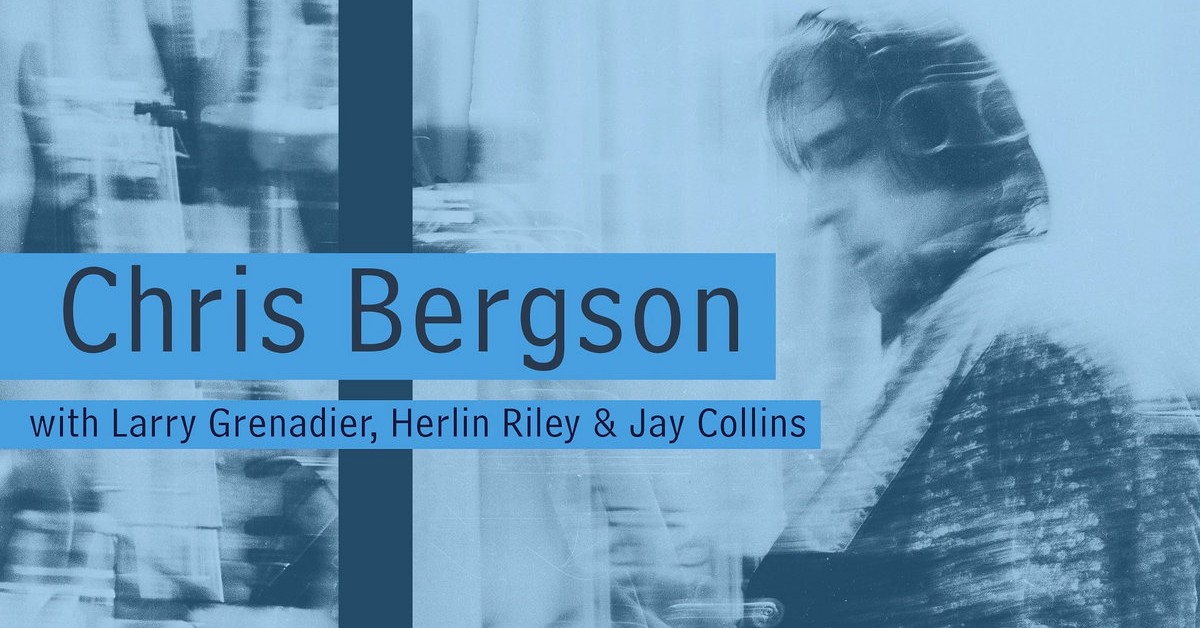
Past albums from New York-based guitarist and singer-songwriter Chris Bergson have often straddled the line between blues and soul, especially those with vocalist Ellis Hicks. Yet, there have also been jazz tracks on his previous albums. After all, Bergson was a student of jazz great guitarist Jim Hall and has consistently expressed an affinity for Grant Green’s soul-jazz. Now, on East River Blues, Bergson collaborates with two of the most sought-after musicians in jazz. They are bassist Larry Grenadier (who has played with the likes of John Scofield, Brad Mehldau, Charles Lloyd, and the recent debut from Gabrielle Cavassa, released just two weeks ago), and drummer Herlin Riley, the premier New Orleans drummer, who has backed such giants as Dr. John, Wynton Marsalis, The Preservation Hall Jazz Band, and is currently a member of the Jazz at Lincoln Center Orchestra. Joining this trio on three tracks is saxophonist Jay Collins, late of Gregg Allman’s and Levon Helm’s bands.
Yet, other than frequent collaborator Collins, it wasn’t so easy putting this trio together. Initially, Bergson wanted to pair Grenadier with drummer Al Foster, but had to scramble upon Foster’s passing in late May of 2024. Serendipity intervened. Three months after Bergson had reached out to Riley, it just so happened that Grenadier and Riley were playing in Connecticut the night before the recording session, and could make the session in the Catskills.
Bergson, who currently teaches guitar at Berkeley, unveils an array of guitars for this highly traditional session that mixes originals with covers, all rendered in unadorned ‘old school’ fashion. Bergson begins by deftly fingerpicking his way through Muddy Waters’ “Mean Disposition,” bending the strings in a way that evokes Muddy’s signature slide attack. He sings with feeling, crediting the late Foster, who was the first to encourage the then-only guitarist to sing some twenty-plus years ago. The vocals here match the flat-out emotion of his guitar lines.
On Rodgers and Hart’s “Little Girl Blue,” Bergson shifts to one of the most favored blues axes, the Gibson ES 335, beginning with an unaccompanied intro. Rendered as a stripped-down slow blues, Bergson channels a Ray Charles-like approach to the tune while the bass-drum tandem delivers simpatico, subtle support, giving the expressive guitar center stage. The presence of Grenadier and Riley looms much larger on the boogaloo original title track, as they set an unshakable groove for the guitar and Collins’ tenor, in the first of his three appearances. The tone evokes the joyous Blue Note soul-jazz of Lou Donaldson, Grant Green, and Stanley Turrentine, among others.
“Sad Strains,” composed during Berson’s college years, is a jazz waltz that honors his dad. Here, one can clearly hear Jim Hall’s influence on Bergson’s highly lyrical guitar stylings. Riley stays busy with somehow being unobtrusive on the drum kit while Grenadier steps in for a monstrous solo on his double bass. Riley again proves his mettle on the blues shuffle “Kindless Villain,” co-written with Bergson’s wife, Kate Ross. It’s a slice of Chicago blues with utmost guitar clarity, done New York style.
Having previously mentioned Ray Charles, we’re blessed with a Brother Ray tune in “What Would I Do Without You.” Bergson unleashes his vintage Fender Vibrolux and invites Collins back in to contribute soulful lines. Here, as much as on some of the strictly blues fare, Grenadier and Riley exhibit their comfort with the idiom. In yet another nod to early Blue Note 1960”s jazz, the quartet closes with Herbie Hancock’s “Drifin’” from his 1964 Empyrean Isles. Bergson trades licks with Collins, eventually retreating to the head and giving Riley his due on the eighths. The track captures as pure and unadorned an album of classic blues and jazz as has been issued recently.
Plenty of blues guitarists have more notoriety, some of whom are far less skilled players than Bergson, who straddles the lines between blues, jazz, and soul; unfortunately, he remains lower on the radar. East River Blues is a clean exposition of masterful guitar playing. Perhaps it will bring Bergson more deserved recognition.
Comments
Loading comments...
Leave a Comment