
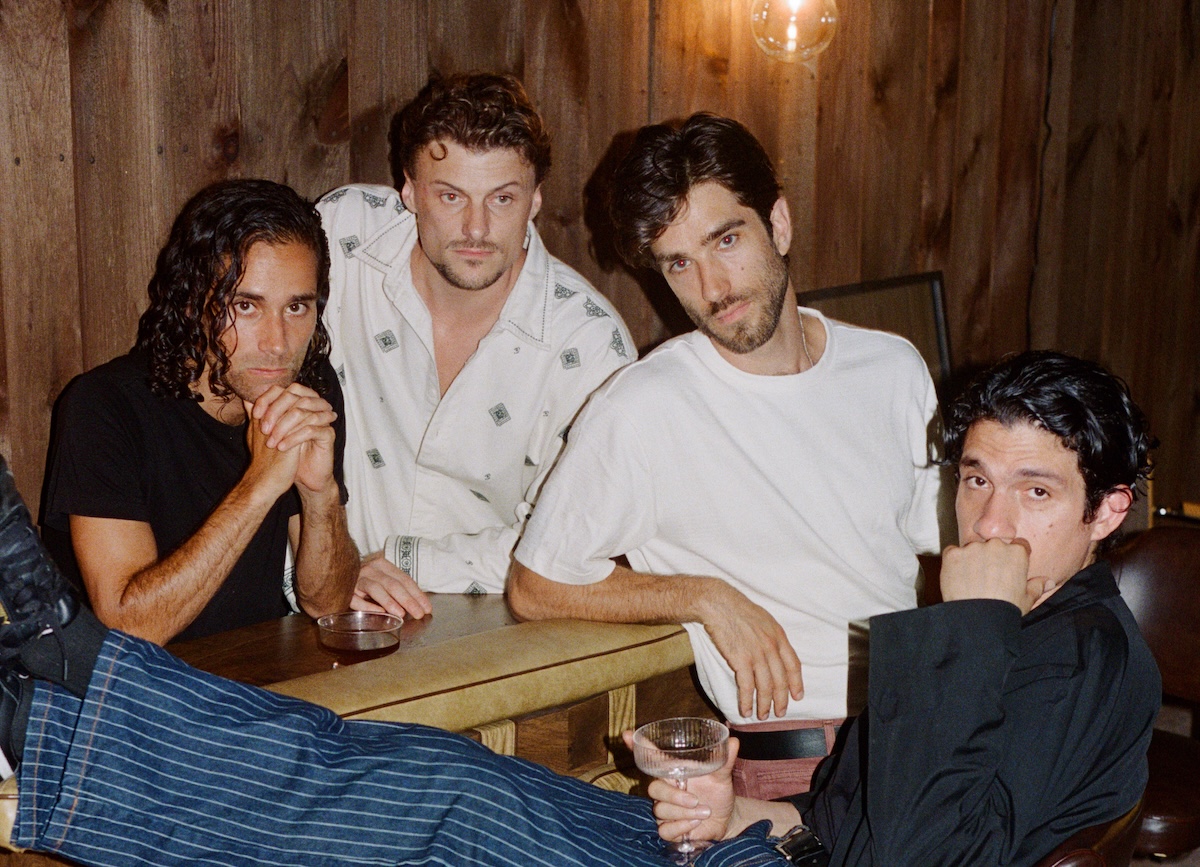
City of the Sun is a Brooklyn-based Latin global groove fusion band that continually stretches into new directions and works mostly with instrumental music. Formed by guitarist John Pita and drummer Zach Para, and also joined by guitarist Marco Bolfelli and bassist Matt Fasano. They’ve just released their latest album, Under The Moon, via Nettwerk, which was recorded in Seattle and produced by Phil Ek (Fleet Foxes, Father John Misty, Built to Spill). With Elk, they were able to stretch their sound further into rock and Americana, while still preserving their core multicultural identity founded on the streets of New York.
Built on close musical communication among the band members, City of the Sun is also a naturally cinematic band that thinks visually and has infused its videos with sweeping vibes, working closely with collaborators. They are particularly interested in desert and open-road imagery and align it with their music, especially with Under The Moon, which already has hints of surf rock and desert rock. I spoke with guitarist John Pita and drummer Zach Para about bringing rock and Americana elements into their fusion sound and how working with Phil Ek contributed to that goal.
How much time has passed since you recorded Under The Moon?
John Pita: About a year and a half.
Zach Para: We’re actually ready to get back in there!
This is not your first rodeo. You’re getting into the rhythm of releasing albums.
John: Back in the day, in the 60s and 70s, they used to do one album a year. That would be good.
I feel like live play is a big part of your lives, and you really want to be with people. Working that into a writing and recording schedule is tricky. Do you have any plans to play this year?
John: Very soon, we’re going to go and play a festival in Mexico, and we’re going to make our Mexico City debut and play our first show there. What’s on the books for the future is that we’re planning our return to Europe in a big way, like we used to pre-COVID. We’ve been to Europe in small pockets since then, but we’ll do a real tour. I think it’s going to be the first time since 2019 that we’re going to do it properly.
I heard that you spent some time in Europe, as a band, when you were first getting started, and that it impacted you. Does spending time in other countries help you find your identity?
John: I think it does, but for me, whatever we end up writing is a force of its own. In general, live experience, when it comes to creativity, has more influence than anything else. Europe definitely is what we look forward to in a live setting. The US is a big pop music-focused world, and Europe is as well, but Europe also loves music that tells a different story, such as instrumental music. That’s very cool for us to go there.
Zach: I feel like when we first went to Europe, it was really validating. It gave the music a lot of meaning because people there are generally passionate about their relationship to art and music. People were really open to sharing about how much our music might have affected their lives. You could just feel it. In the US, there is that passion, but I think people express it differently. It’s not as normal to put your emotions first like that. It’s really validating and reassuring that the music is reaching people on a deeper level. That can happen anywhere.
It seems like Mexico City is a great place for you to play. It’s a natural fit. Also, cities generally have that multicultural side to them. Often, people are looking for a different experience. Do you have that experience in New York, where you’re based?
John: I tell people that I don’t think that we would have been able to do what we do anywhere else in the world than New York, especially when we first started playing. It’s so specific, the way that we were able to busk, and have the audiences walking by when we were busking, being New York-minded. I totally agree with that.
Zach: Harkening back to the international thing, when we are playing around the world, or in Europe, there are still people who come out and say, “I saw you in Central Park ten years ago!” I think New York works because it’s such a multicultural city. Maybe it’s because people are all out on the street.
John: I don’t think that’s always as true now. New York was always expensive, but it is more so now. You can only live in Manhattan if you have a corporate job now. Back when we were younger, busking, there were those people, but there were also people there who were like artists, people who wanted to find that little treasure. They go to plays, or want to find the hidden gem that no one knows about. Sometimes they’d hear us in the street and say, “You won’t believe what I found! Only in New York would you find three guys playing Latin-influences Spanish guitar music rocking out!” People would say, “I have to tell my friends about this!”
I agree about that attitude, it’s like finding a little secret in New York, one to share but only with a few people, so they know how cool it is. But I also see what you mean about changes in New York. The biggest changes I’ve ever seen in New York were after the pandemic and the economic shift. People are being driven much further out if they want to be artists. I’m glad you did that breaking-in period earlier!
John: Totally. People now would be like, “What is this? Where’s the money?”
Tell me about your recording experience for this album. It was a little different, right?
Zach: This was our first release with Nettwerk, and we found a Producer, Phil Ek, out of Seattle. It just made sense for us to record in Seattle. I really liked the setup because the studio felt like a second home for us. We did an intensive period of going there six days a week to bang this out. We did some pre-production stuff in Brooklyn, recording song ideas and maybe doing scratch takes. But we had a couple of weeks at Studio Litho, owned by Stone Gossard of Pearl Jam, and the studio had a lot of history and good juju. It’s kind of like an underground studio, and Stone keeps it accessible for cool projects.
It was nice because we found an Airbnb a block and a half away, so it felt like we were living there.
I’ve spoken with Phil before, and also in Studio Litho. That’s intriguing because I associate him a little more with Indie Rock or Americana vibes. But it makes sense, because I also think of him as being very guitar-focused.
John: The interesting thing about that is that this is the most Rock, Americana-driven album that we’ve had so far. When we first started writing, one of the things that we wanted to do was channel the nostalgia for American travel and highways, because we tour a lot. There’s that feeling of listening to the Allman Brothers, or Neil Young, or Surf Rock, and driving down the highway. That is all over this album.
If you watch the video for “Metamorphosis”, it’s got acoustic guitar, but also a wailing guitar solo that’s very much like a timeless American desert feeling. We wanted to incorporate a little more of that, whereas our previous albums leaned a little more towards a Spanish, Mediterranean feel. This has that, but a little bit more of the American as well.
I’ve been coming across the phrase “desert Rock” more, and I think people associate it with the sounds you’re talking about. But I do recognize the Surf Rock elements in this album. I heard it a few times. It’s a great fit for you. Was that a conscious decision?
John: I’ve been trying to do Surf Rock with City of the Sun since 2016, but I think I was pushing too hard and getting ahead of myself. Sometimes, with music and creativity, there’s something in the air. I’ve been thinking about Surf Rock for years, but now, ten years later, there are many bands doing Surf Rock. It was in the culture. Musicians wanted to do more of that. A manager told us we should channel The Shadows. It’s been brewing for a while, but it’s fun to finally be doing that.
Zach: Regarding Phil, a lot of people think that he works with more Indie or Americana bands, but what he’s really good at is capturing expansive sound in a way that’s not over-produced, but is just tactile and raw. His knowledge of capturing the guitar in a really nice way made it easy for him to capture things with a lot of breath and atmosphere. Other than that, he didn’t try to change our sound or change our style; he just embraced it. It was a cool process working with him. We worked on getting sounds for the album for a few days before we started working on any songs.
It was kind of like building the tool belt that you’re going to use, and once you’re ready to go, you have all these tools. I had three drum sets that were out, tuned differently, with different dampening, and stuff. So I’d say, “Okay, this song is more like this, let’s use this kit.” That provided a big relief for me, since I wasn’t faced with the situation of playing differently on the same drumset. I would already know that the sound was something that we felt great about, so I could relax, play, and not worry about it. I knew that it was already in the bag.
John: As a musician, whenever we play a song, I picture it sounding the way it sounds as a band. A lot of times, when you start recording, you realize the harsh reality that the music sounds depleted of all its juice and dimension. Because it’s really hard to capture sound the way that you hear with your own ears. But Phil is able to get a lot of substance out of tones and things that we’re playing, and mirror it the way that you imagined it. On other records, we’ve done a lot of overdubbing, and we still did some this year, but not as much. The space makes things sound bigger in terms of what is in there.
Zach: For a lot of the album, it feels like you’re in a room with four guys playing. I feel pretty protective of that element. I think that “realness” is what attracted people to us in the first place.
I know what you mean about the expansiveness on the album. It feels like there’s air around the instruments. When you’re trying to get a desert or an outdoor feel, it’s becoming a little bit of a lost art to preserve that in recording. It almost takes a more analog mind to push back and get that.
Zach: I think that’s exactly it. We ran everything through an analog board while mixing. When we were in the mixing phase, we had to commit. He was there, writing the mix, so he was saying, “I’m printing this.” We couldn’t go back and change it a week later, and I thought that was awesome. It was all supporting that moment in time.
As a sidenote, I’ve seen some of your videos where you’re playing in a room together, not with an audience, but just the two of you. There’s one for “London” where you’re in a very big space, facing each other, and playing. When you record, do you like to play facing each other, too?
Zach: When we did the drums, we were all facing each other.
John: When we recorded the first take with drums, we were all facing each other and isolated. But that’s kind of a coincidence because that video was done by a guy called Jacob Butler, who has a lot of cool ideas. He wanted to get us together in a room and make it as cinematic as possible. He made it look like a live performance in a movie set. He said, “How about we do it live, and in one take, and I just walk around you?” It was an idea he had two days before, and that’s my favorite of the few videos we did with him.
Zach: It works well because that song has a lot of motion, and that video is always moving. It was really cool. The way we record is to get the drums and the bass pretty much finished, but I need the emotional context. It’s not just like putting on a metronome. So when I’m in the studio recording, I like to see everyone and feel everyone’s energy. We intentionally recorded in a way that we were in different parts of the studio, but we were all kind of in the same room and could see each other.
I was a little concerned that some of the guitars might bleed in, but Phil said, “Don’t worry about that. Let’s just get the energy of this. It’s going to be fine. It’s going to feel good.” I was happy about that. It felt more natural. Sometimes when you’re only recording by yourself, it’s like a metronome, and the last thing I want is for it to feel mechanical or robotic.
Comments
Loading comments...
Leave a Comment