
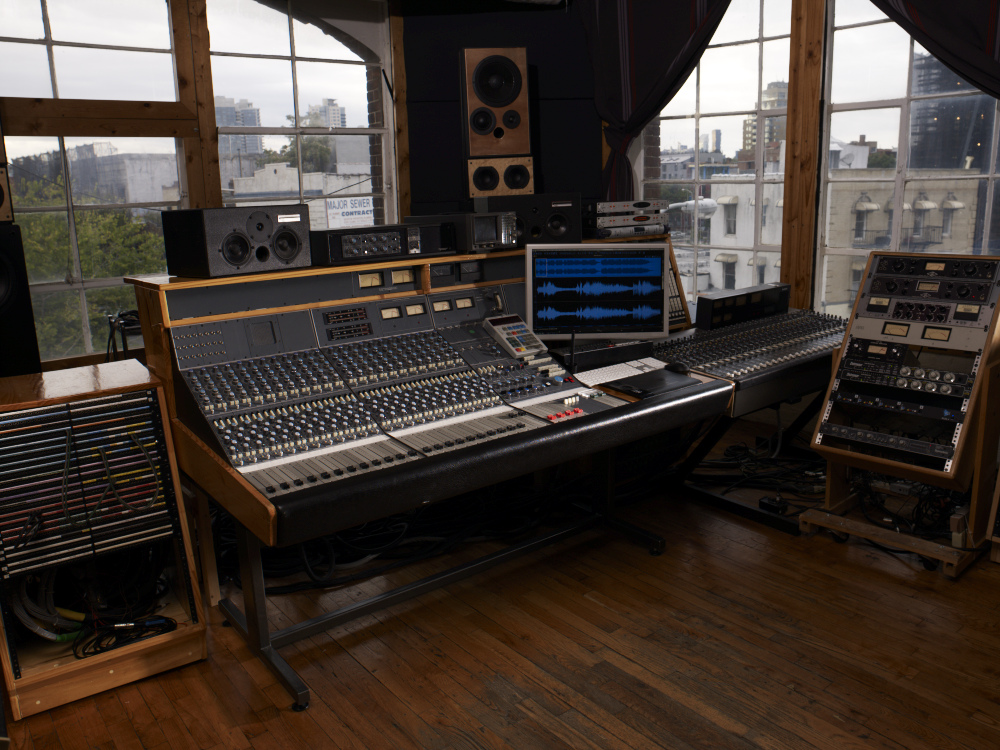
A musician from Ukraine became a senior audio engineer in the U.S. enterprise AV and high-stakes event production industry, delivering mission-critical sound for senior executives at major technology and entertainment companies
AI in music is here to stay. By 2026, AI is embedded in meeting and conferencing workflows: Cisco Webex says its AI Assistant can generate in-meeting summaries, post-meeting summaries, transcripts, and action items, while also supporting call summaries and transcripts. If sound becomes more automated, more data-driven, and more mission-critical, where does the musician go? Do you become an operator who happens to know music, or do you remain a musician who can command technology without being consumed by it?
Ihor Kovalenko, a Ukrainian sound engineer working at AVI-SPL, a global AV integrator and one of the largest AV solutions providers worldwide, offers one working example. He came up through performance and classical training, working as a drummer and saxophonist, and spent years in live and studio environments in Ukraine before transitioning into large-scale corporate audio in the United States. Today, his work spans two demanding areas of the audio field: high-stakes corporate event production and enterprise AV commissioning, where intelligibility and reliability are as important as the sound itself. He is an Associate Member of the Audio Engineering Society and a member of the IEEE, one of the world’s largest engineering and computing associations. He continues to maintain a connection to the creative side of the industry through ongoing collaboration with Seattle producer and studio owner Robert Lang, whose studio credits include sessions connected to Nirvana and the recording of the Foo Fighters’ debut album.
His path offers a practical way to think about how a working musician can move into enterprise AV and event production without losing the musical core of the work.
From Taste to Repeatability
Many musicians believe their main competitive edge is taste. In audio, taste is the entry ticket, not the differentiator. What truly matters is the ability to make a room and a signal chain behave the same way every time, regardless of pressure, personnel changes, or venue quirks. Ihor’s early career in Ukraine illustrates where the real bridge between art and engineering begins: the moment a specialist stops chasing “a good sound” and starts building control through gain structure, signal routing, microphone technique, and verification habits that survive real-world variables.
He spent six years as a front-of-house (FOH) engineer, the person responsible for what the audience hears in the room. He also worked as a studio sound engineer at the Children’s Creativity Center in Kyiv, mixing cultural events, recording and mixing studio sessions, and mentoring junior technicians. Earlier, he served as FOH sound engineer at the Palace of Culture “Friendship Between Nations” in Cherkasy, supporting large public productions with orchestras and ensembles. As an assistant recording engineer at Zranku do Nochi, one of Ukraine’s largest recording studios, he led sessions with orchestras and top-tier performers for national television.
He recalls, “I did not come from money. I came from music. I started early, got into music college, and was the top student in my class. I later went to university for sound engineering because I wanted to control what the audience hears, not just perform.”
Over time, he founded and ran a music school and professional audio studio in Kyiv for more than five years. That role forced the leap from good ears to systems thinking. He designed and built multiple studio rooms and a large performance hall, made key decisions on acoustics, signal routing, and equipment selection, and developed teachable processes through educational programs in music and audio engineering.
He frames the shift as a design problem rather than a talent problem: “If you want to grow from performer to engineer, put yourself in situations where you must design the environment and the workflow, not just operate inside it.”
That period taught him how to make sound behave predictably across changing rooms, ensembles, and technical conditions. When he moved to the United States, the stakes changed. His work shifted from cultural venues and studios to corporate production, where budgets are larger, timelines are tighter, and reliability is not a preference but a contractual expectation.
Where good sound becomes risk management
In the U.S. corporate event market, audio is judged less by artistry than by reliability. When the room is full of executives, investors, or public officials, sound becomes part of operational and reputational risk. That changes the engineer’s role: the value lies not only in taste, but in repeatable execution, crew leadership, and failure prevention.
He describes the move to the United States not as a romantic leap: “When I arrived in the U.S., I had to prove that my experience could translate into a very different professional system.”
He entered the event world through Encore Global in Washington State, first at the Hyatt Regency Renton, where he served as technical supervisor and audio supervisor. He supervised technical staff, led AV equipment logistics, planned installations, managed strike operations, calculated acoustic coverage, and still mixed on-site as FOH and A1 when needed. That work led to stronger client evaluations, more executive-level assignments, and a broader scope inside the company.
He later joined Encore’s regional production team as lead audio specialist, supporting larger corporate events across Washington and Oregon. He handled system design, stage planning, acoustic coverage modeling, RF coordination, final DSP tuning, and cross-department coordination with video, lighting, and staging. His events were delivered without technical incidents that escalated into client-facing failures.
“When you lead, you stop chasing your own perfect sound and start designing conditions where the audience consistently gets what they need. That’s a musician’s mindset expressed at system scale,” he explains.
Turning sound into a quality gate for modern work
In enterprise meeting rooms, audio has become operational infrastructure. As meetings are recorded, transcribed, and turned into summaries and action items, intelligibility becomes a quality gate. If capture is inconsistent, the meeting cannot reliably translate into action. Commissioning is what turns an installed room into a trusted one.
At AVI-SPL, Ihor works as a commissioning specialist and field engineer during the phase in which a room must demonstrate that it can perform reliably in everyday use. In practice, this means tuning DSP, shaping microphone behavior, calibrating conferencing audio, resolving post-install issues, and validating speech clarity under real call conditions. In large enterprise environments such as Microsoft’s Redmond campus, this involves beamforming microphone arrays, noise suppression, gain management, and acoustic echo cancellation, followed by repeatable test scenarios and speech-intelligibility checks.
He applies the same approach across other enterprise environments, including projects at the University of Washington, Airbnb’s corporate office, and Apple’s Seattle office. Performance must hold across different room sizes, microphone layouts, and meeting formats.
“Do not treat technology as the enemy. Treat it as a multiplier. In today’s workflows, one decision can get copied everywhere, and that is the point. The only real question is what it multiplies in your work, your musical judgment, or your blind spots,” the expert says.
For Ihor Kovalenko, automation does not erase the musician’s value so much as raise the standard it has to meet. Taste still matters, but in modern audio, it must hold up under measurement, scale, and operational pressure. What remains truly valuable is the ability to turn musical judgment into something repeatable and dependable.
Comments
Loading comments...
Leave a Comment