
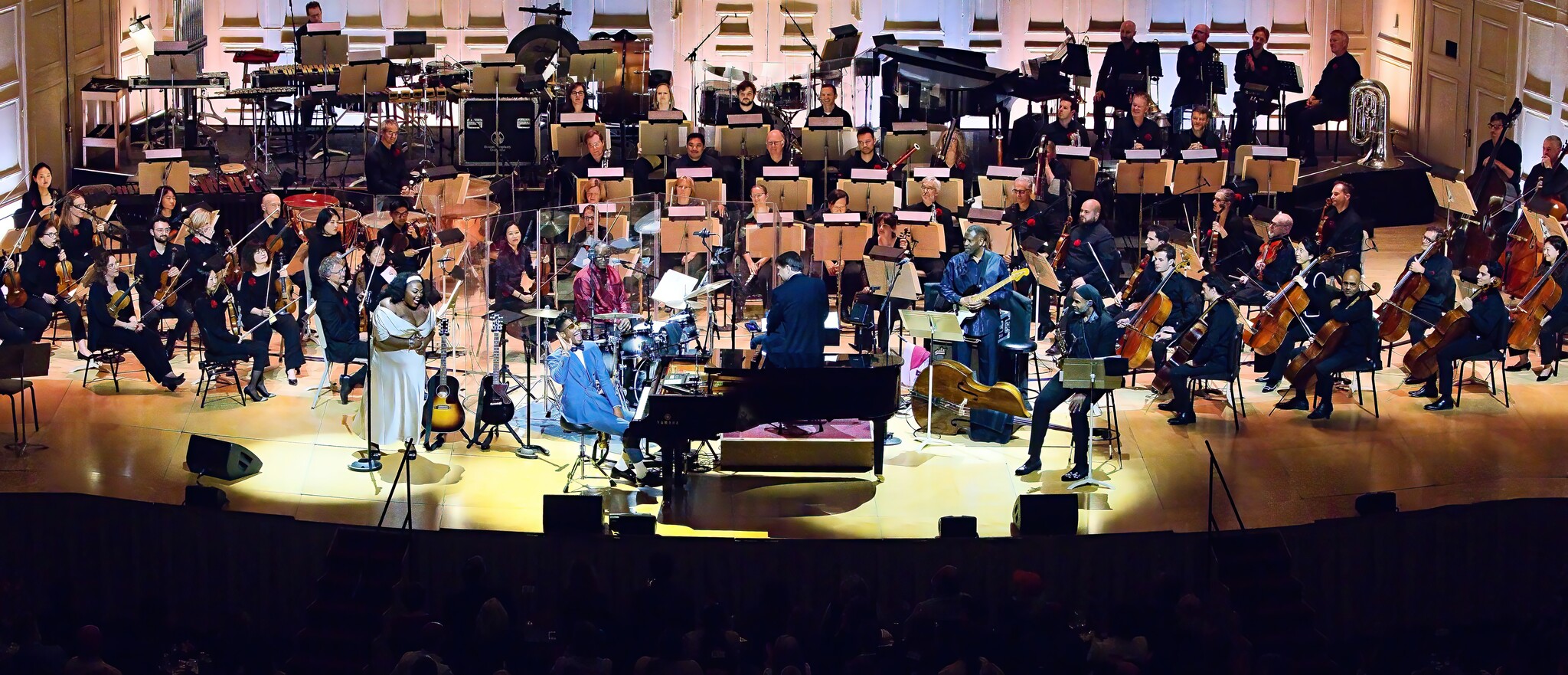
For the third night in a row, Jon Batiste demonstrated to a capacity crowd at Boston’s Symphony Hall that he’s more than just a singer, songwriter, pianist, and award-winning composer. He’s a genuine National Treasure.
Before the NOLA native and his quartet joined the orchestra, Conductor Keith Lockhart led the Boston Pops through a smooth-as-silk rendition of Miles Davis’ “All Blues,” off his landmark 1959 achievement, Kind of Blue, in celebration of this month being what would have been the jazz icon’s 100th birthday.
Batiste then joined the pops alongside a quartet of his choosing, comprised of a drummer, alto sax player, powerhouse vocalist, and a standup bass player, before jumping head-first into a swanky interpretation of “Beethoven’s 5th” that started out by-the-books but quickly took on a life of its own, imbued by Batiste’s confident swagger and well-honed sense of tastefulness. The selection couldn’t have been more appropriate. Boston Symphony Hall is widely regarded as the single most acoustically pristine concert hall in the Western Hemisphere, and it was built as a venue for the music of Ludwig Van Beethoven. His name is even etched into the gold leaf above the stage.
“BIG MONEY,” off the 2025 album of the same name, was a hit with the crowd and was immediately followed by an eye-watering version of Louis Armstrong’s “What A Wonderful World,” an utterly unadulterated sonic definition of the word “Beauty.”
Following a set break, Batiste and the Pops returned to the stage and performed “American Symphony,” a composition whose creation was captured in the 2023 Netflix documentary of the same name.
Later on, Batiste put fingers to ebony and ivory for an interpretation of The Beatles’ “Blackbird” that featured vocals, but which primarily focused on the instrumental, letting his left hand play rhythm while his right focused on hitting the appropriate notes to perform the vocal melody sung by Paul McCartney on the original recording.
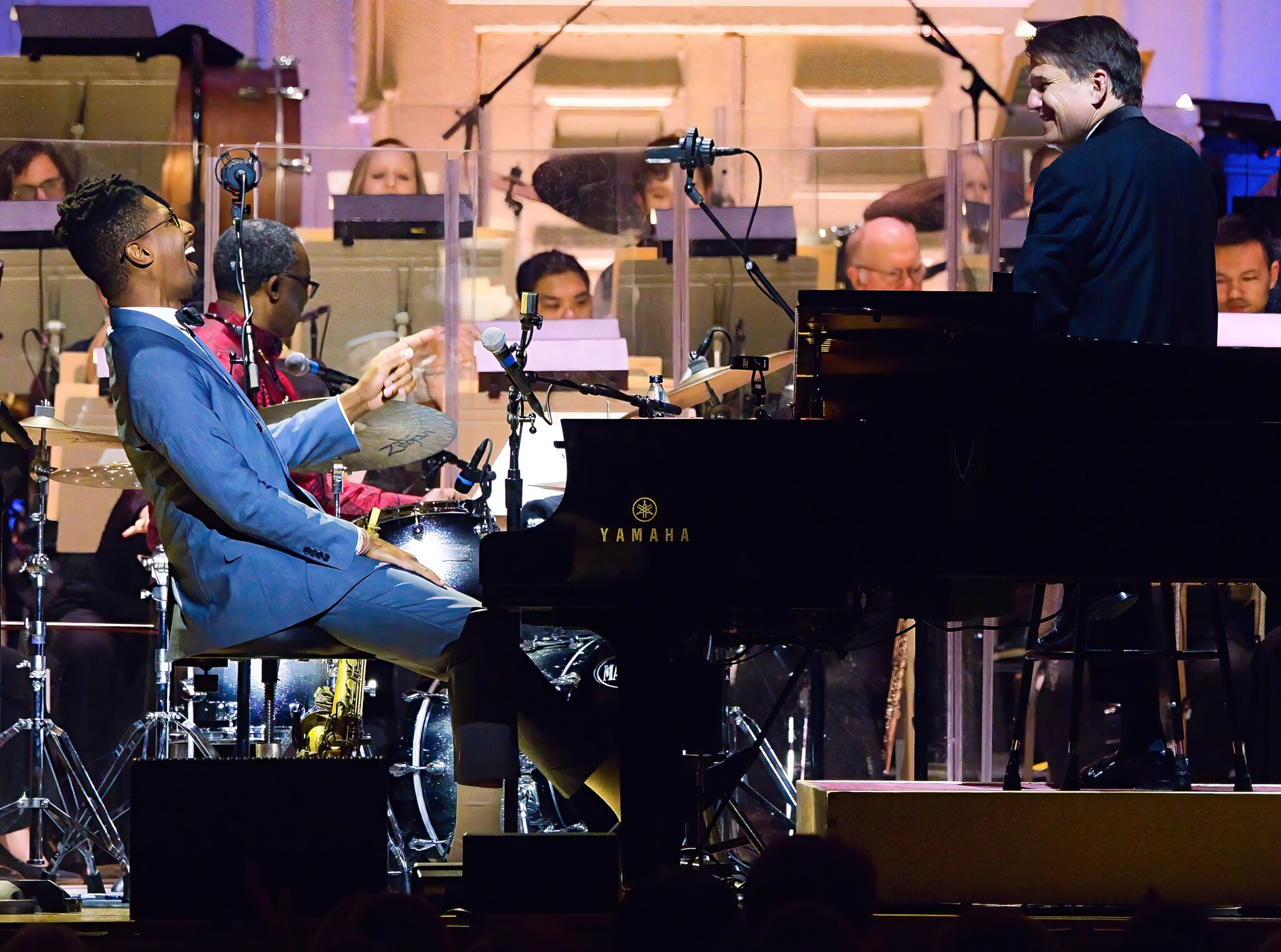
For an encore, Batiste returned to the stage and performed “Butterfly” off of 2023’s World Music Radio, but first, he graced his audience with a sole verse and chorus of Leonard Cohen’s “Hallelujah.” Ninety-nine out of a hundred times this song is covered, it’s corny and cliché, but in this case, it was that one other time. Batiste’s voice has a tender dignity to it that lends itself to the scope of the song’s emotional and lyrical intentions, and when it was time for the chorus, Batiste kept his mouth shut and let his audience sing it, word for word, without anyone on stage joining in and sending chills down his audience’s spine.
For the Pops’ part, Lockhart was a gracious host, giving Batiste a surprising amount of space to do his own thing, demonstrated by how often the dozens of performers on the stage sat still as one man became the entire performance. With a melodica in hand, Batiste rose from behind his grand piano and worked the stage, strutting back and forth, before walking into the crowd, working his audience into a frenzy.
The novelty of popular artists incorporating orchestral arrangements into their live show has become a fad in recent years, be it The Flaming Lips or Dua Lipa, and there’s a tendency to get bang for the buck out of the novelty by laying it on thick with symphonic, but when Batiste came to Symphony Hall, the arrangements worked perfectly. They blended nicely when the moment called for it, and at other times, the Pops kept their powder dry rather than shoehorning their way into a moment that didn’t fit.
Another thing that stood out was the comfort Batiste felt in the room. For well over twenty years, the Boston Pops have been hosting popular acts to perform alongside them, and for a room that’s just above 2,000 seats, it has a reputation for being more intimidating than that number suggests. Last year, Orville Peck put on a Pops performance that was fine, but the two elements failed to blend. In the Summer of 2006, My Morning Jacket put on an iconic performance with the Pops. It was memorable how awkward and uncomfortable they were on that stage in their tuxedos.
But for Batiste, a smile plastered across his face and welding charisma like a superpower, he felt right at home. Not only did the time and place fail to diminish him, but he did the opposite, making Boston Symphony Hall and its capacity crowd transform into something more closely resembling iconic New Orleans venues like the Saenger Theatre or the Howlin’ Wolf.
A fantastic display was put forth, demonstrating the full breadth of Batiste’s talents, but what made the performance so much more memorable was his sheer force of personality. Boston Symphony Hall came to Jon Batiste, and not the other way around.
Photos by Hilary Scott courtesy of the BSO
Comments
Loading comments...
Leave a Comment