
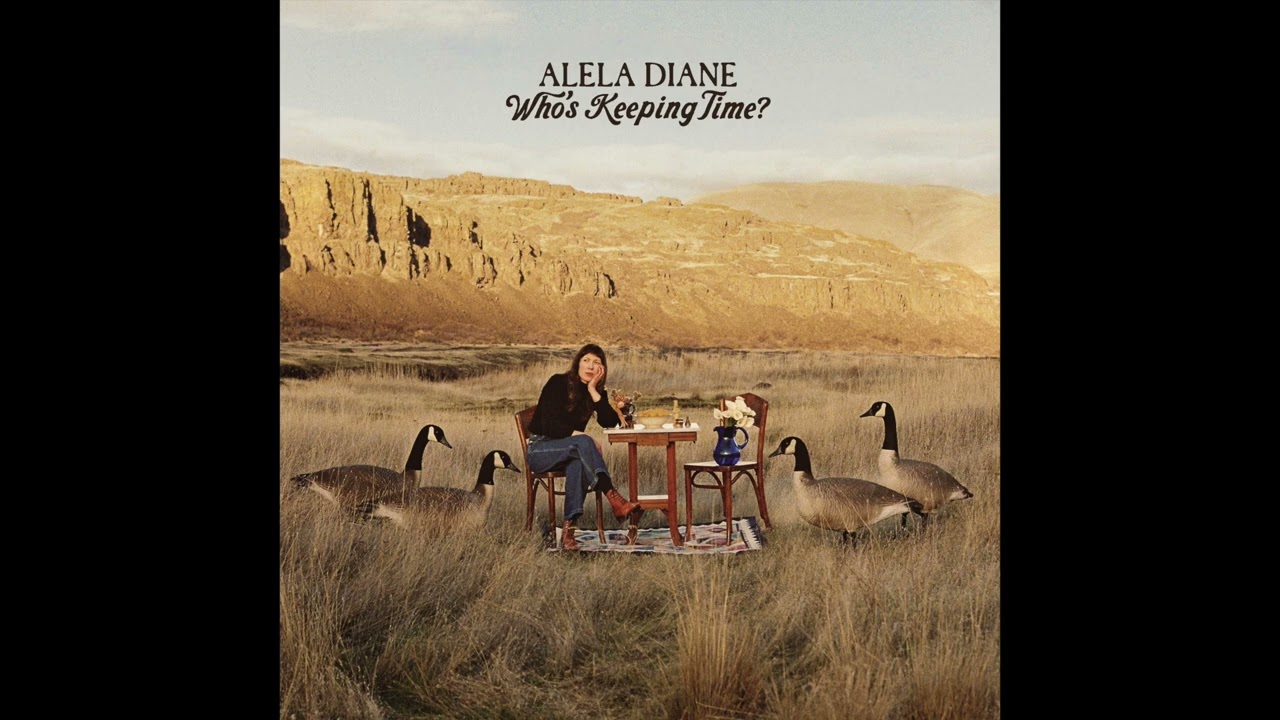
At some point over the more than 20 years that she has been performing and recording, Alela Diane quietly became an American treasure. Every time she releases a record, it feels like a gift, something tangible you can hold in your hands whenever you need a reminder that powerful music comes from actual humans playing real instruments. With the release of her new record, Who’s Keeping Time?, that gift is more poignant than ever.
Conceived in the wake of losing her friend and mentor, the legendary folk singer Michael Hurley, Diane nurtured this new set of songs from ideas to live recordings in the attic of her Victorian home in Portland, Oregon. Coinciding with that was her deepening need to reconnect with the town’s music community. She took guitar lessons from Lucius guitarist, Peter Lalish, and forged new friendships with drummer Danny Austin-Manning, singer-songwriter and violinist Anna Tivel, and guitarist and producer Sam Webber.
The result is an album that is at once introspective and outward-looking, a collaboration and the product of one woman’s musical and poetic vision. Each song draws on the same cast of musicians (including those mentioned above, such as Sebastian Owens, Luke Ydstie, and others), giving it a band-record feel. And yet, from the pattern of her fingerpicking to the architecture of her melodies, these songs are unmistakably Diane’s.
Many of them are quiet and sound like they were played quietly, using a piano with the damper pedal down or a rubber-bridge guitar. Sometimes a dulcimer or high-strung guitar pierces the dull thud of a baritone guitar, or a clarinet or violin gives second thought to a melody. They’re sturdy little things, these songs, folky in appearance, but intricately arranged and imbued with a gentle determination.
One of the reasons for that determination is the power of Diane’s poetic world gathered from memory, relationships, zeitgeists, and the detritus of daily life. Her albums are legendary in this way. The bare agony of About Farewell (2013) makes what the San Francisco Examiner called “the mother of all breakup albums,” but the elegantly sculpted Cusp (2018) enshrines the beauty of motherhood at a time when she was pregnant with her second daughter, while the solemn fear of Looking Glass (2022) fidgets amid the four walls of the pandemic.
Four years hence, Diane takes us back into her world to remind us of life’s fragility. “Rain falling down again,” she sings in “Fragile as a Flame,” near the end of the record, “Seasons move through/ I see the changes in me and in you.” True to time itself, the elements of Diane’s world change at a rate that belies the music’s stately pace but underscores the reality that death is not the only thing that makes life fragile.
Whether it’s the child “with a heart that might ignite” in “To Be Kind,” the woman in “Dusty Roses” who stumbles home “night after broken night,” the distance between the present and a shared memory in “Wide Open Spaces,” the scattered fever dreams in “Galloping,” or the singer herself returning to and leaving California in the album’s opener—change is how life mimics death.
Add to this the zeitgeist of the age in “Piss, Coffee, Blood, or Wine?”: powerful men stealing souls and “hiding money” while a puddle of indiscernible fluid gathers under a slumped figure on a sidewalk. “Honey, is this all we’re here to do?” The answer might be grim, but in the shape of Diane’s songs, it isn’t.
For one thing, Who’s Keeping Time? teems with life. Birds and flowers (near constant images throughout Diane’s work), dogs and cats, brothers and sisters, children, painting, fixing, mending, waltzing, and who knows what else are captured in her staccato lines and sewn into her legato melodies. Even the album’s lynch pin, “Spring is a Fine Time,” is, ironically, its most whimsical number as Diane says farewell to Hurley. “Fly on with the black crows cawing/ Honking with the geese/ Fly on with the werewolf howling/ Hoot owl in the tree/ Fly on . . .”
For another, Diane returns throughout the record to the durability of the love she has found in her relationships, particularly in her marriage. You could listen to a thousand flashy, seductive love songs and never feel the depth of yearning and intimacy that she describes in “Could Be” and the first verse of “In My Own Time.” That she finds the embodiment of this kind of love in her grandparents speaks to a lineage that continues to flow amid life’s changes and uncertainty. “My grandparents are waltzing/ Through the last light of their time,” she sings in “Endless Waltz,” the album’s closing number, “All those years of loving/ And they’ll pass the torch at sunset/ To their children on the shore/ Their love, an endless river.”
- ← PreviousLes Claypool’s Fearless Flying Frog Brigade Returns With Psychedelic Fire & Weirdness on ‘Live Frogs: Volume 1’ (ALBUM REVIEW)
- Next →Golden Age Thursday Samples: Bob James’s “Take Me to the Mardi Gras” (1975) Gets Filtered Through The Colorful Lenses of Run-DMC (1986), N.W.A. (1988) & A$AP Rocky (2015)
Comments
Loading comments...
Leave a Comment