
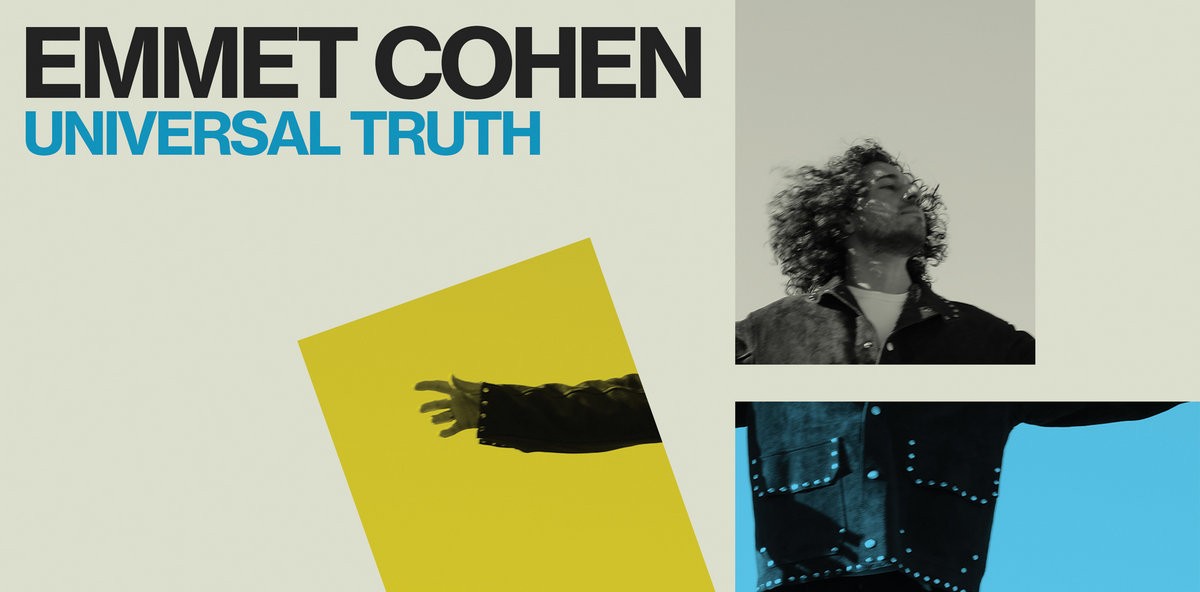
Most of today’s jazz fans recognize pianist Emmet Cohen from his popular livestream series, Live From Emmet’s Place. Though Cohen typically plays in the piano trio format, he has a legacy of inviting prominent guests to his livestream series. Still, other than his Master Legacy Series, Cohen’s albums have mostly featured his trio at the time. So, playing and touring with a quintet is rather new. His Centennial Tribute to Miles Davis and John Coltrane tour has already concluded as we write this, with his Universal Truth album as the underlying foundation. The album quintet features his current trio of bassist Yasushi Nakamura and drummer Joe Farnsworth alongside trumpeter Jeremy Pelt and tenor saxophonist Tivon Pennicott, both of whom have appeared on Live From Emmet’s Place multiple times.
Yet, the album is far more than a collection of cover tunes from the twin giants. Cohen enlisted two legends who played with Miles, tenor saxophonist George Coleman and bassist Ron Carter, to join or substitute on certain selections. The reunion of Coleman and Carter, performing “My Funny Valentine,” comes sixty years after they performed on the Miles Davis album of the same name at Lincoln Center’s Philharmonic Hall. Also, Cohen, known mostly as one of the swingingest pianists of today, dug deep to compose a deeply personal and spiritual three-part suite inspired by Coltrane’s never-ending search for a higher power. This stands as arguably the most creative composing endeavor of Cohen’s young career.
As you might expect, given Cohen’s straight-ahead tendencies, the covers are from the ‘50s and ‘60s. They kick off with bebop, first with Davis and Bud Powell’s “Budo,” from The Birth of the Cool. Monk’s (Coltrane did play with Monk) “Well, You Needn’t” follows with Carter on bass, and Pelt, one of the most fiery trumpeters on the scene, strutting his stuff. Coleman, Pelt, Carter, and all give an appropriately sensitive reading of “My Funny Valentine.” Coleman, at age 90, is a marvel with his robust tone and phrasing. Cohen sublimely adds his delicate touch on the keys.
Pelt (on muted trumpet) and Pennicott front the rhythm section, with Carter plucking a walking bass line, for Jimmy Heath’s “Gingerbread Boy,” which appeared on Miles Smiles. Cohen dances on ivories, with one of his most sophisticated solos. Incidentally, Heath would have also celebrated his centennial this year.
From that point, the group turns toward Trane. Part 1, “Eternal Glimpse,” is a flowing mid-tempo ballad, featuring fine interplay between the two horns as well as stirring solos from Pennicott and Cohen, the latter mixing powerful chords with fluid right-hand notes. “Compassion” is a gorgeous ballad in the realm of Trane’s “Naima,” with Pelt, on muted trumpet again, the principal soloist. Cohen’s glittering solo brightens the mood before Pelt re-enters with a tender close. Tempo kicks up for Part 3, “Universal Truth,” with the horns locked in unison. Farnsworth propels this one with his uncanny sense of time and cymbal flourishes. Cohen launches into swing mode, inspiring soaring turns from Pelt and Pennicott, who engage in a vigorous dialogue, with Farnsworth bringing it to an explosive close.
The final piece is Coltrane’s “Blue Train,” which was originally rendered as a sextet with Curtis Fuller (trombone) and Lee Morgan (trumpet) joining Trane on the front line. Cohen arranged a sextet version here as well, featuring the twin tenors of Coleman and Pennicott, along with Pelt for a three-horn front line that pulsates with similar verve as the original.
The group has a much wider repertoire than what’s offered on Universal Truth, but, as stated, this is both a respectful and creative take on the influence of these legendary masters.
Comments
Loading comments...
Leave a Comment