
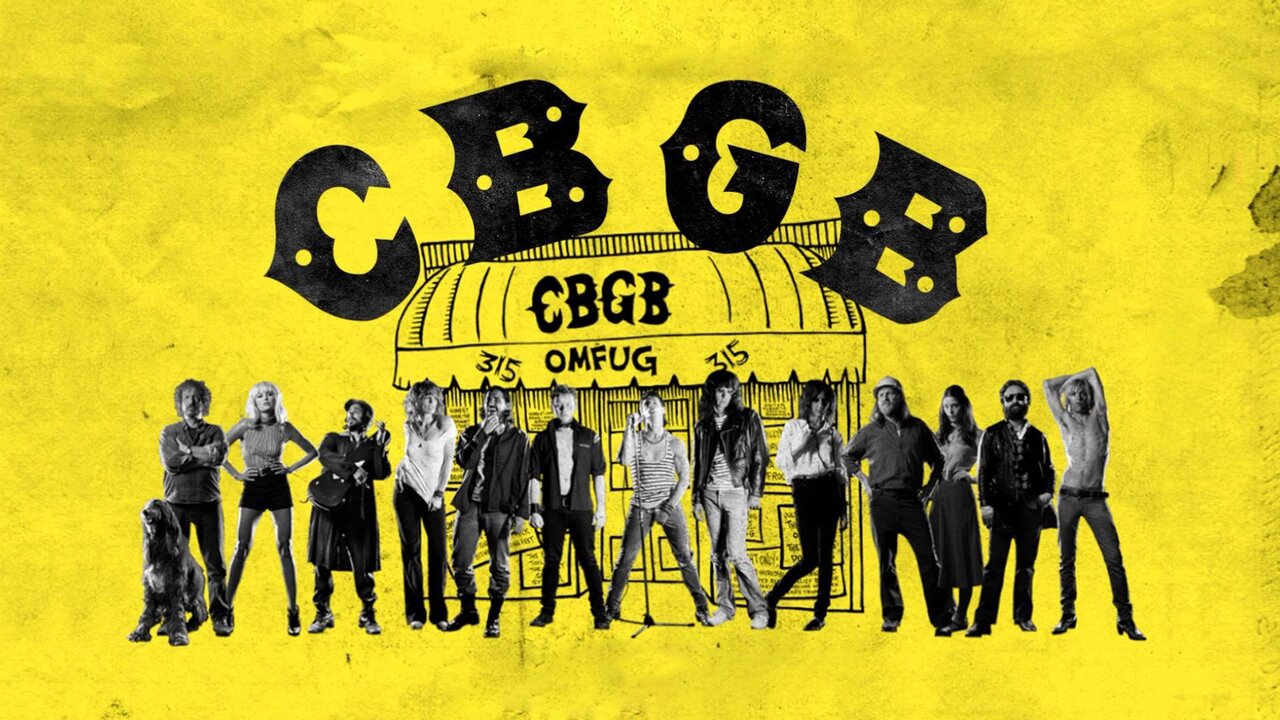
CBGB (2013) has some of the elements that make a good rock ‘n’ roll movie, but is missing others. In the end, many viewers may find themselves wondering, “Who cares?”
What does CBGB stand for? Why “Country, Bluegrass and Blues,” of course, though that’s not the music the club was remotely known for.
Anyone with a passing interest in punk probably knows the basic true story. A shithole club in NYC in the mid-70s improbably births some of the greatest bands in rock history: Talking Heads, Blondie, Ramones, The Dead Boys, and many more.
The owner of the club, Hilly Kristel, is played by the legendary and much-missed Alan Rickman of Harry Potter and Die Hard fame in a really bad wig. Rickman injects the character with a gruff distance that’s not without its charm.
But that’s really all we learn about him, and that problem is really the major flaw. At the beginning of the film, it’s shown that he has two prior failed clubs. Then he borrows money from his mother (Estelle Harris, who gets a couple of great fish-out-of-water scenes) to make one last attempt, which we know will become CBGB. He starts booking bands.
But why?
At times it seems like he truly believes in original music and wants to support art. At others it seems like he thinks hosting bands is simply a good way to get people in to drink. But this lack of clarity leads to a lack of conflict, giving the whole thing a lackadaisical pace. The question of “Why does he care?” should be driving the whole thing, and it’s simply ignored.
The main challenge Hilly faces is money. CBGB isn’t making much, and what it is making is managed poorly. This small conflict peaks most of the way through the movie when the landlord sends some leg-breaking goons to collect, but that’s really about it. Why does he keep this going besides not wanting to get a regular job?
Some half-hearted conflict arises with his adult daughter, who tries to straighten out the money problems. And Hilly’s dog shits on the floor constantly, annoying employees.
Otherwise, this is a fairly straightforward dramedy, similar in tone to Almost Famous, but without the character development that made that one so good.
A recurring visual motif places the characters in comic book frames, which works. These famous punk rock personalities are over-the-top and seem almost like flawed superheroes, so absurd they can’t possibly be real people.
The big strength of CBGB lies in the sets and band recreations. We get early gigs (and auditions!) from the likes of Talking Heads, in all their awkward, robo-glory; the Ramones, who fight onstage; and Patti Smith, who brings poetry to the cantankerous punks. Television’s audition is one of the movie’s highlights. These parts are well-cast and fun.
And the soundtrack slams, with the original recordings used throughout the movie. Licensing these iconic songs must have cost a fortune, and it’s a shame that the care taken to include them wasn’t invested in a good screenplay, which is really the Achilles heel here.
It would have helped thematically if the reactionary origins of punk had been explored. Why was this music different from what was currently dominating airwaves and Billboard charts? The movie assumes that viewers are familiar with the ‘70s bloat of arena rock, prog and the hangover of the ‘60s, but that may not be the case.
The casting is uniformly good, with a couple of exceptions. Late Foo Fighters drummer Taylor Hawkins is simply too recognizable to pull off Iggy Pop, and sports a wig almost as bad as Rickman’s. And nothing against Ron Weasley, but Rupert Grint just can’t pull off Dead Boys’ Cheetah Chrome. It’s almost a sacrilege.
The main thing the movie gets right is the sense of community that pervades the scene. If you look at all the legendary rock scenes (from San Francisco in the ‘60s to Seattle in the ‘90s), that sense of cross-pollination is key. And you can sense that the bands fed off each other’s energy, even if they sounded completely different from each other.
Still, as light watches go, you could do worse than CBGB. The recreation of the auditions and gigs is fun enough, and Rickman is good in everything. But viewers may find themselves coming away hungry, as if they just drank distilled water. “That’s all there is?” It’s lacking a certain spirit.
And if there’s one thing that makes punk rock, it’s spirit. If you can’t capture that fire, you’ve got nothing.
At one point, Dee Dee Ramone asks Hilly, “Do you think we’re gonna be rock stars?”
“You already are,” says Hilly, simply. But he doesn’t seem to mean it. We just know it because it’s the Ramones.
And when this is the story of CBGB, one can be forgiven for wanting a little more.
Comments
Loading comments...
Leave a Comment