
Rating: C-
I’ve never quite had an experience with a movie like I did with The Midnight Sky. For a good majority of the film, I quite enjoyed myself. In fact, for roughly 115 of its 120 minutes, I was settled into a B- review, ready to call it a fun, if wildly derivative and forgettable, melding of hard sci-fi tropes with post-apocalyptic nightmares. It was a review I was comfortable with, and ready to defend. And then it ended.
It seems likely that one day The Midnight Sky, which is directed by and starring George Clooney, will become something of an academic case study in the importance of sticking the narrative landing. Any good will I had built towards the film during those first 115 minutes completely evaporated in the last 5 with a conclusion so baffling and idiotic that it completely breaks the narrative logic of the film, rendering it a pointless and futile exercise of bad will and worse storytelling.
Which is I guess partly my fault. To be entirely honest, the ending itself is predictable; so much so that early inclinations regarding the supposed twist were dismissed as being so obvious that there was no way the story would go in that direction. Surely something bigger, better, and more meaningful would be done with the film’s simple premise. In hindsight, that’s my fault. Clooney, for all his star power and charisma, isn’t exactly known for his skills in the director’s chair. Though, to be fair to him, the problems lay much deeper than his skills, such as they are.
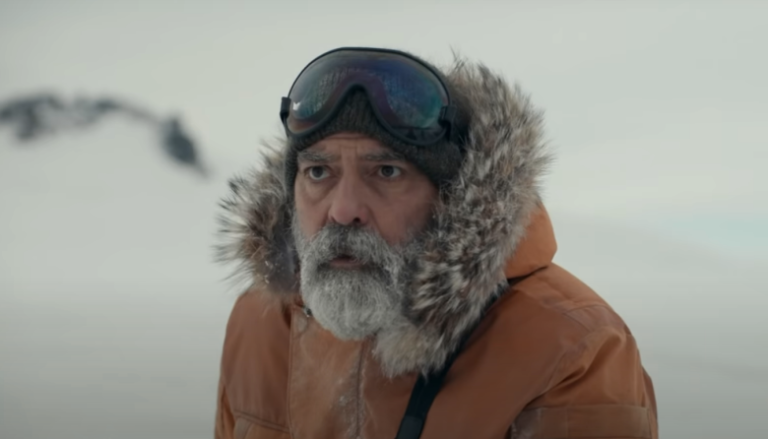
Based on the novel Good Morning, Midnight by author Lily Brooks-Dalton, The Midnight Sky follows a lone scientist (Clooney) stuck at a research facility in the arctic after an unnamed radioactive disaster has rendered humanity all but extinct. As the last act of humanity, he hopes to contact the deep space exploration ship, Aether, which is returning from a successful pre-colonization study of a newly discovered habitable moon of Jupiter, in order to convince them to turn back and find what safety they can. In the process, he discovers that the young daughter (Caoilinn Springall) of a former colleague has been accidentally left behind at the research facility, forcing him to confront his paternal instincts for the first time since abandoning his own daughter years ago. To make matters worse, he’s dying from cancer and has only a limited window of time to contact Aether and save their lives as well as any future humanity might have.
On paper, this is the kind of story that tends to speak to me specifically. A big fan of both apocalyptic and space exploration fiction, it was exciting to see the juxtaposition of these two genres and how well they work together. The film bounces back and forth between Clooney’s isolation in the arctic and Aether’s isolation in space, and some interesting parallels are drawn that explore the emotional undercurrent of humanity.
And yes, this is all derivative. Most modern hard sci-fi about space exploration owes a great debt to 2001, just as arctic survival stories owe a debt to The Call of the Wild. And even the basic premise of the earthly apocalypse, which largely goes unexplained except for an ever growing, deadly cloud of radiation circling the globe via the wind patterns, owes a debt to Nevil Shute’s 1957 novel, On the Beach. Somehow, this story manages to blend all of these into a coherent and engaging work.
Until the ending. I have a personal philosophy to limit what I discuss about a movie in order to avoid spoilers; they’re unfair to readers, even if I don’t personally mind them myself. What’s frustrating here is that this philosophy limits my ability to critique the film and adequately explain how it damned itself after praising it as I do above. Suffice it to say, there’s a twist. It’ll probably be the same twist you see coming. You’ll probably want to dismiss that idea as being stupid and moot, as it would render much of what we’ve seen prior to it illogical. Except that is exactly what The Midnight Sky does.
Which is a shame. As derivative as the film is up to that point, it does manage to be highly engaging and an interesting study on what survival means on both the individual and species wide level. Clooney, though exactly a fantastic director, is still a great performer, and his performance here is in line with that. So too with the crew of Aether. Led by David Owelowo as Captain Adewole and Felicity Jones as Mission Specialist Sullivan, they lend a stark urgency to the impending disaster that is humanity, and their parallel story lines work well together.
But none of that means anything if the ending is dumb, and this ending is dumb. So much so that I cannot recommend wasting any time with The Midnight Sky, even to appreciate what might otherwise be enjoyable about it. There’s wisdom in the old entertainment industry ideal of “wow them in the end” because the end tends to be what audiences take away the most. And unfortunately, with that philosophy as our guide, there’s nothing worth taking away from The Midnight Sky that makes this a journey worth taking.
The Midnight Sky is now available on Netflix.
Comments
Loading comments...
Leave a Comment