
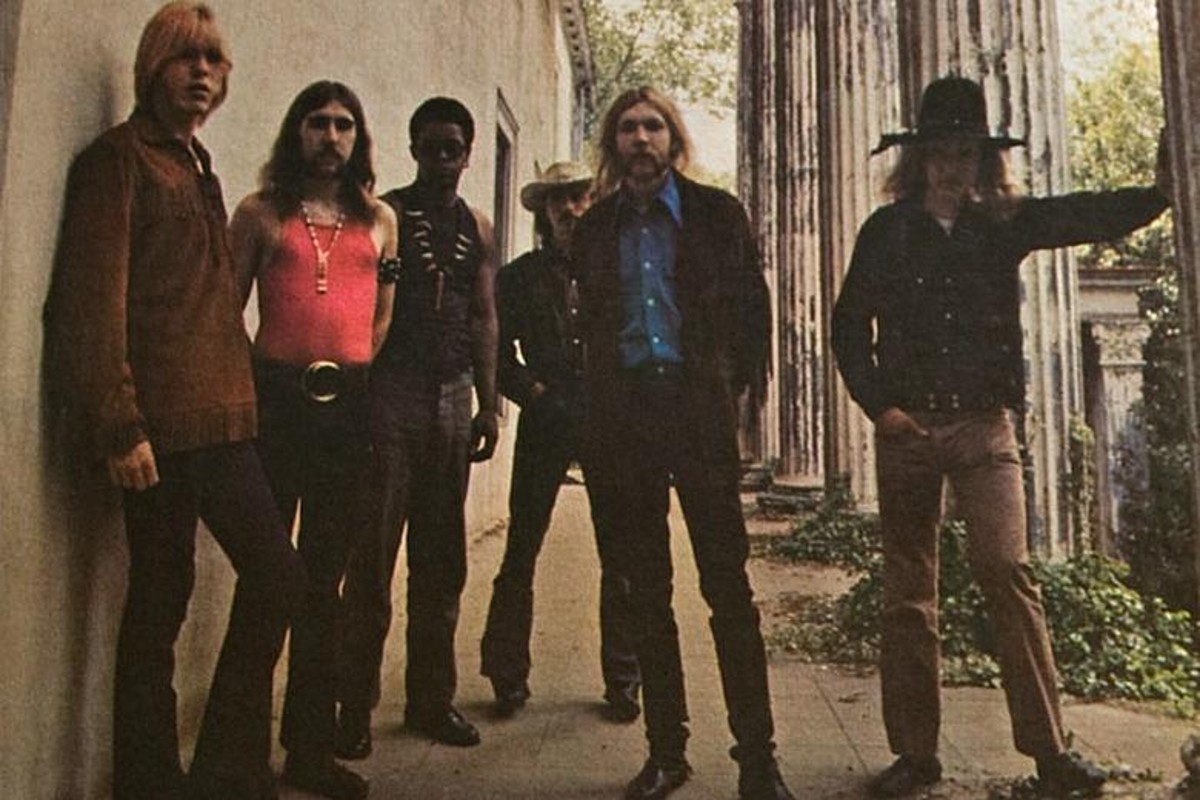
With fifty-five years’ hindsight, the relatively minimal impact of The Allman Brothers Band’s self-titled debut record (released 11/4/69) was out of proportion to the band’s potential, eventual commercial success, and artistic influence. Famed producer Tom Dowd—Ray Charles, Aretha Franklin, and Eric Clapton, among others—was to oversee the sessions, but the band’s subsequent long-time collaborator ran into an irreconcilable conflict.
Consequently, engineer Adrian Barber supervised the work at Atlantic Studios in New York, who concentrated more on the technical side than on creative guidance. Partly because of those circumstances, the record is comprised of selections from the ABB’s stage repertoire, a factor that only aided in the condensed recording time (merely a matter of days rather than the original two weeks allotted).
The explosive cold opening of “Don’t Want You No More” is a tacit but unmistakable statement on the part of a band to be reckoned with. Slashing guitars of Duane Allman and
Dickey Betts–tellingly positioned at the former’s right shoulder in cover photos from and back–lead the charge over the insistent prodding of Berry Oakley’s bass: the latter provides a cushion for dual guitars simultaneously cutting and melodic, often in tandem harmony.
Adding to the rhythmic drive is the interweaving of drum patterns by Butch Trucks and Jai Johanny Johanson (aka Jaimoe, who also utilizes space elsewhere for some conga playing to enrich the instrumental mix). The noticeably thin-sounding sonics Barber produced do not allow for the requisite detail to become any more apparent than the vibrance of the musicianship, so it makes sense Dowd would later remix the audio for inclusion in a re-packaging of the first pair of ABB albums, Beginnings, a two-fer designed to capitalize on their commercial breakthrough.
The Brothers cement that startling first impression with the second submission of the two main staples of their style. The immediate segue from the instrumental Spencer Davis Group covers into the twelve-bar blues that is “Ain’t My Cross To Bear” not only introduces Gregg Allman as a gutsy singer but the performance functions as his first recorded foray into original songwriting.
The other notable examples of the vocalist/keyboardist’s writing artistry, “Dreams” and “Whipping Post,” act as signposts for the septet’s collective and individual predilection(s) to improvise. A particular hallucinatory atmosphere permeates both tracks, and while the first posits the singer rising above the obstacles to his ambition(s) by sheer force of his will, the second finds him almost literally throwing off the sources of existential pain that dogs him; based on a set of driving jazz changes tendered with great gentility in the latter, the author’s wail at the conclusion is as significant as the molten slide guitar Duane overdubbed after encountering some difficulty otherwise completing a satisfactory take.
Wisely sequenced in juxtaposition at the very end of the seven tracks, these stellar compositions reaffirm the ebb and flow of The Allman Brothers Band. “Black Hearted Woman” and “Every Hungry Woman” are riffs serving as vehicles for the septet to flex its vocal and instrumental muscle, individually and collectively. Not only do these two suffer in comparison to the warhorses above that close the LP, they also sound slight with “Trouble No More” placed in between them.
Muddy Waters’ number is purportedly the first song the ABB played together once the younger Allman sibling arrived from the West Coast at the vehement request of his older brother in early 1969. The ensemble’s founder and titular leader’s bottleneck work is prominent in the arrangement of a song that would become one of the most readily recognizable entries in the Allmans’ repertoire.
With retrospect of over a half-century and taking into account a running time of just over a half-hour, there is hardly a more efficient debut album in the annals of contemporary rock than the self-titled first LP by the Allman Brothers Band. The unit would subsequently progress by leaps and bounds with its sophomore effort Idlewild South (perhaps because Dowd was at the helm of the studio sessions for the first of many endeavors over the forty-five years the Allmans existed).
The ABB would continue the maturation process in the form of the original material composed by Betts for that second LP. “Revival” and “In Memory of Elizabeth Reed”—the first in a series of his trademark instrumentals—would predate “Blue Sky” (where the writer would make his debut as a lead singer), eventually contained in the follow-up to this sophomore long-player.
Remarkably, the evolution of the Allman Brothers Band would continue virtually unabated despite the eerily similar accidental motorcycle deaths of Duane, aka ‘Skydog’ and Oakley (who took the fall ’71 loss of the titular leader particularly hard). That year’s summer release of the now iconic live album At Fillmore East was bringing them stardom just before the first tragedy.
In its otherwise devastating wake, the remaining quintet not only would complete Eat a Peach for release as a double album in early ’72, but they would proceed forthwith into sessions for the work that would become the following year’s Brothers And Sisters, featuring yet another tune of Dickey’s, “Ramblin’ Man,” that work completed under such duress would garner mainstream popularity for the reconfigured lineup.
Recruited roughly coincidental with work on Gregg’s first solo album, Laid Back, pianist Chuck Leavell and bassist Lamar Williams would be the first two of many personnel changes to occur over the long-term arc of the Allman Brothers’ career. Yet it’s arguable that, without the staunch foundation laid by the original seven-man band on its first album, such personnel modifications would not allow for the four-and-a-half-decade durability of the seminal Southern band.
Special thanks to John Lynskey, Allman Brothers Historian
Comments
Loading comments...
Leave a Comment