
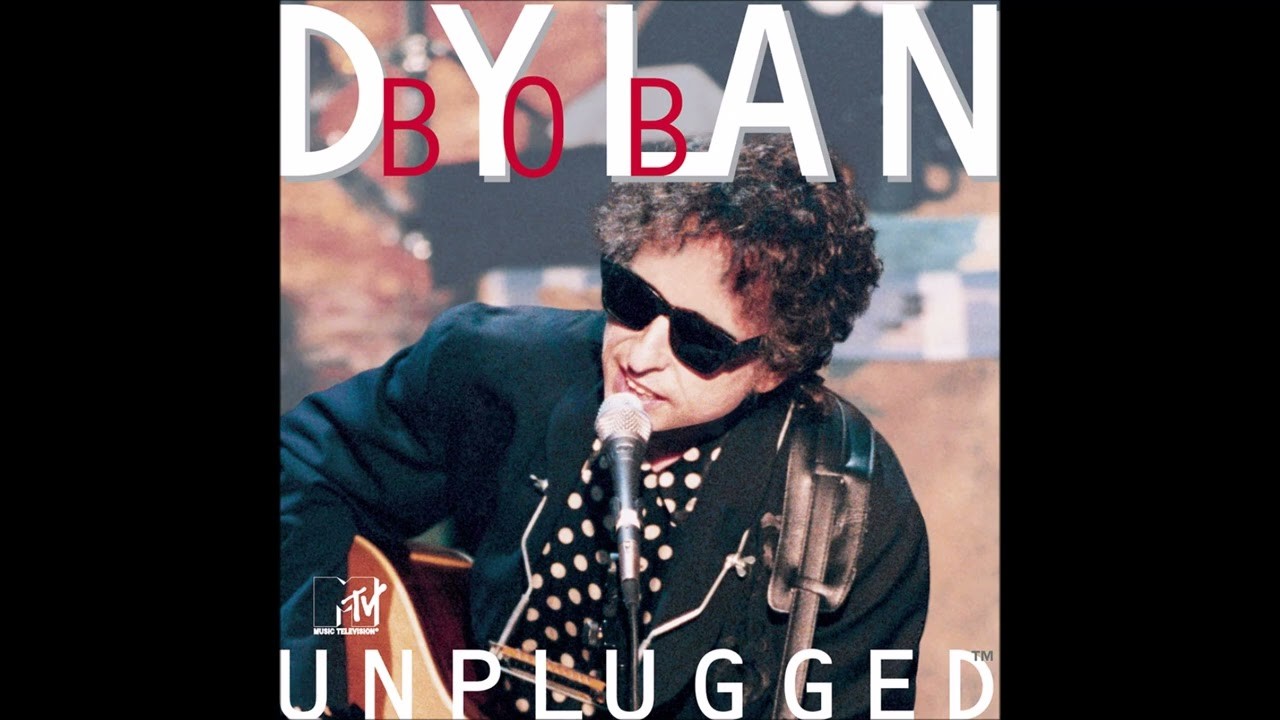
Even given Bob Dylan’s self-professed discomfort about exactly who constituted his audience by the time the Eighties rolled around, it still defies logic he would attempt to connect with the MTV Unplugged demographic by appearing on the popular television series half-way through the next decade.
But, leave it to the Nobel Laureate to fully play the part for those watching and listening. In his dark glasses and loud polka-dot shirt, he looks to be replicating his appearance in film footage from around the very time he gained fame in the mid-Sixties (see D.A. Pennebaker’s Don’t Look Back from 1967 and Martin Scorcese’s No Direction Home nearly forty years later).
But not all was so arch on this occasion, recordings of which appeared on both CD and DVD (though lacking the entirety of the setlist on both configurations). The semi-acoustic arrangements intrinsic to the decade-long series are a direct reflection of the folk and rock mix of Dylan’s music at his commercial peak and Bob’s band of the time more than did them justice too, playing with a deft touch introduced right away via the snappy opener of “Tombstone Blues.”
Also participating is Brendan O’Brien, who had by this time elevated his profile via collaborations with Pearl Jam, Stone Temple Pilots and Soundgarden). The producer/musician plays appropriately assertive Hammond organ parts on “Like A Rolling Stone,” and elsewhere throughout the program, such sensitivity suggesting he might well have efficiently shepherded The Bard through some studio sessions around this time.
Bob Dylan didn’t play coy with the MTV Unplugged performance. Rather, the expansive nature of the various selections mirrored the repertoire growing within the so-called ‘Never Ending Tour’ begun roughly a decade before through tours with Tom Petty and the Heartbreakers.
Accordingly, Dylan and company did not have to rearrange the chosen material here any more (or less) than any other night: the instrumental settings were then as now in constant flux, including the modified shuffle that is “Dignity,” an outtake from 1989’s Oh Mercy from which also comes the relatively unsung “Ring Them Bells.”
The man touches upon his halcyon years not only with the aforementioned signature song, but also with “Desolation Row” from the same 1965 Highway 61 Revisited album. The latter two numbers are nine and eight minute plus in duration, as indicative of Bob bearing witness to his ambivalent engagement with this occasion as the knowing choices from his early topical writings.
Yet the ominous air of “John Brown” contrasts markedly with the a devil-may-care “Rainy Day Woman #12 & 35” that follows. “With God On Our Side,” however, does appears in close proximity to the anthemic “The Times They Are A’Changin'”–where Bucky Baxter’s dobro encapsulates the melancholy in the deliberate performance–while a cull from the Woodstock era LP John Wesley Harding, “All Along The Watchtower,” finds the author howling in his own inimitable way.
Maximizing the opportunity presented by the event, Bob Dylan presents a cross-section of his discography on MTV Unplugged that is simultaneously a primer to dilettantes and a refresher to aficionados (both of which demographics no doubt benefit from the inclusion of the words to all the songs on the enclosed CD booklet).
And, for all we know with three decades hindsight, The Bard From Minnesota also ended up piquing his own creative curiosity just prior to initiating a long-term return to form roughly two years later. 1997’s Time Out of Mind ushered an artistic and commercial renaissance for Bob Dylan that, for all intents and purposes, has continued right up until the present day.
Comments
Loading comments...
Leave a Comment