
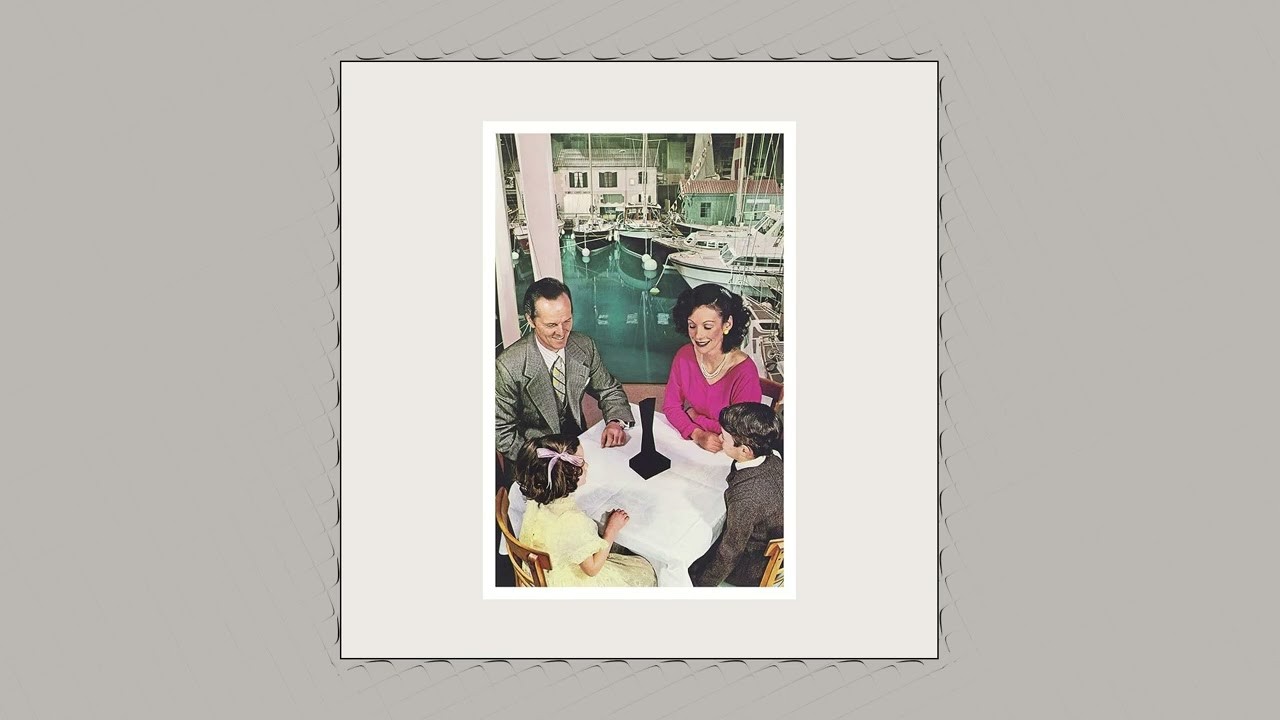
At a quick glance, Led Zeppelin’s seventh studio album, Presence (released 3/31/76), has much in common with the rest of the monolithic band’s discography. There’s the cryptic symbology of the cover images, some de rigueur blues, references to mythology, and a preponderance of Jimmy Page guitaring that competes for attention with Robert Plant’s singing.
But it only takes a cursory listen to discern the difference between this forty-four minutes and, say, Led Zeppelin III (apart from the title that is). For one thing, the comparatively temperate quality of Plant’s vocals stems from his singing while in a wheelchair due to physical infirmities resulting from an auto accident in 1975.
The lead singer sounds genuinely emotional on “Tea For One,” no doubt mainly because of the aforementioned adverse circumstances, but also because his situation (and the whole band’s) was compounded by the logistical difficulties in recording as he recovered from those aforementioned injuries.
Much more so than their appropriation of Blind Willie Johnson’s “Nobody’s Fault But Mine” elsewhere on the record, the final number on Presence is certainly the most sincere blues Zeppelin ever recorded. The unself-conscious emotional authenticity may account for its nearly nine-and-a-half-minute duration, but the fact is that the foursome had otherwise disposed of melodramatic formalities by placing the longest track of the seven as the very first.
The 10:22 duration of “Achilles’ Last Stand” carries more than that single distinction, though. Former Yardbird Page’s solos and fills are markedly terse for a guitarist who’s displayed such a penchant for overplaying in the past: perhaps doing all the overdubs in a single session moved him to play economically.
Regardless, the guitarist’s pithy approach correlates to the comparatively streamlined arrangements on Presence (as well as the Zep lead singer’s unusually straightforward delivery).
Accordingly, John Paul Jones plays no keyboards, relegating himself to the nearly inaudible bass sound rooted on producer Page’s fondness for the trebly textures of the vintage Sun Records sound of the Fifties. The heavy echo on the singing of “Candy Store Rock” also aligns with Jimmy’s taste in that respect (not to mention Plant’s own fondness for that era: see his 1984 Honeydrippers project).
Late drummer John Bonham is particularly limber on the latter number, while his frenetic timekeeping during “Hots On For Nowhere” rivals the relentless pace he maintains on this record’s initial number. The absence of any prominent acoustic guitars throughout Presence no doubt allowed the man nicknamed ‘Bonzo’ to forge ahead with such ferocity, sans much interruption.
But the full-steam-ahead momentum may well also derive from a surfeit of energy based on Zeppelin’s cancellation of tour dates in support of Physical Graffiti (their previous release and debut on their own Swan Song label) due to their frontman’s mishap.
And the ‘spontaneity’ with which Page describes the sessions in the Musicland Studios in Germany was at least particularly rooted in the foursome’s need to finish in time for the Rolling Stones to occupy the same space (for their 1976 Black And Blue longplayer).
The eighteen-day duration of the Led Zeppelin work belied the delay in formulating the cover for the album through Hipgnosis (also famous for Pink Floyd graphics). Prolonged design changes kept the record from coming out in short order after Page, and long-time engineer Keith Harwood completed the arduous mixing.
It is thus no little irony that, despite delays in the album’s release — and mixed critical reviews — this LP is the lowest-selling title in the band’s catalog. By the same token, the difficult circumstances of a half-century ago brought pressure on Led Zeppelin that ultimately paid off, at least artistically: the relatively unembellished, deceptively intense performances comprise what is arguably the most true-to-life record this quartet ever issued.
Comments
Loading comments...
Leave a Comment