
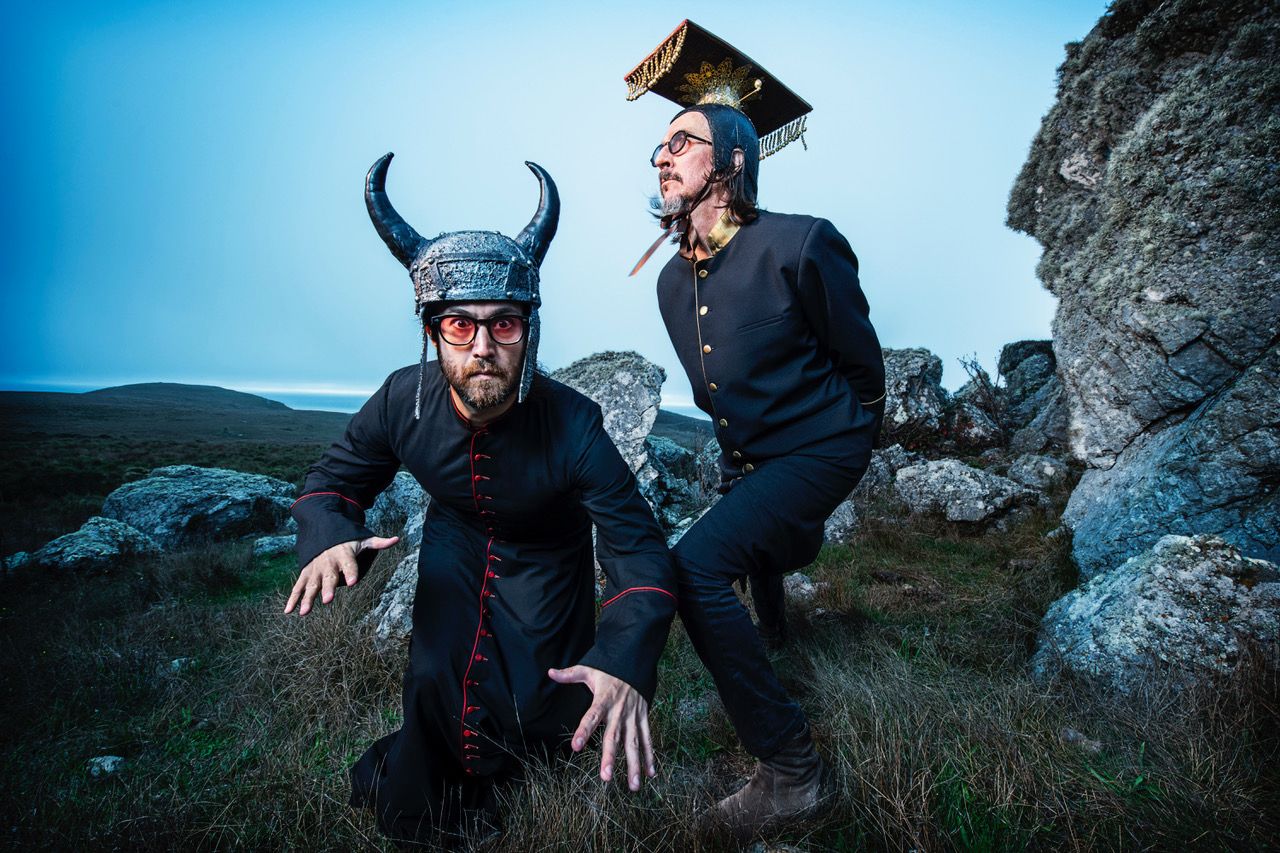
Sean Lennon and Les Claypool return with the third album from The Claypool Lennon Delirium, The Great Parrot-Ox and the Golden Egg of Empathy—an ambitious concept record that both skewers and warns of the accelerating rise of AI.
This isn’t just a listening experience. The double album arrives with a lavishly illustrated 24-page comic book that deepens the narrative and visual world. Fans of Claypool’s offbeat imagination will find plenty to latch onto, from talking paperclips to oddball creatures and surreal stops like the Troll Bait Café—characters that feel unmistakably born from his singular creative lens.
We caught up with Lennon via Zoom from his home in upstate New York. Though the son of John Lennon and Yoko Ono, he’s long carved out his own artistic identity. While this project may be his most visible, Lennon’s résumé also includes work with Cibo Matto and a range of solo efforts.
Meanwhile, Claypool’s eccentric songwriting and virtuosic bass work—best known through Primus—continue to anchor the project’s sonic adventurousness.
Still, Parrot-Ox stands out as something more: a strange, layered fusion of challenging music, surreal storytelling, and deeply human artistic expression.
What came first, the story or the songs? They’re very intertwined.
Well, I would say the story kind of came first, but some of it was simultaneous. We spent a long time trying to write a concept and a narrative for this album. We knew we wanted to do a concept record that was like a rock opera. We had talked about Yellow Submarine, and it would be cool to have our Delirium version of a story. And it was really, actually difficult. It took a very long time. Les is a great writer, and I’ve written screenplays and stuff, but we’ve never done that together. We’re really fast with writing songs, and I guess it’s because we have our way and the way that we work together that kind of is our system. For the most part, Les will have a song idea that’s mostly done, and then I’ll help him finish it off. And the same is inversely true. Meaning we do that kind of how John and Paul wrote songs. You know, it’s like, “Check out this songwriting. What do you think?” Whereas writing a story together is actually a very different dynamic.
We actually came up with one or two completely different stories before we settled on this one. We were recording, making songs and ideas, and jamming the whole time. We probably had a couple of musical ideas we incorporated, but for the most part we didn’t want to get into songwriting until we had the story, because we knew we wanted to write songs around it.
The theme is inspired by current events: ChatGPT, Palantir, and so forth. What about the fantasy elements of the story? The talking paperclips and so forth. The art itself seems Crumb-inspired.
Well, Crumb is obviously somebody that Les and Rich Ragsdale, who drew the comics, and I are really into. Honestly, I can’t say enough about how much I love Robert Crumb, and I actually own an original Zap comic cover that he drew. I’m really into comic books. Les is essentially a cartoonist. I mean, he’s great at drawing. Why the fantasy element? We didn’t necessarily think of that, but I think we all share a similar taste.
And Les is really great at coming up with characters. I’ll never forget when he said, “What other characters should we have in this story about the paperclip dilemma, the paperclip robot? And he was like, “How about we have a parrot ox that’s like half parrot, half ox, and it’s the paradox.” And I was like, “Dude, that’s fucking amazing. And he goes, really? He was like, ” You like it? I was like, not only do I like it, but that should be the title of the record, like the Great Paradox or something.” And he had this idea about an egg. He had an idea about it, he said he keeps seeing a golden egg. I was like, “Man, if I went into a record store, and I saw some weird prog band with an album called The Great Paradox and the Golden Egg of Empathy, I would buy it without listening.” And so that’s kind of where we got that. Les’s entire catalog is populated by these very fantastical creatures and characters.
He’s definitely a kind of fantasy writer, in a way. I’m considered a weirdo by, like, almost everybody I know. But I’m kind of the more normal person in our collaboration, and I’m thinking more about basic story structure and stuff like that. But he’s really got an innovative, surrealist imagination, and he came up with a lot of amazing stuff. He came up with a manatee, too. Which is funny, because I didn’t realize that people would kind of associate the manatee with the walrus. It’s so funny, I didn’t realize that, though. I’m really dumb.
But as soon as we dropped “What a Predicament (WAP),” the first single, which had the animation of the characters riding the manatee, everyone was like, “Oh, it’s the walrus. And I was like, oh, fuck, I didn’t think of that.” But anyway, we were not thinking about the walrus. We were just trying to figure out how to create a character that represented nature. So, you know, young Hippard comes from this techno-empire where his dad invented the paperclip machine, and he’s very wealthy. But his dad is destroying the planet, and he doesn’t realize it. And the son kind of discovers what’s really happening and winds up kind of collaborating with what I would call these forces of nature, the manatee and the great paradox.
At the end of the comic, the themes are laid bare. The meaning of the “paperclip problem,” the concerns about AI. Did you have any concerns that you would violate the writer’s maxim of “show, don’t tell”? Would you consider that more of an activism moment where you wanted to make sure the message got through?
That’s interesting. And for me, I think it was more about the character of the way we tell this story is kind of funny to me. We have the paperclip kind of wrapping up the whole story in the end, and this is a fable about man and paperclip, or whatever he says. It’s all supposed to be kind of tongue-in-cheek and fun. So instead of worrying about exposition or something, it’s more about creating this kind of kitsch tone where, you know, it’s like, “Okay, kids, well, the moral of the story is…” That’s the style we were kind of going for. And, obviously, we don’t take it that seriously.
It’s a fun piece of art. To be honest, if we were to do a film version of it—or an animated feature—I think we would get a lot more serious about making it entertaining and compelling. And I think a lot of what you’re talking about in terms of exposition or “show, don’t tell” is really important to think about when you’re actually watching a film, because the reason you don’t have characters do too much exposition is that it just makes it boring. And you also don’t believe the story, because you don’t have time to discover what’s happening, because the characters just say, “Oh, we need the magic amulet, which has to be put in the thing,” and they tell you all the details, and you’re like, “Okay, well now I’m not interested.”
So, it’s more about how to make your story compelling. I think for the comic book, it works really well to have this kind of moral of the story thing from the clip keeper or whatever we call them.
You mentioned your dad and Paul before. I hear Beatles elements in something like “WAP,” for example. It has a sort of Beatles lilt to it, I would say. I hear some of those elements in your overall catalog, but I also hear a lot of music that has nothing to do with the Beatles or whatever else your family was involved in.
Well, first of all, I would say that I find that interesting because “WAP” to me was a T. Rex thing. Like I was trying to be equally unoriginal, but it was a different source in my view. I think that I do genetically have a little bit of tone that might remind people of my dad a lot in my voice. And then I also learned music by playing the Beatles. So, I think my muscle memory is going to be reverting to a lot of Beatle-y kind of melodies and chord changes, because that’s sort of where I come from.
At different times in your career, finding the balance has been hard. You struggled with the promotional cycle for your first record, Into the Sun, amid questions about your family. But then at other times you’ve curated box sets compiling your father’s work or been involved in documentaries keeping your dad in the zeitgeist, in your own words. How do you know where the line is?
I was 21 on my first press campaign and I was so green. I had no idea what was going to happen. And in fact, I had been in this band Cibo Matto touring for a few years already. And when I was touring with them, I just had what you could call a normal experience of being in a band. No one was asking me about The Beatles. We would play shows, and our fans would come, and it was just really fun and easy. I was so naïve that I thought, “Oh, well, now I get to deal with Grand Royal, friends of Cibo Matto. We’re all kind of a group here, and I’m going to put out a record, and people are going to kind of take it for what it is.” I had no idea how impossible it would be for people to see me as a person, not just a sort of signpost for my genetics. And it’s on me that I didn’t see that coming.
But it’s been a long time. I’m 50 years old, and I think very early on, I stopped trying to avoid people talking about my dad or about my parents, because it wasn’t something I wanted to hide. I was always openly influenced by them. I’d always said the reason I played music was because of my dad. And in fact, my greatest music teacher was my mom, because I was in the studio when she made albums. I learned about slap delay, compression, and harmonizers for vocals, and all sorts of other stuff, directly from my mom.
I never pretended that I wasn’t sort of a product of those two people. I think I just wasn’t ready for the degree to which most people will see me only as a sort of reflection of my parents, or like a cardboard sign representing John and Yoko. I think it’s taken me my whole life to just sort of accept that. And it’s just the truth. It’s just the reality.
However, my private life isn’t like that. Again, my friend group are my musical peers. And they’re people I grew up playing music with and learned the ins and outs of music with. And it has nothing to do with trying to reflect on The Beatles or my parents. So, it’s not like I’m miserable about it. It’s really just a press thing. I think a lot of people, when they come to see me, they only see me as a sort of trigger to remind them of my parents. Especially older people. They don’t actually see me. I actually don’t think it’s technically even possible for me to escape. For example, my brother had a number one album (Julian Lennon, Valotte, 1984). He was one of the biggest rock stars in the world when that came out. And he still gets it just as much as I do.
Your parents are larger-than-life figures and icons in the world of rock music. And you look a lot like them. Nobody’s going to look at you and be like, “Really? Is that guy really the son of John and Yoko?”
Everyone looks like their parents. People notice that and they point it out to me, “Oh my god, you look like your dad.” You’re only saying that because my dad is this big figure to you. But obviously, everyone always looks like their parents. It’s not like a weird thing at all.
I look exactly like my dad. It’s just that people don’t recognize him.
Exactly. It’s the only difference (laughs).
Before you’ve said the band is progadelic. What does prog mean to you? Are we talking about ‘70s prog rock with Genesis, Yes, those kinds of things? Or are we talking about progressive in, I guess, the adjective sense, where you’re trying to progress music forward?
Well, look, I mean, these labels are always tenuous and kind of only useful inasmuch as you find them useful in the moment. They’re just useful in trying to communicate with people, but they don’t really mean anything. When I say it’s prog, progadelic, I think it’s really because I just want to make sure we have an excuse to do like a fucking 12-minute song. Or play one bar in seven and then one bar in five. As soon as you kind of escape, or go outside of the standard rock and roll format and you’re doing stuff that’s a lot more experimental, not just in terms of concept, but in terms of chord structure and time signatures, people usually associate that with prog.
So, it’s just kind of an easy way for people to understand that if you’re going to buy a Delirium record, anything could happen. But none of those labels are actually that important. And frankly, I don’t think our records sound like Yes. They just sound like Les and I. And Les and I have very specific personalities. And our music is the fruit of our weirdness. And I find labels sort of like stifling or kind of silly, ultimately, because it’s such a cliche. But music is just music, you know what I mean?
Comments
Loading comments...
Leave a Comment