
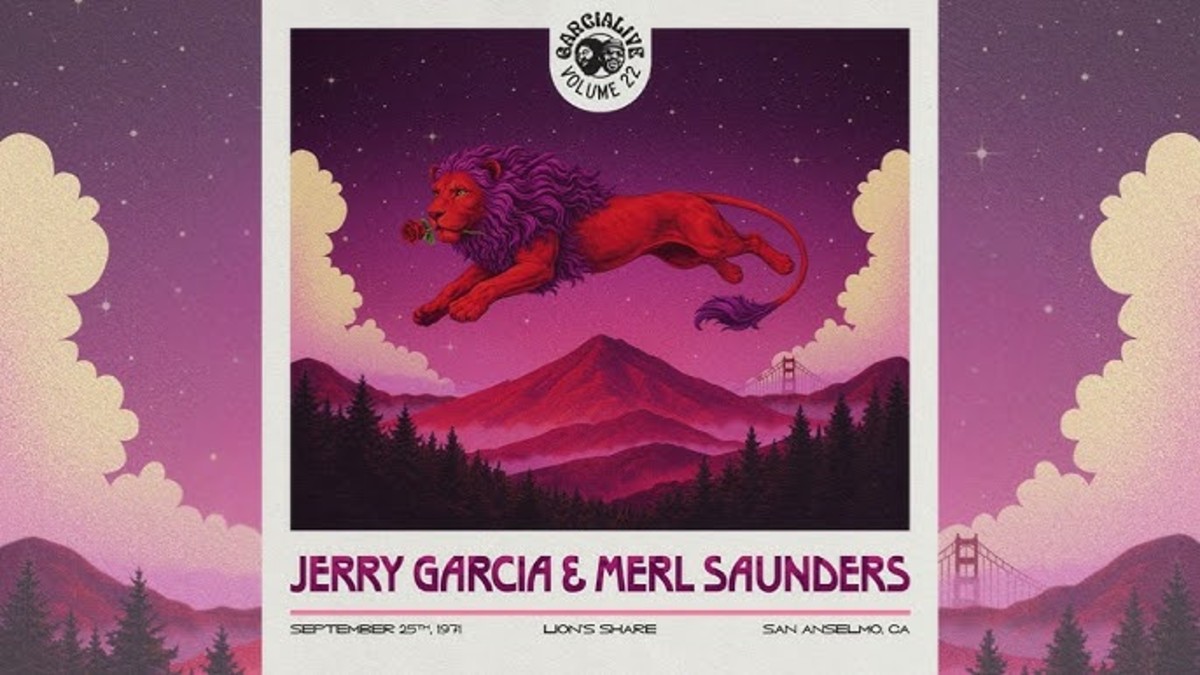
The curators of the GarciaLive archive series have always taken great pains to avoid undue repetition of content, and Volume 22 is a case in point. Nevertheless, September 25th, 1971, at Lion’s Share has its precedents: Betty Cantor Jackson and Bob Mathews recorded at the same tiny San Anselmo, California venue for Volume Six, while Volume Twelve features a similarly novel lineup of musicians accompanying Jerry Garcia and Merl Saunders, most notably vocalist Sarah Fulcher.
The wild card on this most recent exhumation from the vault is guitarist Tom Fogerty, still becoming comfortably ensconced in such proceedings following his departure from Creedence Clearwater Revival (during this time, he played on studio albums with the two co-bandleaders, too). And further adding to the undercurrent of serendipity on the occasion is the appearance of Grateful Dead’s Bill Kreutzmann.
Sitting at the kit in place of its usual inhabitant during this period, Bill Vitt, the drummer for the iconic band makes for a steady yet fluid rhythm section in tandem with long-time Garcia counterpart bassist John Kahn: they never falter even in the most exploratory passages within these two sets (captured almost in their entirety on tape with the exception of the early interval’s closer, The Band’s ” “The Night They Drove Old Dixie Down”).
Deep within the instrumental dialogues comprising “Manchild,” ten minutes out of a total forty or so in the late show, the ambiance is that of an after-hours jazz club on an ever-so-rare occasion where spooky noir melts into the rollicking adieu of “W-P-L-J.” In the process, the individual personalities of the players mesh into a collective musical entity far greater than the sum of its parts.
Apart from Garcia’s request to turn down the lights, no voices appear until roughly sixteen minutes into the first of two fall ’71 shows. “One Kind Favor” is an elegiac reading of Blind Lemon Jefferson’s “See That My Grave Is Kept Clean,” retitled but in no less effective form. The same might be said of this loose appropriation of John Lennon’s “Imagine”: bereft of its soporific verbiage, the arresting melody shines much brighter, especially as it is an immediate segue from the occasionally dark and abstract take on Saunders’ environmentally oriented “Save Mother Earth.”
A chipper instrumental adventure through Stevie Wonder’s “I Was Made To Love Her” reminds one of Jerry’s fondness for all things Motown, and its near-majestic close presents a tasteful contrast with the easygoing shuffle of Jimmy Reed’s “Baby What You Want Me To Do” (sung largely by John Fogerty’s sibling, though it is not specified as such).
Closing with Jesse Winchester’s “Biloxi” is a provocative move because the arrangement highlights Merl’s sumptuous organ playing. Cushioning as it does the abjectly melancholy of Garcia’s voice, both tones offer a stark contrast to the cathartic edge in the latter’s guitar playing on numerous occasions here: the titular leader of the Grateful Dead was clearly exorcising some demons in his forays outside the mother band at this point.
It all makes for a deceptively ambitious approximately forty-five minutes, the successor to which also includes another Winchester number, the jaunty and sly “That’s A Touch I Like.” The latter arrives juxtaposed with George and Ira Gershwin’s “Summertime,” one of the many standards Garcia was learning during his outings with Merl (not limited to the famous Keystone shows).
To that end, in the enclosed twelve-page booklet, erudite Joel Selvin provides a well-rounded historical essay that accurately recounts the sequence of events in Jerry Garcia’s initial solo endeavors. Nevertheless, the West Coast author/journalist succumbs to the temptation to offer something of a play-by-play of the proceedings, a minor faux pas if only because such accounts cannot communicate the unself-conscious chemistry the two principals demonstrate here.
Neither Garcia nor Saunders monopolizes the proceedings, though, preferring instead to draw in the other members of the ensemble as the improvisations develop into a singular display of low-key but sensitive musicianship. These interactions are inherently self-disciplined even in the most spontaneous moments.
In that respect, the musicianship on display on these two CDs mirrors the appeal of the detail in the graphic design on the inside and outside of the double-fold covers. As it is with the art, so it is with witty instrumental reimaginings such as this “Hi-Heel Sneakers”: the layers of allure seem to become innumerable, in terms of the audio, thanks in part to Fred Kevorkian’s mastering of this fifty-five-year-old recording.
It’s fair to say no entry in the GarciaLive initiative has so fully lived up to its name as Volume 22. And, in the broadest possible sense, these nearly ninety minutes constitute that rare occasion when an effort by a member of a famous band outside the group fulfills audience expectations as fully as the musician’s ambition(s) for the project.
Comments
Loading comments...
Leave a Comment