
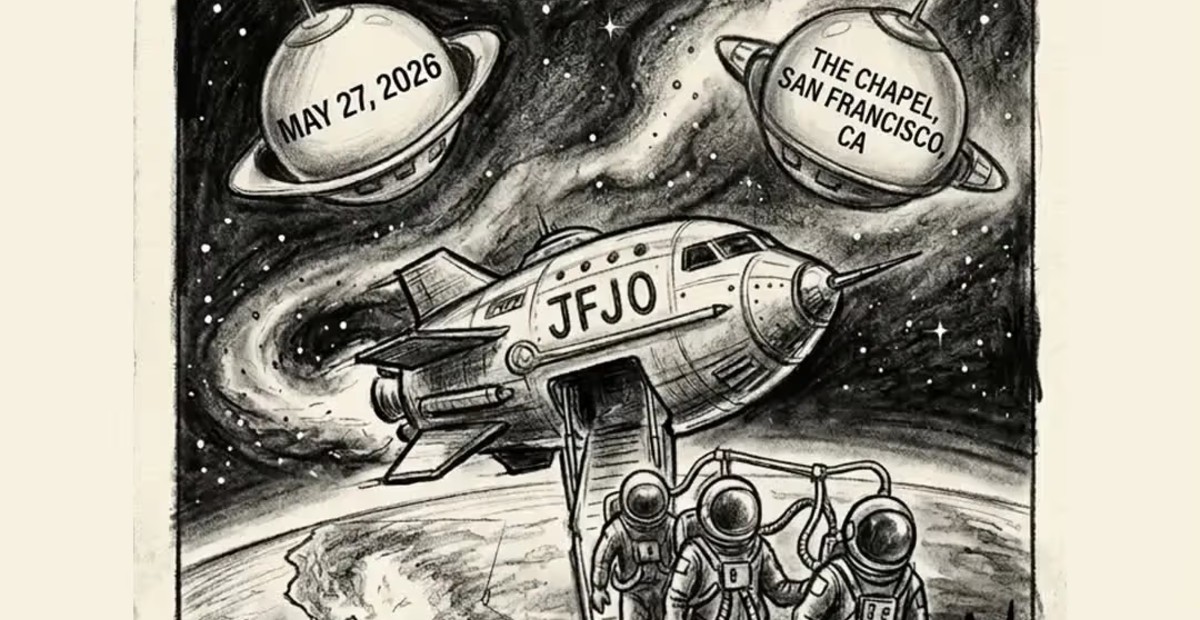
After over a decade of estrangement, Jacob Fred Jazz Odyssey will play two rare shows this week, both in Northern California. The first will take place on Wednesday, May 27, 2026, at The Chapel in San Francisco, and the other on Thursday, May 28, at The Crepe Place in Santa Cruz.
These shows follow two gigs in Tulsa in March of this year, and have some fans hopeful for a return to full activity. The electric jazz ensemble has also reunited in Tulsa for the last two years, as well as in Denver and New Orleans.
The band—notable for their abstract-yet-funky, rock-intensity sound—has gained a significant following in the jam scene and beyond. But there have been many times of turbulence since Jacob Fred formed in Tulsa in 1994 as a horns-loaded octet. By 1999, they dropped to a traditional organ trio format that might be considered the “classic lineup”: Reed Mathis on bass, Brian Haas on keyboards, and Jason Smart on drums.
This trio is currently in action, though the band has had a total of 16 members over the years. That’s the “turbulence” part. Keeping a lineup together is not easy.
We talked to bassist extraordinaire Mathis via Zoom from his Bay Area home about the status of the band, the origins of two 2021 live albums, and musical development as artists age. And we had to talk about his edit of the Star Wars prequels, which is so solid it should stream on Disney+ (good luck with that one).
For Mathis, despite leaving Jacob Fred, the music never stopped. He was a member of Tea Leaf Green, played with Steve Kimock, joined Bill Kreutzmann in Billy & The Kids, played solo gigs, and so much more.
Mathis confirmed that a new Jacob Fred album has been recorded, though how or when it will be released is unknown. “I don’t even know what the status of it would be. I don’t even know how to put out an album anymore. What is an album?”
The following interview has been edited for length and clarity.
After 15 years apart, I guess the question about the Jacob Fred reunion is “why?”
In 2020, I was already kind of starting to go through a life change. Right before COVID, I quit drinking, quit smoking. And then lockdown happened. There was a lot of contemplating. Humans don’t like to know what’s ahead. I wasn’t physically active enough, and I started having heart palpitations from not exercising. And just from holding my breath, because I was working on music a lot. And pacing in my room was hurting my knee. I was like, “Do I have a heart problem? Am I that old now?” I didn’t have a heart problem. I just needed to go for a walk.
But there was a second there when I was like, “What if I died? And even if it wasn’t COVID, or even if it wasn’t an illness, like, what if a bus hit me?” It’d be a real shame if I died and hadn’t at least gotten some closure on that part of my life that was so important. Jacob Fred started when I was 16. We taught each other how to play, and we grew up together. And when I left, it was like a divorce. I needed to make sure the story of the music was told. I have hard drives, I have bins of CD-Rs, and even cassettes of old stuff. None of the albums were that great, with a couple of exceptions. Our best work is on those live tapes. So, I put together eight hours of unreleased Jacob Fred from back in the day. What I felt like was our best work.
And then I was like, “No one’s gonna care about this” or “They’re not going to understand what this is unless I tell them.” So, I made a 25-minute infomercial about the new releases that kind of started with a short version of the band’s history. And that became almost like a mini-documentary. I didn’t tell Brian or Jason or anybody I was doing it because I didn’t want them to say, “You’re not in the band anymore. You have no right to do that.”
Yeah, because Brian kept it going.
They gave it a real strong five years after I left. I just put all the music in a Google Drive folder. I sent it to Brian and said, “Yo, I made a thing.” And he was like, “Oh, cool.” And then I didn’t hear back for a couple of weeks. And then suddenly, in the middle of the night, I started getting these texts in all caps/ “Dude. Whoa. Brother.” We got on the phone a couple of times. He’s one of the most important people in my whole life. The fact that we hadn’t spoken in 10 years just seemed like a shame.
When you left, Brian denied any real problems. He said you guys had just gotten tired of playing with each other and all this. In retrospect, does that still reflect what was going on?
One of Brian’s great strengths is his relentless optimism. And, you know, science has shown that optimism is largely delusional. In study after study, it seems that pessimists are more accurate in their descriptions, but optimists outperform them. He was carrying on and telling a story that made carrying on possible. It was a mess back in the day.
So, there was some estrangement. You didn’t talk for ten years. That’s a long time for a childhood friend.
It was awful. He called me a traitor. He said the band could finally make good music because the dark energy had left. He didn’t mean any of that. Now we have 12 new songs and a new record that we haven’t put out. And we’re playing better than ever.
So, the reunion gigs are made up of material from back in the day, as well as some of this new material?
All the new songs are getting played every show. I can’t even believe how much I love the stuff we’ve been writing. We’ve all grown so much. And definitely a lot of old stuff. Not as much as you would think, though, because the last time we got together, we rehearsed and Brian had written this huge list of all the old stuff he wanted to do, especially a lot of my older songs. He really had been practicing and really was excited about stuff from back in, like, ’01, ’02, ‘03. And I was just like, “I don’t want to visit those guys that we were.”
From the perspective of being 49, you know, these sound like the emotions of young, young people. They sound naive, they sound rambunctious. They sound antagonistic. They sound overly idealistic at times. And they’re really overdone. Like, they’re trying too hard. We’re doing some of the older tunes, but I kind of had to veto some of that stuff. I want to enjoy the shows, and I don’t really want to feel old feelings. I want to feel we’re better now.
But this is improvisational music, so even if you’re playing the songs, that doesn’t necessarily mean you’re playing them in a 2002 style. You may be reinterpreting them as the 49-year-old, right?
Those are the ones being played. The ones that feel still feel new, that have managed to be reborn. The ones that were the only way we could play it are the ones that require a 2003 approach; those are the ones I have a harder time with, just because I don’t really want to shred. We used to really try to move the audience through momentum and force. We’re living life differently.
I’m sure there’s still a lot of great memories to be made back in the day.
Around 2005, we started to become a really good band. We’d been playing for a little over 10 years. It was just sublime. With the studio album Winterwood, I feel like I was lucky to make one thing that good in my life. And of the live albums, there’s Nine Improvisations. I mean, you just don’t get better than that. That has everything we’re good at except for composing. But if I didn’t tell you those were improvs, you would think they were compositions, because they’re so orderly, and they’re so melodic. And there’s such storytelling. And we would shred less in pure improvisation than we did in the songs. Usually, I would be playing a melody on my instrument. People always thought, “Who’s on guitar?” And it was like, “No, that’s Reed on the bass.” And Brian would be playing the bass role on the keyboard. That’s why the Nine Improvisations album is probably the most representative of what’s great about Jacob Fred until the new album, which I wish was out.
Do you think at some point it’s in the cards for more regular gigs, maybe some tours or festival appearances?
Definitely, definitely. It’s important to me that we don’t leap. I want to walk. We’re definitely increasing. I could see us doing these kinds of two-night runs. You know, once every six months, then we do once every three months, and then we’ll do once a month. I don’t know about getting in a bus or a van and humping it like we used to. But we could do the real urban centers. New York, Chicago, New Orleans, Austin, Seattle. We always had great shows in those cities.
One of your primary influences is Metallica’s Cliff Burton. The music from his era is the most beloved, but the band consciously shifted to a less complex style that mirrors the change you’re talking about with shredding. Why do so many musicians want to shift from complex material early in their career to more streamlined material as they age? Phish is another example. Trey’s songwriting has gone from “You Enjoy Myself” to much more accessible arena rock kind of stuff.
I think there’s two easy answers for that. One is, you said the words “arena rock.” People playing in small venues play more intricate music. Faster, denser, more counterpoint, more dissonance, all that stuff works well in a little room, where you can hear every nuance. The bigger the venue gets, the more that stuff gets lost, the muddier it gets, the less it translates, the less fun it is on stage. The songwriting starts to take on the traits of the venues. So, with bands like Metallica and Phish, it’s like, you get into those bigger rooms, and you’re just less interested in things that don’t translate as well. So much of the immediacy of ‘80s Metallica is, like, little clubs. Same with early Phish. Jacob Fred never graduated to huge venues. But think about the difference between a big band, which played in theatres, and then Charlie Parker and Miles Davis playing to 50 people. And 50 people being a packed room. You’re just going to play a whole different style. The kind of stuff Charlie Parker and Miles Davis played in 1948 wouldn’t work in a huge theatre, you wouldn’t be able to hear what was happening, it would just sound like a blur.
So that’s one reason. The other reason is that they aren’t objective for the artist. For the audience, it’s like putting on Raiders of the Lost Ark. “Oh, man, I love this,” you know, and it hits the spot every time. But for Harrison Ford, Raiders of the Lost Ark means something completely different. It means “What was his marriage like at that time?” Or an analogy might even be—for the artist—it’s almost like an intoxicant that that your body won’t tolerate anymore. It’s not something you will observe, like an audience. It’s something you will undergo. It’s like, “Well, I know if I eat something that spicy, I’m gonna have upset stomach for three days.” You just get to a point where you’re like, “I don’t want that anymore. I literally don’t want that experience.” I’ve seen Phish, you know, and I prefer, pre-1995 Phish to anything since, although I do love the way they improvise as middle-aged men. I think there’s a lot more patience, and there’s a lot to like about their improvising now. But as far as composing, no question. There’s also the idea of being hungry. It’s almost like how teenagers are just dying to lose their virginity.
On a non-musical note, people who follow you on Facebook know you put together an alternate cut of the Star Wars prequels that is quite an achievement, to put it mildly. You make it regularly available there. How did that come about?
I didn’t have great role models in my life. I had a father betrayal wound that I had to deal with, you know, and just the general theme of the underdog and nature versus the machine-oriented overlord really resonates with me. I stood in line to see Return of the Jedi. Then it was “The prequels are coming, and we’re going to find out where Darth Vader came from. Yes!” When The Phantom Menace came out, it was so disappointing. I was angry. Then Attack of the Clones came out, and I was also very disappointed. When Revenge of the Sith came out, I was like, “All right, this is a little closer. But why is George Lucas surrounded by people that are not telling him? Any basic editor could fix this.” And if I’m being honest, a casting director should have said no a couple of times. But they did so many things right. And the basic story is awesome. Like, like the way it’s built is incredible. Probably three-fourths of the animation is amazing, but some of it’s just shoddy. And so, in 2006, I got my first laptop, and one of the first things I did was take a stab at editing the prequels.
It wasn’t very good. I did it again in 2007, a little better. I did it again in 2008. I made an edit of the prequels every year since 2006 from scratch. They were so low resolution at first, and I had the most basic free software. Every year I would show it to people in my life that were not fans, and check their response, and see when they tuned out. Then the next year, I would take all that into account. I would notice people that were not Star Wars fans would watch my edit and be engaged. I made a 2012 edit. I made a 2013 edit. They’re all different. One year, I went so far as to have nobody speak. Literally. I made a silent one where you don’t hear their voices. Nobody talks. I used all the score. I used the sound effects and I rebuilt the whole thing with nobody speaking.
Was it watchable?
I thought it was amazing. It was too long for somebody that doesn’t already know it, but I just wanted to see what would happen because the dialogue is so much of the problem. There was one year when I tried to see how short I could get them. I got Phantom Menace down to 32 minutes. And those were good. But again, if you weren’t a fan, you couldn’t quite follow, especially the first two. None of them are compelling enough, especially after editing, to watch all the way through. And so, if you don’t make it through those first two, you don’t get to the great stuff, which there is a lot of in the third movie. I was like, “Well, what if I call the third movie the present, and treat the first two movies as flashbacks?”
So, I make the third movie the spine, and I keep jumping back to the first two movies. Now that makes sense. And then once I started doing that, I was like, “Oh, if you just adjust it very slightly, those flashbacks set up the next part of the third movie.” When you arrange it a certain way, you have to keep track of less things. What I ended up with was basically like if each movie has four acts. You get The Phantom Menace act one, Attack of the Clones act one, Revenge of the Sith act one, The Phantom Menace act two, et cetera. And then, that was still a three-hour movie, but it worked.
And then after I saw Andor, I was like, “What if these were episodes? What if this wasn’t a three-hour commitment?” So, it’s just psychologically different to have the option. After I did that, it’s 12 episodes and they averaged ten minutes. I was like, “Now we’re talking.” I feel like all the pieces came together in this year’s version. And I did it in HD for the first time.
Some changes jump out. Jar Jar Binks is essentially gone, as are the real groaners in the dialogue.
A lot of times it was as simple as shortening a shot or shortening a line. Sometimes it’s like the line was fine until those last two words. Chop. Or sometimes a whole scene only needs one exchange to make sense. Sometimes these lines work better over that shot. Sometimes this line should have gone before that line. I adjusted more than you would think. The fact that it works does not mean it was simple. There’s an edit every three seconds. It’s a hundred thousand hours of work.
Comments
Loading comments...
Leave a Comment