
If Legacy Recordings’ ongoing Miles Davis Bootleg Series has proven anything, it’s that there can never be too much music from Miles Davis. Beyond simply expanding the catalog, these releases provide a rare window into his creative process — revealing how he interacted with musicians, shaped sessions in real time, and continually pushed jazz forward as a living, evolving art form. Each volume gains its power by deepening our understanding of music we already thought we knew, while also uncovering entirely new layers of invention and spontaneity.
There is still plenty more in the vaults waiting to be explored, but the volumes released so far collectively trace the astonishing range of styles Davis pioneered following Birth of the Cool and his later adventures through hard bop, modal jazz, fusion, and beyond. With what would have been his 100th birthday arriving on May 26, 2026, there’s no better time to dive into these remarkable Bootleg Series releases.
Vol. 1: Live In Europe 1967- This collection from the vault restates the case for the compact disc configuration as an efficient means of archiving for historical as well as collecting purposes. The rare sources of these recordings, most from radio and television broadcasts, don’t preclude bootlegging, but the collection in a single source speaks with a clarity the music deserves while simultaneously transcending mere academia. Seven complete concerts on CD and DVD by trumpeter Davis’ second great quintet–pianist/composer Herbie Hancock, saxophonist/composer Wayne Shorter, bassist Ron Carter, and drummer Tony Williams– depict how the ensemble drew upon reservoirs of discipline to foster spontaneity in their moments together on stage. Little wonder, as depicted in these stark black-and-white images of the two shows on DVD (complete performances, like all in this package), the fivesome indulged not a whit in showmanship: any overt theatrics could only distract the band and thus undermine its instrumental equilibrium.
Vol. 2: Live in Europe 1969– It’s little surprise that the recordings comprising this release were captured in the wake of the recording sessions in February of 1969 for the jazz icon’s seminal album In A Silent Way and prior to the release of the even more significant follow-up, Bitches Brew, in the spring of the next year. Miles Davis was clearly so inspired that he aligned a skeleton crew of the many musicians who had appeared (and were to appear) on those studio recordings in order to go on the road and hone the music in the form of “Miles Runs the Voodoo Down” and “It’s About That Time,” among others. The quality of the audio is superb throughout (notwithstanding edits on the November 5th Stockholm set), while the crystal-clarity color video likewise mirrors the lucid creativity of Miles and company: that artistry itself is a tribute to the spontaneity at the heart of the greatest jazz.
Vol. 3: Miles At The Fillmore 1970 – The intensely hypnotic and ultimately intoxicating effects of this music increase incrementally through the course of its four compact discs. More than doubling the playing time of the original four-sided vinyl release, this set argues that the band(s) of this era were among the finest ever led by ‘The Man With The Horn.’ And if that sounds hyperbolic, it’s difficult not to rhapsodize about the music: only slight rotation of tunes provides a reference point to absorb the dynamics of the ensemble playing as it moves from furious frenetics (“Directions”) to gossamer-like delicacy (“It’s About That Time”). Quotes from “The Theme” appear each night, a carryover selection from previous ensembles that here sound like an almost sarcastic comment on how far the music has come since its first appearance. Teo Macero’s distillation of the extensive recordings extended the groundbreaking production approach he and Miles began on the two halcyon studio albums of this era.
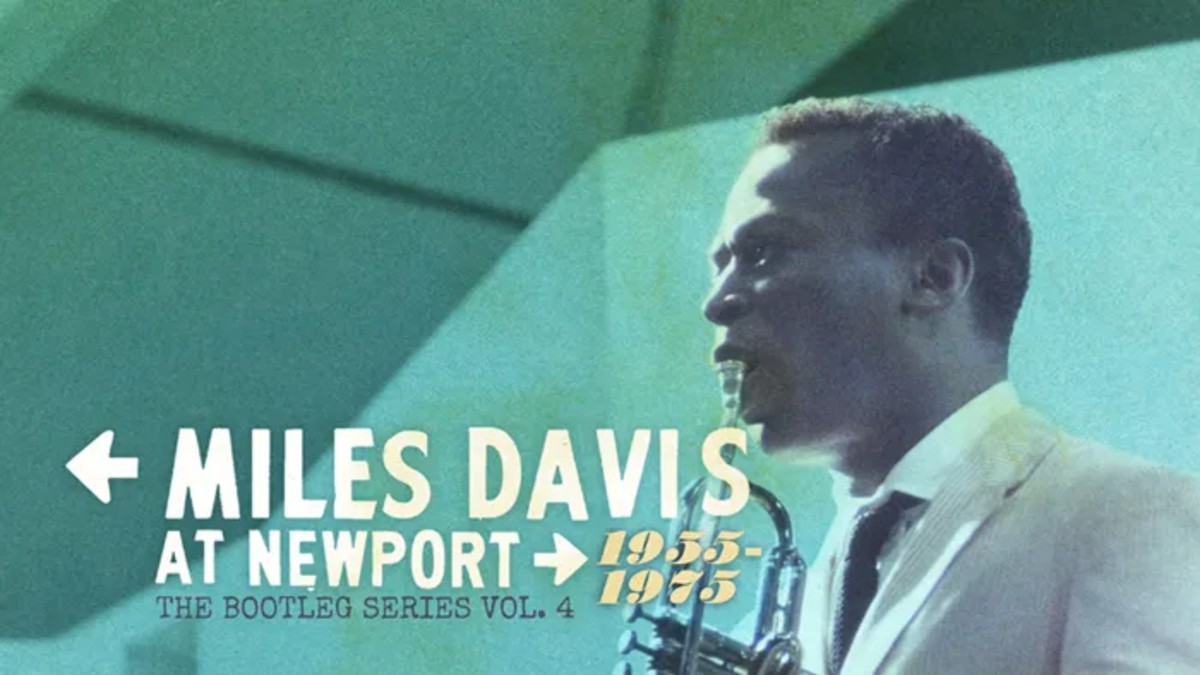
Vol. 4: At Newport 1955-1975 – The ascension of Miles Davis as innovator and cultural figurehead couldn’t be outlined more effectively than on this set. Just hearing the intros to the earliest recordings is evidence aplenty that there’s no hint of overstatement, but there’s also clarity and purpose in the musicianship of kindred spirits finding their own level, individually and collectively, on the stage of George Wein’s famous festival. Heard in sequence, the grand leap from these acoustic-based performances, including “All Blues” and “Seven Steps to Heaven,” to the electrified (and electrifying!) likes of the late Sixties/early Seventies material remains awe-inspiring even after absorbing the complete 1966 concert of the ‘Second Great Quintet.’ By 1975, the addition of electric guitars by Pete Cosey and Reggie Lucas — evidence of Miles’ admiration for Jimi Hendrix —turned the sound into a volcanic flow, accentuated by additional percussion from Mtume. Davis’ own horn thus accents the skills of those around him.
Vol. 5: Freedom Jazz Dance – If ever a band of Miles Davis’ deserved the high-intensity inspection/dissection represented by The Bootleg Series, it is his ‘Second Great Quintet.” With the bandleader as the great catalyst for composition as well as arrangement, then recording(s), the rapport between Hancock, Shorter, Carter, and Williams is virtually unparalleled in the history of jazz. Accordingly, to hear the machinations behind their creations here is almost as fascinating as listening to the ‘finished product’ itself. Liner notes rightly suggest using headphones to hear all the nuances, one of the major revelations of which is that, much more often than not, the working recordings lead to much shorter master takes. The give and take between the five musicians (often including producer Teo Macero) is completely unself-conscious, verbally as well as instrumentally: perhaps because there is no lack of ideas, there is no apprehension about cutting out parts and condensing longer performances to their essence.
Comments
Loading comments...
Leave a Comment