Street Eaters are an Oakland, California-based post-punk rock band who just released their new album, Opaque, via Dirt Cult Records. The record channels a lot of emotion and struggle, and has the climate and feeling that we’re all familiar with these days where police action and immigration raids seem to be the new normal. However, the album is also very personal and relatable, and mines the experiences of the band members in this fraught environment of the past few years. It actually spans the period since their 2017 LP, The Envoy, for co-founders Megan March (drummer/vocalist) and John No (bass/vocals), who have also been joined by guitarist Joan Toledo since 2019.
During that intervening time, a lot has changed in the world, including Megan March having a child, and the members of Street Eaters had plenty of life experience to bring to the table for this new effort. For all of them, working in multiple creative and community fronts is common, and they pride themselves in really “living life” and then bringing that wide-ranging life into their music. I talked with Megan March about the ways in which the new songs reflect the “haunted” feelings we can have about the past or future, the band’s love for making music videos, and how remaining tight-knit is their survival strategy in a chimerical world.
Listening to this album made me think about setlists and how the songs would go together in a show. Though it would be a very high-energy show!
Totally. It’s all about the experience. I know that a lot of people listen to singles, or one song at a time, like a mixtape, these days. But there’s something that’s really special about allowing a band to really transport you into another dimension, so you can really understand the universe that they are trying to create and paint for you.
That’s a great comparison. Your video for “Spectres” really supports that, because you’ve got some live play scenes there, and you’ve got the lights and the texture, and then you’ve got the other image-based scenes, like the junkyard with the door that won’t open. The texture really meshes.
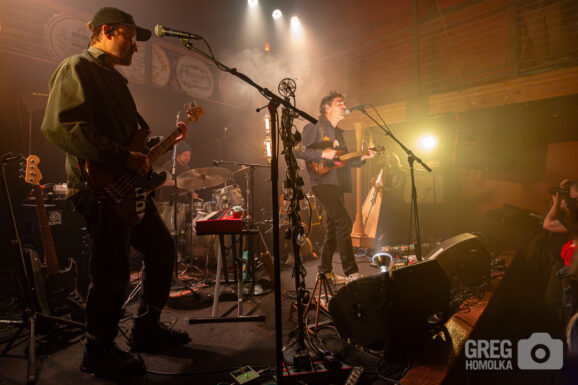
I love that you picked up on all those details, because that was really what we were thinking. The visuals are a part of the band. We really enjoy doing videos, and the album artwork is really important to us. It always has been. With “Spectres”, we were thinking about showing the band playing live, and what that energy feels like, and also that I’m singing and playing drums, and John is ripping it up on the bass, and Joan is totally going off into another dimension on guitar. But it’s also bringing in the element of haunting.
So there’s this ghost-like figure that is in search of something. There are doors that won’t open. There’s a running towards something, or running away from something. There’s also a really cool moment where the feet are kind of walking up Joan’s guitar neck, trying to put those two different worlds together and thinking about the ways in which we haunt ourselves. That’s whether that’s things from the past, or thinking about the future. I think that says a lot to mental health, and struggles with depression or anxiety.
Now I’m thinking about the “feet” part of the footage, since you do show them several times, walking on different surfaces, but also walking up to that door, and that’s the transition, right, between the two worlds? Not to get too esoteric, but it made me think of music being a bridge between worlds.
Exactly, and I think there are a lot of parallels between art and music. That’s one of the fun things about getting to explore an art form like a music video, where you can play with different visuals and concepts that are part of the music. The song has lyrics, which have their own meaning, and then you have the music itself, which also speaks on its own level. When you bring in visuals to that, it makes it a really rich experience. I think that’s really fun. Also, bringing in the live element to it was important. We have shown some live footage in some videos that we’ve made in the past, but I don’t think it was necessarily as immersive as this one was.
It’s funny how it all came about, actually, since we were playing a show in San Francisco at The Knockout, with Lydia Lunch, and I had the camera there. Spur of the moment, I thought, “Maybe we should get some footage, or see what happens.” A friend of mine was there, Helena, and I asked her to do whatever she wanted to do. She suggested I ask her friend Joey, who was there, who ended up being a music photographer, so the camera ended up in some great hands. That was an absolute happy accident. When we looked back on the footage, it was obvious that he knew what he was doing. So, later, when we went to film the ghostly figure, we were thinking of how those two elements would come together, and how to open the veil between these two worlds.
That’s so cool. It’s a little David Lynch-like, right? Opening the way between these realities, parallel to each other? It’s very psychological.
Yes, absolutely! It speaks to what the song is about, too, watching someone struggling through a traumatic experience, being there with them, experiencing it with them, as much as you can. I think that also parallels to our need to be there for ourselves. It’s kind of like being your own friend support when you’re going through something that’s really tough. That’s kind of the idea of the haunting ghost, trying to search for a way through that.
That really speaks to me, because I was always brought up to be very pugnacious in the face of difficulty, so you don’t really acknowledge how severe the conflict or issue may be, or how it wears you down.
Yes, that’s like stoicism!
I like this idea that you have to be your own friend, since that takes some of the energy out of the struggle.
And I think that’s very empowering. It’s the idea of finding the power to be there for yourself, and to find survival. We are living in some really fucked up times, where we are experiencing all sorts of violence in one form or another, especially state violence. We need our community, and we also need to be kind to ourselves.
The song “Tempers” creates a feeling of being confined against one’s will, or stuck in something, and also looking for a solution for this duress. The video really reinforces all of that.
Absolutely. It’s being trapped in a waiting room, and trying to play by the rules, and be patient for whatever help you need, and then realizing that it’s not coming. There’s betrayal in that sort of social contract that we might have. And in the end, you just need to rip up the room and destroy it.
The band does sort of walk away at the end, but watching the video, I still felt anxiety, like there’s no way out of that room.
Like, “They’re trapped!” I guess John does kind of slowly slink off, and there’s kind of a collapse. There’s some beautiful joy in that, too, since we’re trying not to crack up at the end. I think that just speaks to how complicated things are. There’s a lot of anger, and frustration, and sadness, but we have to still find those bits of joy with each other.
Our band is very close. The three of us are definitely a tight unit. We practice every week, and Joan stays over, and we kind of have sleepover vibes, where after practice, we eat some kind of trashy junk food, and sit on the couch, and watch some kind of terrible TV show. We kind of unwind together, and I think that’s why the band is so important to us. We need to have that time together, and we’re also intensely creative people who have found a very strong stride together. We’re working on new material, and it’s incredibly collaborative and exciting. I love that we are always moving forward. We have all these irons in the fire and we are propelling those things forward. We’re already working on demos for the next record, which I think is super-exciting.
That’s another reason why it’s cool to see the live play elements in the “Spectres” video, because it shows that energy of the interaction between you, and suggests a lot of what you’re talking about in the band dynamic. All of you are extremely energetic people.
Slightly insane! We gotta do what we gotta do. I am currently getting my MFA in Fine Arts, with a focus in Sculpture. Joan works for a well-known bookstore and is a labor organizer. John is an author who put out a book called Teaching Resistance, which is about radical pedagogy. I think the three of us just really need to keep busy. I really admire John and Joan for all the stuff that they do, which is constantly very intensely creative.
Do you think that there’s a plus side to working in multiple fields at once? Does that bring energy into the music that might not otherwise have happened?
MM: Oh, absolutely. We’re living lives, and I think that we’re writing songs that reflect that. We’re not stuck in the strange industry K-hole, of writing songs about touring, you know? Or about animosity among your band members. We’re a tight unit, and we exist in our mental universe, but we’re also very much alive and observing what is happening around us, in our smaller community, but also politically and culturally.
That’s very inspiring. I appreciate that.
I think it’s important to make interesting art. I guess there’s a place for art about art, or music about music, but I am someone who likes to keep moving forward, and I think everything that we do informs what we do next. Maybe that’s also why I really like albums, because I feel like they are a body of work. I think there is a place in time where there was a sentiment that really needed to come out and be examined from several different perspectives. And that’s what an album is.
Like we were talking about earlier, it’s looking at a certain event, or a certain place in time, but from different perspectives. Because emotions are really complicated. There’s no binary.
That reminds me of what you just said, that it’s a continuum, too, and what you create now is influenced by what you created before. One of the things that I’ve noticed working in creative fields is that peoples’ work tends to break down when there’s a lack of continuity. When something interrupts their life hugely, or they make a big change without elements of continuity.
Right, because you’re bringing your context and your experiences with you, wherever you go. That affects, too, how we interpret art or music. Everyone comes from their own perspectives. I understand what you’re saying, though, about some big, huge event in people’s lives being somewhat paralyzing.
For instance, there are people who understandably want to move to another country right now, but that takes a lot of mental and emotional work to make sure that will be workable for a creative person.
Sometimes we do need those big changes, even if it feels like you’re having to make a change by defense, rather than by choice. I fantasize about leaving, too, and even the adventure of it. It’s very complicated, and there are a lot of reasons not to leave, as well. I have a six-year-old son, and I think about what kind of world he’s going to be growing up in. That doesn’t really seem like a fair choice, either, so I don’t know. These are tough questions in life.