Instrumental Rock ‘n Roll band, Los Straitjackets, released their new album, Somos Los Straitjackets, on September 19th, 2025, via Yep Roc Records. It marks their first all-original album since 2012, and a change in approach as they headed to Chicago to work with Alex Hall at Reliable Recordings (JD McPherson, The Cactus Blossoms) to track it.
Touring relentlessly for the majority of their career, Los Straitjackets have also been Nick Lowe’s backing band for more than ten years, so have a deep identity in performance and in-person collaboration when it comes to songwriting. Drawing on many years of material that has continued to evolve, the album features many brand-new compositions, and also a few that have grown and shifted into entirely new creatures over time, captured in their new form for this collection. I spoke with founding member Eddie Angel while he was out on tour about the song-first approach that the band holds dear, and some of the new experiences this album offered to Los Straitjackets.
With this new album, I know that some of the songs have very different histories. It must have been hard to choose what to record, given the sweep of time this album covers.
Usually, someone just comes up with a song and says, “Let’s try it.” Lots of times, people think you have a strategy, but you really don’t; you’re just winging it all the time. [Laughs] But it’s very true that these songs span a long time, and it’s been a long time that some of them have existed, but when you go in to record them, you do them a little differently, with different ideas and arrangements. For instance, the song “Spin-Out.” I recorded that song, probably 20 years ago, with one of my other bands, called The Neanderthals. But we revamped it, and it’s very different. We got Tom Kenny, the voice of SpongeBob, to do voice-overs on it, which I think makes it really cool. It’s a really different-sounding song now than the one I did 20 years ago.
And another one, “Catalina Farewell”, is from one of our songs from a previous record, called “Catalina”, but I totally revamped it. I wrote a different bridge, and I played it at a much slower tempo, and it’s got harmony guitars on it. It’s a way different animal now. Some songs are kind of brand-new, but the album is all different things, all different avenues by which songs have come together. We don’t just get together one day, sit down, and write the whole record.
Are the possibilities ever daunting?
There’s that. We also live spread apart, one of the guys is in LA, and I’m in Nashville, and two of the guys are in upstate New York. So to get together and record, we have to plan that out. When we do get together to record, we have these sessions where we knock around ideas and see what’s working. Then, when they are on the road touring, we might do that at soundcheck, or something like that.
That’s got to be the time when you see each other the most, when you’re touring.
Oh, yeah, absolutely, because we tour a lot.
You really do!
Yeah, we’ve been touring for 30 years!
Someone told me recently that it’s becoming far less common for people to spend so much time on the road, year after year, as you guys do. Do you feel unusual in that way?
Yeah, that’s all we know! We don’t know what else to do. I didn’t know that, that’s interesting. What do you do if you’re not touring? I guess you’re trying to get yourself on social media. Or else, how are people going to know about you?
Live play is such an important thing for you all. You are performance people above all.
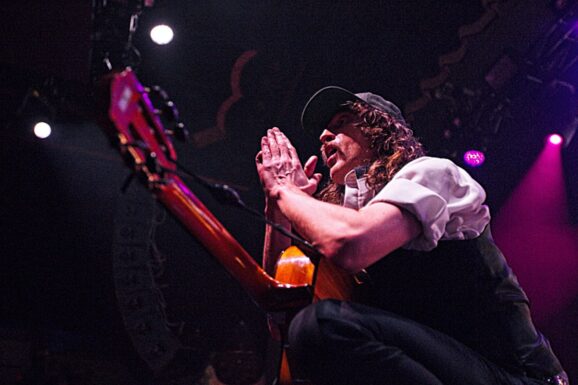
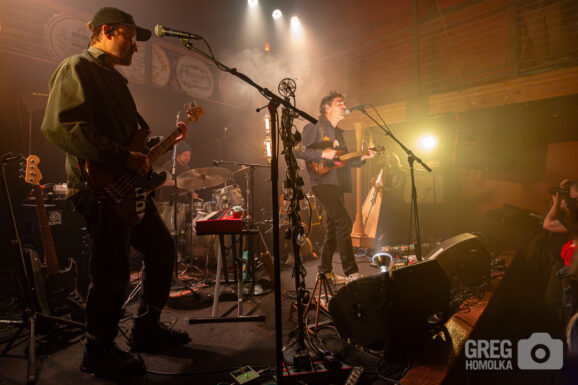
Yeah, we’ll put on a show. I mean, we’re up there in wrestling masks, with matching guitars, and matching outfits. [Laughs] That’s what we’ve always done. We want to perform. We want to put on a show.
With the sets that you play now for Los Straitjackets, how do you select your songs? Are they from all over your discography? Do you change that up?
Our set is everything from our first record to Somos Los Straitjackets, our new record. There’s 30 years of recorded stuff, so we still do stuff from our first record. There are certain ones that you have to do that become like your standards. It’s a very wide range of stuff.
Not many bands can look over 30 years of work and make observations about that. Do you think you sound different now than you did on your first album? Have there been changes over time?
No (laughs). Not at all! It’s still two guitarists, bass, and drums. We never try to add new instruments, or anything like that, or change stylistically. What we try to do is come up with good songs. That’s sort of our M.O. We want to write good songs that are fun to listen to. Kind of like The Ramones, you didn’t expect them to change much; that’s what you were going to see. So it’s the same with us. You come to see us if you want to see guitars and instrumental Rock ‘n Roll that’s kind of vintage. We’re not all of a sudden going to bust out into a jam session or something.
As an audience member listening to this album, I feel like each of these new songs has something about it that’s a core idea. I don’t mean a story, necessarily, though it could have one, but I mean a kind of sound idea or attitude. And that’s what the song is. And that makes each song very distinctive.
I think that’s right. With an instrumental, you’re trying to capture a feeling or trying to make it cinematic somehow. Sometimes you want to make it a really fun Rock ‘n Roll song, and sometimes you want to make it more orchestral-sounding. Sometimes in the early days, interviewers would ask, “How can you just do instrumental music??” But when you look at the world of music, at large, most of it’s instrumental music. It’s Classical and Jazz. An instrumental can conjure up all kinds of emotions, you don’t need a singer to do that.
I know of a few instrumental bands who are working in Rock and Psych Rock, and there’s just so many more kinds of instrumental music than people typically think about. There’s probably more kinds of instrumental music than any other kinds.
Exactly, yes. There’s a whole world of instrumental music, but people probably just think in terms of what’s on the radio, and Pop music.
Do you feel like you have to be aware of what other instrumental groups are doing, or do you focus wholly on doing what’s right for you guys, and try to leave that comparison out?
Sometimes I’ll look around out of curiosity, but I don’t actively do that. Sometimes, if I hear about a band, I’ll check them out. I do pretty much stay in my own little bubble, but I’m curious at the same time. Sometimes when I start looking around, it feels overwhelming how many people are playing music and doing things. You do have to kind of put on blinders and do your own thing.
I heard that where you recorded and how you recorded this time was influenced by going in to record one of Nick Lowe’s albums previously. How did that impact you?
A lot of Nick’s record was recorded at this studio in Chicago called Reliable Recorders, and we were familiar with that studio since actually a good friend of ours started it, Jimmy Sutton. We knew him and this guy Alex Hall, who took the studio over. So we were familiar with him. We were fans of what came out of that studio, like JD McPherson and The Cactus Blossoms. It was so comfortable to record there that we thought we should, too, and it was a wise decision.
It was really comfortable, and I don’t like recording studios, in general. They are like going to the hospital or something. It’s a sterile environment, and then you have to try to come up with something. But this was very homey, and there was the added bonus that Alex, who was good friends with the band Wilco, let me borrow a lot of their gear, including guitars and amps. We had access to some cool stuff.
You had also had a chance to literally hear your own playing as it sounded in that studio, too.
Oh yeah, and we’re a big fan of Alex, who’s a great guy, and also a drummer, who plays in Chicago in a lot of bands. Most of our other stuff, we’ve recorded in our bass player, Pete [Curry’s] studio, in LA, Pow Wow Fun Room. Obviously, that’s comfortable. But when people say, “Hey, man, you want to go into a recording studio?”, I say, “No, man.” (Laughs) It’s not something I look forward to.
That’s enviable, to have a studio that belongs to one of your own.
Exactly, and there are no time constraints. You can mess around for as long as you like.
Then what prompted the change?
It just seemed like the time to try something different. You know that you’re going to do something a little different if you choose a different studio, so it seemed like a good idea for the time.
One of the new songs, one of yours particularly, is “April Showers.” I heard that it had an earlier iteration or demo. Did it change much in the new version?
Well, that song came about in the pandemic, when everyone was locked in. These things just come to you. The intro riff just came to me, and I recorded it, and sent it. Everyone was home, not touring. I sent it to our manager, Jake, and he actually came up with a little melodic idea for it. I think I took it and tweaked it. It just came about from bouncing ideas back and forth, remotely. We recorded a version of it remotely, too, and that actually got put on Spotify. But we went in and re-recorded it to try to get better fidelity, and I think it actually turned out better.
And actually, my son played on it. He played on three tracks on the album, and he played on that. It was a roundabout way of writing. We recorded it in Chicago, but on his laptop, my son was able to overdub a few things. It was a weird use of both modern technology and older technology. For me, that’s an odd way to write a song, remotely.
For you guys, writing together is a very human thing.
Yeah. As you’ve probably realized by now, you’re speaking to a luddite!
Well, I think I’m speaking to a musician, really. A lot of people across genres feel this way. It seems like people coming up from a continuity in musical tradition write the way that you all do, but people who might be coming to music new, now, might write and record more remotely.
Right, exactly. But it was a new experience for us. I had never written a song like that.
Would you do it again that way, or do you prefer not to?
I’d do it again.
I really appreciated how unhurried and dreamy “April Showers” is. It’s very mood-driven. And everything on the album is different, but that has its own pocket. There’s a little bit of a sci-fi mood and feeling in “Polaris”, for example. Then, “Cry for a Beatle” has that big, classic sound and early Rock feeling.
That’s definitely an homage. Our drummer wrote that one, who also plays guitar and bass. He plays guitar on that. Our bass player is playing drums, and I’m playing bass on that, so we all switched around. The Beatles used to do that, actually! But it’s obviously an homage to The Beatles. Are you familiar with a song called “Cry for a Shadow?”
Oh, sure.
For that song, The Beatles were doing an homage to The Shadows, so we came up with that title. That’s a fun one. Basically, we’re just trying to come up with a good song, and that’s the number one criterion, then the next one is to have variety, and then the next one is to have a good performance. We’re all big Beatles fans, and they wrote great songs. But as far as instrumental bands, one of our models would be The Ventures. They always wrote songs and played songs, you know? That’s the problem that I have with some modern instrumental bands: there’s no song there. There will be a riff, and that’s fine if you come up with a good enough riff, like “Wipe Out” or “Blue’s Theme”. But otherwise it’s just not interesting enough to keep your attention for three minutes.
We don’t try to dazzle people with our playing, since none of us are virtuosos, but I think our strong suit is songwriting in the classic sense. We have verse, chorus, bridge, and that’s what we try to do. We don’t jam. We don’t try to fancy ourselves as a jam band or a Jazz band, but we try to put in all our influences. We say, “What would Dick Dale do here?” We’re always referencing our influences. I think that’s one of our advantages now, that we can look back on the whole spectrum of Rock ‘n Roll from the last 50 years, 60 years, 70 years, and pick and choose what we want to reference. For “Polaris”, we thought we’d give it a Telstar feel, for example. We all listen to a lot of music: Rockabilly, Soul, Country music, and Blues. We have a wide spectrum of music that we all bring to it.