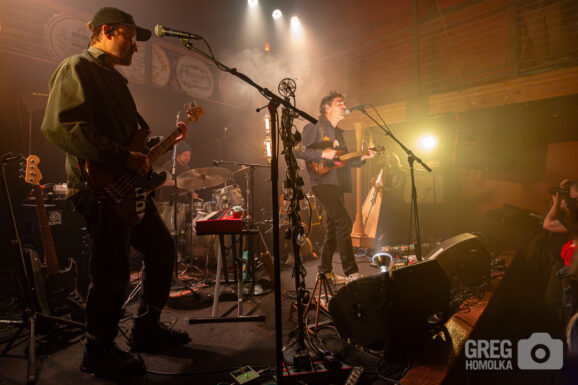
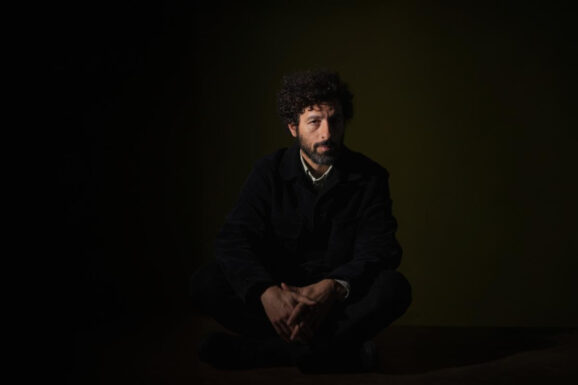
Kansas City Indie Rock duo Katy Guillen & The Drive, led by Katy Guillen (vocals/guitar) and Stephanie Williams (drums) has recently released their sophomore album, Make That Sound. From towering Rock heights, to quieter, more confessional moments, the album really stretches the duo’s sound and shows off their expansive musical chops. There seems to be an intuitive link between genre elements that take the stage and the thematic mood of the songs, making the combination especially effective. The duo will be bringing those songs to audiences live throughout the autumn.
Make That Sound is also an album that brings them into collaboration with Producer and artist Megan McCormick (Allison Russell, Amythyst Kiah), for the first time, continuing to demonstrate the duo’s own path of shining a spotlight on women’s voices in music. There is a related ethos throughout the collection that speaks to empowerment and the grounding aspect of core relationships in life. I had a conversation with Katy Guillen from the road about the new discoveries that she and Stephanie Williams made while recording Make That Sound, and the importance of staying open to new ideas.
This album definitely shows some variety in terms of heavier and more dreamy tracks. I imagine that playing the new songs will give you some dynamism in your setlist.
Yes, it’s been stepping into some new spaces for us, so I’m kind of looking forward to having those moments, too, in the setlist. Like where we kind of have a moment of breath and air, and then you get back to the rocking.
I really appreciated that pacing when listening to Make That Sound.
Awesome. Yes, there’s a pretty good variety on there, especially for us. We’re a very Rock ‘n Roll, and guitar-driven band, but it was fun to play with some of the newer songs and have even a couple of poppier tunes on the album. We moved into some other realms. I’m glad that you enjoyed that aspect of it.
I feel like the mood that you’re creating for each song probably leads those genre elements.
Yes, definitely. The song content and the lyrical content help drive the mood and the vibe, and it helped, in the studio to inform the songs.
As you move into having quite a few releases now, do you have to kind of give yourself permission to expand into new sound territory? I know there’s a lot of pressure on bands to be more fixed and categorized.
Right, it’s like thinking, “Maybe I shouldn’t expand into a space that is different from what my audience expects of me?” I know exactly what you mean. I think that most artists that really care about what they are doing are walking that line all the time. For me, I’m really aware of that question. It’s such an important part of working on a body of work like an album or EP.
I try to have things happen as naturally as possible, but at some point in the process, you think about this issue. Maybe a song pops out, and you think, “This is a little different. This isn’t as hard-driving.” Or maybe, “This is a little pretty.” You surprise yourself. You become really affected by the systems of picking a genre category for all the online platforms. It’s just how music is distributed online.
I do wish there were finer categories for things, because it is so hard. It’s especially hard in the Indie Rock world. Is it Americana Rock? Is it Pop Rock? There are so many shades to any genre. It’s something that we think about, but we like to step out and expand a little bit. I think that’s just part of being an artist. I don’t personally want to stay in one place, or be expected to sound a certain way every time. I think you become blocked in, imprisoned, and caged in that way. I think that’s the challenge.
I feel like that question goes hand in hand with how a person develops in life, too. You don’t want to be so sure that you really know everything about yourself and who you are as an artist yet.
Totally. It’s such a vulnerable place to be, but I think it’s so important to be open, and not necessarily too set in your ways, as an artist and a person.
Especially since you’re both instrumentalists, as well. In most contexts, a person would be encouraged to try everything in the course of their lives. I really appreciate the different areas that I hear on this album, and I was wondering how you were brave enough to do that.
I will also say that working with our Producer, Megan McCormick, on this album, also helped a lot. She was a big piece of this album and a big part of shaping the songs and the sound. It was an instant chemistry, and she’s an amazing artist in her own right, but she’s also such a gentle and sweet person.
On a personal level, I think the three of us immediately felt comfortable together, and it made the creative process that much more comfortable. She helped push us in some of these directions, and that’s what we’re looking for in working with a Producer. We want someone who not only pushes us, but understands us, so won’t push us in the wrong directions. I have had friends to whom that has happened, but with this album, it was just so easy and fun with Megan. She was an important part of stepping into those new areas for us.
I was very interested to hear that you had worked with her. I know that you had a lot of self-taught preparation with recording in recent years, and that must have helped being able to converse with her in the studio.
Definitely. For Steph and I over the last few years, it’s been a learning process. We had a former band, before this project, and we recorded albums. But we really got into the whole process, and pre-production, and learned the value in that, for our last couple of albums. We also learned the value of reaching outside of your bubbles and finding Producers who you will probably like working with. It’s been a process the last few years of trying things out, and also thinking through what we want to do ahead of time.
That’s having a little bit of a plan before we start deciding who to work with, and I think that makes things easier, quicker, more fun, and less pressurizing in the studio. Then, in the studio, you have a little more time and freedom to talk about things and try creative stuff in the moment. The prepping and pre-production at home has been super helpful.
Had you created fairly complete demos that Megan had heard before you went into the studio?
Yes, we did. We had all the songs written and demoed out, and then we took them in with her. But what we’d usually do was workshop them a little bit together, playing together live. She was on bass and we’d do a trio thing in the studio. It was really cool. The foundational tracks for every song were recorded with the three of us in one room, basically live, after a few takes. It felt so natural and organic. We changed a few things with her, and rewrote a few parts in the studio, but for the most part, we had complete ideas.
Though everyone has a different process, I think it’s important, when you go into the studio, to stay open to possible changes. It’s dangerous to get too set before you record a song. There are so many different ways that things can go. Though we had completed demos, we were also totally open to changes.
It’s really cool how you built the tracks, with that live inner core. Were there particular tracks that really surprise you, when you think about the developments that happened in the studio?
I would say that the second track, “Feel Good”, probably went through the most change, but for the better. It started pretty different, but we really like where it lives now. The song, “Make That Sound” was the same way. The bridge part on that song was different, and located in a different section of the song. The way that we developed it with Megan really surprised me, and I felt it really helped the song make more sense.
Then, I also think that “True Madness”, which is the last song on the album, surprised me. I wasn’t expecting it to come across as so raw, but also really pretty. I was just like, “Wow!” Part of that is also because we were working with some wonderful people who really knew what they were doing, like the engineer, who was able to record and capture things in a certain way. I think it’s sometimes really hard to capture the emotion when you’re in the studio. I do think that’s something that we were able to get on this album. I was really surprised by some of the tender moments, and raw emotion that were captured, which are the core of the songs.
I think that all of the songs have that, a really strong emotional core, actually. I’m beginning to understand how the circumstances in the studio helped you do that. I think “Feel Good” is very upbeat and has an ethereal feeling.
It definitely has a kind of spacey vibe to it. It’s like one of my therapy songs. As the song says: This is why I do music, basically, is I make these vibrations to feel good. This is what I have to offer. It’s amazing how the Production can take the song in such a number of ways, but when you find that really, really sweet spot, it helps the song sing to its full capacity. Adding the ethereal, spaciness to that song really opened up the mood of that song and enabled it to float more. That’s an example where I had to open, and rethink that song. I had been playing it a certain way, and it took me resetting my brain to relax and think about a new way of approaching the song. But I was also aware of saying, “This feels right. This feels good.”
I feel like if anything new occurs in the studio, something you haven’t done before, and you like it, then it becomes like another tool you put in your toolbox. That way, you build up your skillset with each project that you work on.
Definitely! I feel like every process of making an album is a new opportunity to broaden yourself as an artist, and hopefully learn and get better at all of the things that you’re doing. I learned so much from Megan, we both did. It was really rewarding, even down to just getting new sounds, and learning new pedals.
I have to add, about “True Madness”, that it’s such a surprising song on this album, and I’m really glad that you included it. The percussion is totally different. How did that happen?
That’s actually one of the very first songs that we recorded with Megan, and before we even realized that we were going to make a record with her. It was the first song that we showed her. The way that you hear it is essentially the way that I wrote it. What enhanced it was all the instrumentation and Production. We did capture that percussion.
Some of that was the way that it was recorded and mixed. It was one of those ones that we recorded all together, and after a couple takes, we just had it, and got it. Then we layered in the vocals and the guitar solo. Something that day felt kind of magical, and I’m just so happy with how the recording turned out. It was a team effort, really, with all the right ingredients in the room at the right time.