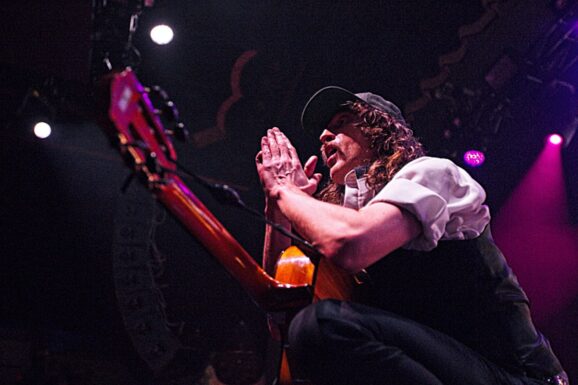
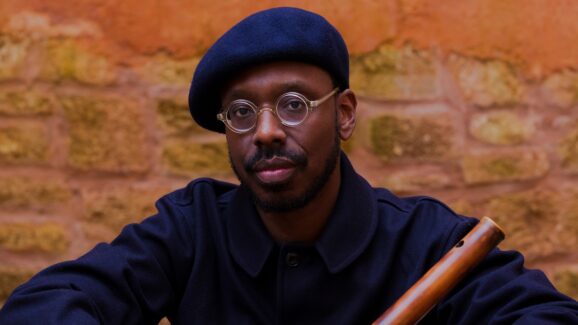
Saxophonist Dave McMurray departs from his last two Grateful Deadication albums with I LOVE LIFE even when I’m hurting, his fourth Blue Note album. Well, almost. He does have one Grateful Dead tune on the record. Beyond that, the album is eclectic. There are vocal, jazz, soul, and funk tracks. In many ways, it is a companion album to the recently released Groove in the Face of Adversity by Don Was and the Pan-Detroit Ensemble. McMurray is a member of that band, and co-producer Don Was, who has known McMurray for more than four decades, plays acoustic bass on five of these nine tracks. Several members of the Pan-Detroit Ensemble are aboard as well. Both titles speak to resilience and endurance. Both albums celebrate Detroit’s music. Both were recorded at Rustbelt Studios in Royal Oak, Michigan.
McMurray composed six of the nine, influenced by a friend who eventually surrendered to an illness and died alone. McMurray’s response was one of resilience, and he decided to write the songs around the theme of positivity. The opening track, “This Life,” played unaccompanied on tenor saxophone with words, sets the tone. McMurray says,” It’s a smile waiting for me somewhere..It’s a joke flying around for me to laugh at… It’s my duty to live. It’s my pleasure to love. I love life even when I’m hurting.”
He then launches into the Afrobeat groove of “Jungaleers,” supported by musicians who have played on his prior albums, and are members of the Pan-Detroit Ensemble. In addition to Was, they are: Luis Resto (keyboards), Wayne Gerard (guitar), Jeff Canady (drums), and Mahindi Masai (percussion). The song title references the mascot of Detroit’s Southeastern High School, where he attended, and the visual image he associates with the tune is “four big African dudes marching.” McMurray’s sustained lines float over the percolating percussion and the driving groove helmed by Was and Canady. The same sextet is in play on McMurray’s heartfelt ballad, “Just a Thought,” dedicated to his wife and daughter. Several influences shape McMurray’s saxophone sound. One can hear at times the spiritual passion of Pharaoh Sanders, the melodicism of Detroit’s Joe Henderson, the soul of Stanley Turrentine, and the exploratory style of Detroit’s Yusef Lateef. To some degree, all of those reveal themselves in this one track, while other tracks are more centered on one of these approaches.
The sonics change on “7 Wishes 4 G,” an original that delves deep into modern-day Detroit soul-jazz, specifically the house and dance scenes associated with artists like Norma Jean Bell and Moodymann. Yet, per the aforementioned, McMurray confesses to rendering the song in an odd 7/4 meter and adding touches that evoke Pharoah Sanders’ “Astral Traveling.” Ibrahim Jones is on bass, and Maurice O’Neal is on keys. This sextet backs McMurray and neo-soul vocalist Kem in a stirring cover of Al Jarreau’s “We Got By” and, with McMurray on flute, a cover of Yusef Lateef’s upbeat, Latin-tinged “The Plum Blossom.” The former was thirty years in the making, as McMurray monitored Kem’s vocal development, feeling that Kem now had the blend of jazz and R&B down. Per the latter, note also that McMurray is on flute on the Pan-Detroit Ensemble album, also covering a Lateef tune.
Was and Resto return for the remaining three tracks. The sonics shift for the dreamy, cosmic title track, where McMurray plays soprano and electric keyboards, his soprano growing in intensity as the tune evolves. McMurray returns to soul-jazz on “Find Your Peace (4 Tani),” a nod to the great drummer Tani Tabbal, who’s worked with such progressive artists as Sun Ra, Cassandra Wilson, and Anthony Braxton. McMurray also plays synth here, but those sounds are subtle at best.
To provide continuity to his previous albums, McMurray covers “The Wheel,” which originally appeared on Jerry Garcia’s first solo album, Garcia, and later became part of the Grateful Dead’s repertoire. McMurray begins in Pharaoh Sanders mode, before settling into a folk-rock groove. This is certainly familiar territory as these members of the Pan-Detroit Ensemble often weave Dead tunes such as “Loser,” “Help on the Way,” “Slipknot,” and “Franklin’s Tower” into their sets with that band. Appropriately, the wheel running between the two bands continues to spin.